Low Mood and Diet: What the Evidence Actually Supports
Some small trials suggest dietary changes may affect depressive symptoms, but food isn’t a proven stand-alone treatment for depression.
Diet can be part of caring for yourself, but two small trials don’t establish a diet as a treatment for depression in women generally. They studied specific groups: women with diabetes and insomnia, and adults with treatment-resistant depression. If low mood is persistent or affecting daily life, getting mental-health support matters more than trying a diet first. 2 4 5
What a food-and-mood link can tell you
When a study finds that people who eat in a certain way also report different mood symptoms, it has found an association. That’s a reason to investigate, not proof that the diet caused the mood difference. An intervention trial is more informative: researchers assign different diets and compare what happens. Even then, the result applies most directly to the people and conditions studied.
That distinction matters in the two trials below: both are small and specific. They’re worth understanding, but they don’t add up to a general prescription for low mood in women. 4 5
What the trials found, and who they studied
One randomized trial involved 44 women ages 30 to 65 with type 2 diabetes and insomnia. For 12 weeks, one group followed a low-calorie MIND diet and the comparison group followed a low-calorie diet. The MIND group had greater improvements in depression and anxiety measures, as well as sleep quality. This is an encouraging result for that particular group, but it doesn’t show whether the same approach helps women without diabetes or insomnia, or whether the effect lasts beyond the study. 5
A separate UK trial enrolled 88 adults with treatment-resistant depression; 61 were women. Participants received either a highly restrictive ketogenic diet or a comparison diet emphasizing vegetables or fruit and replacing saturated fats with unsaturated fats. Both groups also received dietitian support, and usual depression care could continue. At six weeks, symptoms improved in both groups. The average PHQ-9 improvement was 10.5 points with the ketogenic diet and 8.3 with the comparison diet; the between-group difference was 2.18 points. At 12 weeks, the difference was smaller and its confidence interval included no difference. The researchers described the clinical importance as uncertain, and they found no differences in secondary outcomes. 4
The comparison matters: the ketogenic diet wasn’t tested against doing nothing. Both groups got structured food plans and support. After prepared meals and support ended, only 9% of people in the ketogenic group reported continuing the diet, which also raises a practical question about how demanding it was. This trial is an early finding in adults with treatment-resistant depression, not evidence that keto is a suitable or established treatment for women generally. 4
A useful food choice without a mood promise
You don’t need to adopt a restrictive diet to make a nourishing choice. If these foods suit your preferences and budget, sources of omega-3 fats include salmon, sardines, walnuts, chia seeds, and flaxseed. Fish supplies the long-chain omega-3s EPA and DHA; walnuts, chia, and flax provide ALA. Knowing which foods contain these fats doesn’t tell us that eating them treats depression. 3
For example, you might add walnuts to breakfast or choose fish for a meal when it works for you. Think of that as a practical way to include nourishing foods, not a test of whether you can improve your mood through willpower. Neither those foods nor the diets studied above are established replacements for depression care. 2 3 4 5
When food advice should take a back seat
Low mood can be part of depression, which is more than feeling sad for a few days. Depression can affect sleep, eating, work, and other daily activities. Symptoms that persist, interfere with your life, or include hopelessness are a reason to seek support; you don’t need to wait until you’ve tried changing your diet. A primary care provider can be a place to start, and depression can be treated with approaches such as talk therapy and medication. 1 2
Pregnancy and the period after birth deserve particular attention. Depression symptoms can occur during or after pregnancy, and diet advice shouldn’t minimize or delay help for them. If low mood is emerging in either period, tell a health care provider promptly so you can discuss support that fits your situation. 1 2
If you’re thinking about hurting yourself or suicide, get help right away. You can call or text 988; if it’s an emergency, call 911. 1 2
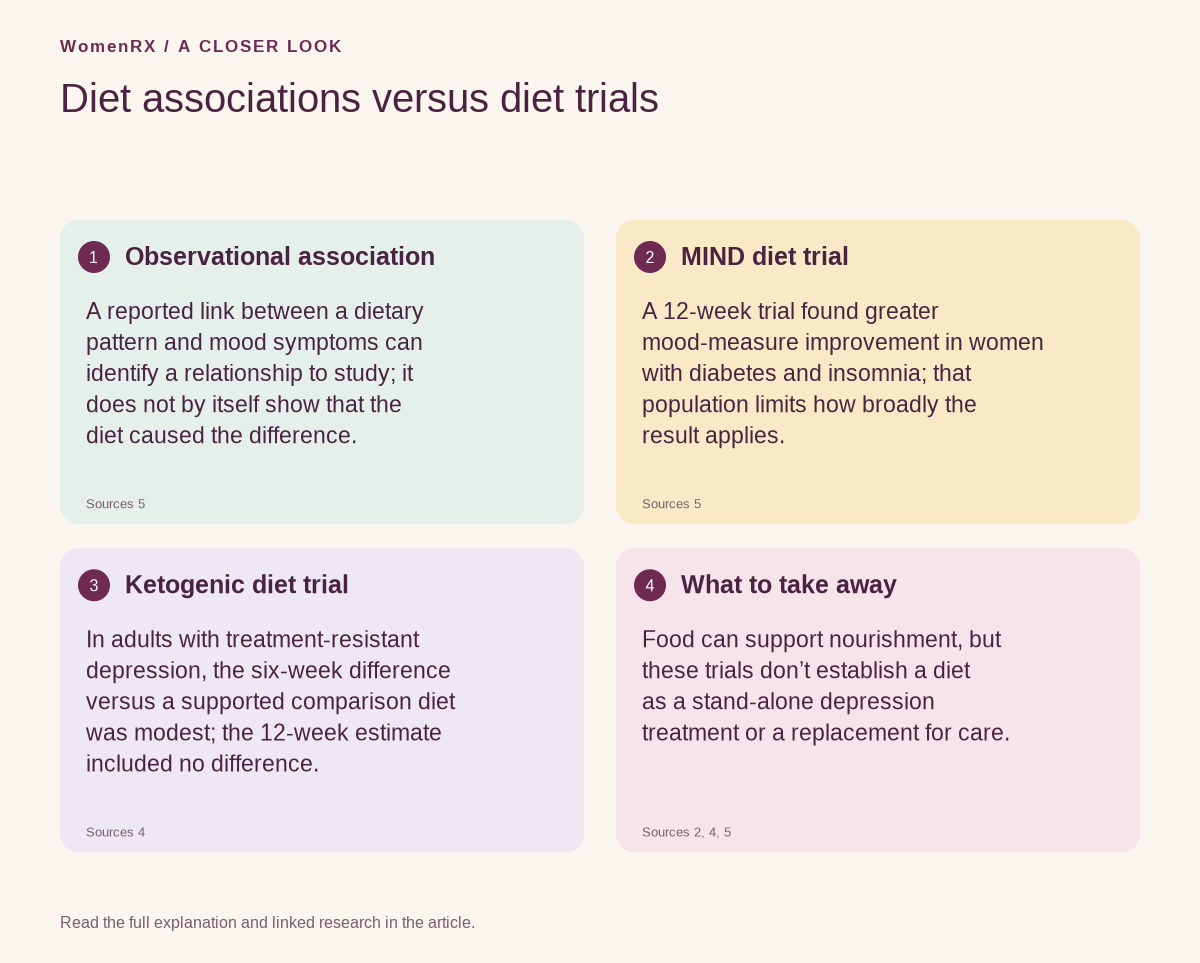
Diet associations versus diet trials
Observational association: A reported link between a dietary pattern and mood symptoms can identify a relationship to study; it does not by itself show that the diet caused the difference.5
MIND diet trial: A 12-week trial found greater mood-measure improvement in women with diabetes and insomnia; that population limits how broadly the result applies.5
Ketogenic diet trial: In adults with treatment-resistant depression, the six-week difference versus a supported comparison diet was modest; the 12-week estimate included no difference.4
What to take away: Food can support nourishment, but these trials don’t establish a diet as a stand-alone depression treatment or a replacement for care.245
Read the figure as text
These study types answer different questions. The trial examples show promising but population-specific findings, not a universal food-based treatment.- Observational association: A reported link between a dietary pattern and mood symptoms can identify a relationship to study; it does not by itself show that the diet caused the difference.5
- MIND diet trial: A 12-week trial found greater mood-measure improvement in women with diabetes and insomnia; that population limits how broadly the result applies.5
- Ketogenic diet trial: In adults with treatment-resistant depression, the six-week difference versus a supported comparison diet was modest; the 12-week estimate included no difference.4
- What to take away: Food can support nourishment, but these trials don’t establish a diet as a stand-alone depression treatment or a replacement for care.245
More questions, answered
Do omega-3 foods treat depression?
Salmon and sardines supply EPA and DHA; walnuts, chia, and flax provide ALA. That tells you which fats the foods contain, not whether eating them treats depression. Food sources can be part of nourishment without being a substitute for mental-health care. 2 3
Does a diet trial in women mean it will work for everyone?
No. The MIND-diet trial studied women with both type 2 diabetes and insomnia, while the ketogenic-diet trial studied adults with treatment-resistant depression, most of whom were women. Those findings don’t establish the same effects in other groups. 4 5
Sources you can check
- NIMH: Women and mental healthAccessed 2026-09-25Return to first citation
- Depression: MedlinePlusAccessed 2026-09-25Return to first citation
- Omega-3 Fatty Acids - Health Professional Fact SheetAccessed 2026-09-25Return to first citation
- A Ketogenic Diet for Treatment-Resistant Depression: A Randomized Clinical Trial.Gao M, Kirk M, Knight H, Lash E, Michalopoulou M, Guess N, Stevens R, Browning M, Weich S, Burnet PWJ, Jebb SA, Aveyard P. · JAMA psychiatry · 2026Return to first citation
- The effect of MIND diet on sleep status, mental health, and serum level of BDNF in overweight/obese diabetic women with insomnia: a randomized controlled trial.Golmohammadi M, Attari VE, Salimi Y, Saed L, Nachvak SM, Samadi M. · Scientific reports · 2025Return to first citation