Can Supplements Help With Menopause Mood Swings?
A few supplements have been studied for mood-related symptoms, but the results depend on who was studied and what the researchers measured.
Evidence for the supplements discussed here doesn’t establish a reliable treatment for menopause-related mood swings. One trial studied mood scores in perimenopausal women using a combination product, while a black cohosh trial found no significant difference for most secondary outcomes, including mood-related measures. Ashwagandha studies suggest possible benefits for stress, but they weren’t menopause-specific. If anxiety is lasting or disrupting daily life, it deserves assessment rather than a supplement experiment. 6314
A shorter fuse after a night of hot flashes can feel different from worry that stays with you all day. Both deserve attention, but they aren’t the same question for a supplement study. Researchers might measure irritability on a menopause symptom scale, perceived stress in adults of various ages, or symptoms of an anxiety disorder. A promising result in one group doesn’t automatically answer the others.
What have studies actually measured?
A perimenopause combination product: A randomized, placebo-controlled trial enrolled 106 women up to age 50 who had vasomotor and other symptoms during perimenopause. Researchers tested a succinate-based supplement together with a vitamin B complex. They reported improvements on menopause symptom, anxiety, depression, and mood scales. That’s relevant to this question, but it doesn’t tell us whether the vitamin B complex, the other supplement, or their combination made the difference. Nor does a lower score on a depression scale establish that the product treats diagnosed depression. The reported scores don’t quantify the size of a mood benefit over placebo. 6
Black cohosh: In a trial of 88 perimenopausal and postmenopausal women with frequent hot flashes and night sweats, mood changes such as depression and anxiety were secondary outcomes. For most secondary outcomes, researchers found no significant differences between treatment groups. A broader review also found insufficient evidence to support or oppose black cohosh for menopausal symptoms overall. It isn’t a convincing choice specifically for mood swings. 3
Ashwagandha: Several short trials suggest that it may reduce perceived stress and anxiety compared with placebo. A review covered seven trials involving 491 adults in India, with mixed-sex samples and either self-reported high stress and anxiety or an anxiety diagnosis. They lasted six to eight weeks. Those findings may interest you if stress is the symptom you mean, but they don’t establish an effect on perimenopausal irritability or show a separate result for women in the menopause transition. Preparations also varied across studies. 1
Omega-3s: An omega-3 supplement label can tell you how much EPA and DHA it contains; products vary considerably. That information helps you identify what you’re buying, but it isn’t evidence that the product will improve menopause-related mood swings. Likewise, recommended nutrient intakes aren’t treatment recommendations for mood symptoms. 2
Let the pattern guide the next question
If your irritability tends to follow nights interrupted by hot flashes, the sleep disruption and hot flashes themselves are worth discussing. Hormone therapy is an effective treatment for bothersome hot flashes and night sweats for appropriately selected women, but that finding should not be recast as proof that it treats a mood disorder. 5
If worry is the bigger change, notice whether it eases or keeps returning even when sleep is better. Anxiety that doesn’t go away, worsens, or interferes with work, relationships, or other daily activities can be part of an anxiety disorder. That calls for a fuller assessment; established treatments include psychotherapy, medication, or both. You don’t have to decide on your own whether what you’re feeling meets a diagnosis before asking for help. 4
Low mood deserves its own conversation, too, especially if it feels persistent or unlike your usual ups and downs. A symptom-scale score in a supplement trial is not the same thing as testing a treatment for depression. 6
Check the product against your medicines
“Herbal” doesn’t mean interchangeable or interaction-free. Ashwagandha may interact with sedatives, thyroid hormone medication, diabetes or blood-pressure medicines, and immunosuppressants. It has also been linked to reports of liver injury, and its long-term safety is unknown. If you take any of those medicines, the relevant question is whether a particular product fits your medication list, not whether it helped average stress scores in a short trial. 1
Black cohosh has no known clinically relevant medication interactions, but interactions haven’t been systematically studied. Liver injury has been reported in people using it, although a causal link hasn’t been established. 3 Those findings do not cover St. John's wort. They cannot tell you whether it is safe to take alongside your medicines, so check that combination with a pharmacist or clinician before using it.
The useful choice isn’t simply supplement or no supplement. It’s to identify whether you want help with stress, disrupted sleep and hot flashes, or a mood change that needs assessment, then judge any product against evidence for that problem and your current medicines.
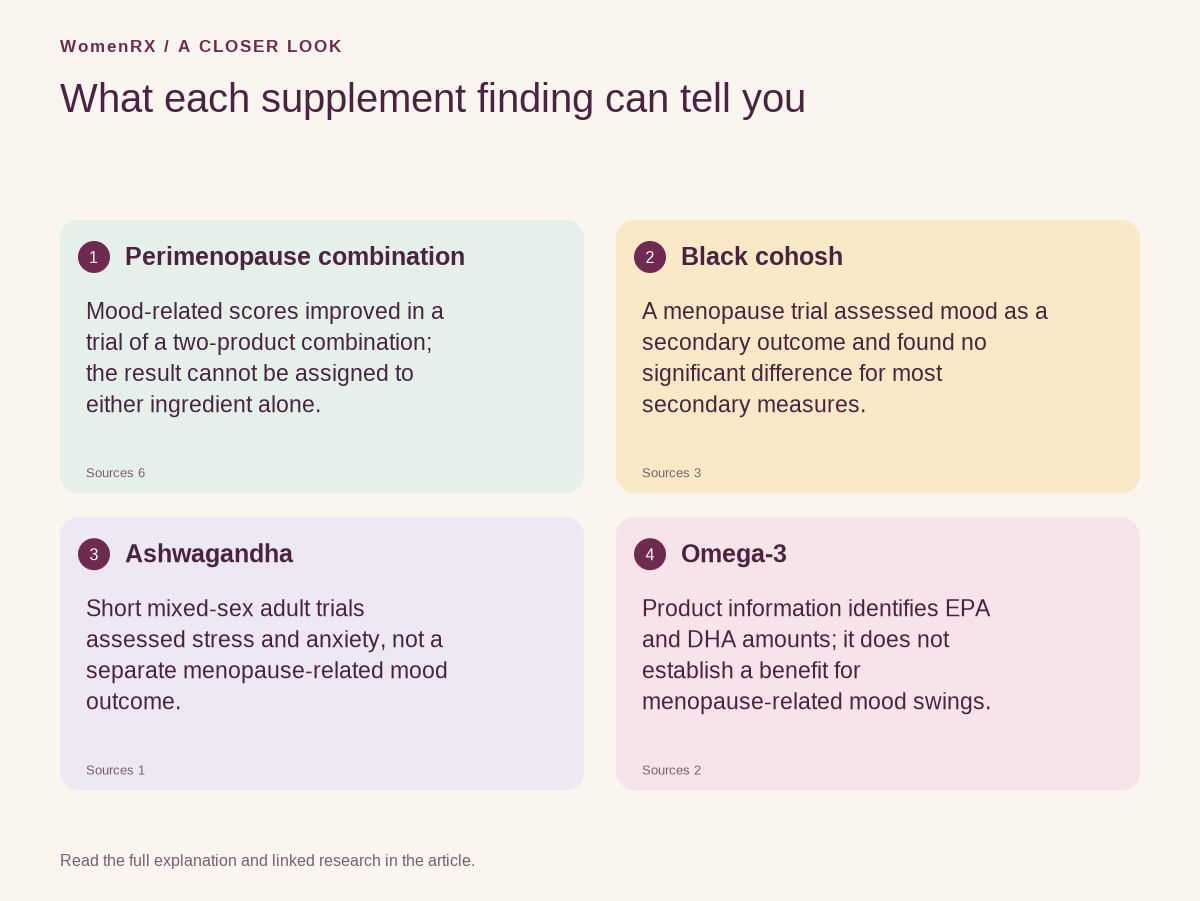
What each supplement finding can tell you
Perimenopause combination: Mood-related scores improved in a trial of a two-product combination; the result cannot be assigned to either ingredient alone.6
Black cohosh: A menopause trial assessed mood as a secondary outcome and found no significant difference for most secondary measures.3
Ashwagandha: Short mixed-sex adult trials assessed stress and anxiety, not a separate menopause-related mood outcome.1
Omega-3: Product information identifies EPA and DHA amounts; it does not establish a benefit for menopause-related mood swings.2
Read the figure as text
The measured outcome and study population determine how useful a result is for menopause-related mood changes.- Perimenopause combination: Mood-related scores improved in a trial of a two-product combination; the result cannot be assigned to either ingredient alone.6
- Black cohosh: A menopause trial assessed mood as a secondary outcome and found no significant difference for most secondary measures.3
- Ashwagandha: Short mixed-sex adult trials assessed stress and anxiety, not a separate menopause-related mood outcome.1
- Omega-3: Product information identifies EPA and DHA amounts; it does not establish a benefit for menopause-related mood swings.2
Sources you can check
- Ashwagandha: Is it helpful for stress, anxiety, or sleep? - Health Professional Fact SheetAccessed 2026-09-25Return to first citation
- Omega-3 Fatty Acids - Health Professional Fact SheetAccessed 2026-09-25Return to first citation
- Black Cohosh - Health Professional Fact SheetAccessed 2026-09-25Return to first citation
- Anxiety: MedlinePlusAccessed 2026-09-25Return to first citation
- The 2022 hormone therapy position statement of The North American Menopause Society.“The 2022 Hormone Therapy Position Statement of The North American Menopause Society” Advisory Panel. · Menopause (New York, N.Y.) · 2022Return to first citation
- Clinical Evaluation of Effectiveness and Safety of Combined Use of Dietary Supplements Amberen® and Smart B® in Women with Climacteric Syndrome in Perimenopause.Kachko VA, Shulman LP, Kuznetsova IV, Uspenskaya YB, Burchakov DI. · Advances in therapy · 2024Return to first citation