Menopause, Depression, and Supplements: What the Evidence Says
Omega-3 studies offer a possible signal for mood symptoms, but they don’t establish a supplement as treatment for diagnosed depression.
Research on nutrition and mood during the menopause transition is promising but mixed. Studies have measured mood symptoms in different ways and tested different interventions, so pooled results don’t show that omega-3, or any one supplement, treats diagnosed depression. If low mood is disrupting daily life, seek an assessment; tell the clinician about every supplement and medication you take, especially St. John’s wort.
A mood change and depression aren’t interchangeable
Perimenopause and the years after menopause can coincide with mood changes, but feeling low doesn’t by itself establish a depressive disorder. Depression is more than a few sad days: symptoms such as depressed mood or loss of interest usually need to persist most of the day, nearly every day, for at least two weeks and affect everyday life. A clinician can assess the pattern and consider whether a medical condition or medicine could be contributing. 2
That distinction matters when reading supplement studies. Some research asks whether a supplement changes a mood-symptom score. That is not the same as testing whether it treats diagnosed major depression or works as a substitute for depression care.
What omega-3 research can, and can’t, say
A review focused on omega-3s during the menopause transition included 17 studies: 11 in people and six in animals. Human findings weren’t uniform. For example, one included study reported improved depressive symptoms in women without a major depressive episode, while another found no mood improvement over placebo. Taken together, this is a reason to keep studying omega-3s, not proof that they treat a depressive disorder in menopausal women. 4
A separate review pooled trials of many different nutritional interventions in women during the menopausal transition or menopause. Overall, results favored the interventions for depressive symptoms, but the studies varied in what they tested and how they measured symptoms, and the review reported substantial heterogeneity and risk of bias. Because the analysis combined different approaches, it can’t tell you that omega-3, or a particular product, caused the overall result. 5
So omega-3 may be worth discussing as one part of a broader conversation about mood and nutrition. The research doesn’t establish what product, formulation, or amount would treat depression, or whether it would help a particular woman. Omega-3 products also vary in the types and amounts of fatty acids they contain, so “fish oil” isn’t a single standardized intervention. 1
Be especially cautious with St. John’s wort
St. John’s wort is not an automatically safer or simpler alternative to prescribed care. A review of human evidence identified clinically relevant interactions between this herb and prescription medicines used for neuropsychiatric conditions. Herbal products can affect how medicines work, so mention St. John’s wort before starting, stopping, or changing it, and ask a pharmacist or prescriber to check your specific medication combination. 3
The research doesn’t establish that St. John’s wort treats depression around menopause. Don’t assume that evidence about one supplement applies to another, or that “natural” means interaction-free.
A useful next step if low mood is affecting your life
You don’t have to decide on a supplement before asking for help. Start by describing how long the low mood or loss of interest has lasted, how it is affecting sleep, eating, work, or other daily activities, and what medicines or supplements you use. An assessment can help distinguish mood symptoms from a depressive disorder and consider other possible contributors, including medical conditions or medicines. 2
Then ask what care options fit the assessment, and whether adding a supplement makes sense alongside them. Bring the product label or a complete list of ingredients, not just the front of the bottle. If you’re having thoughts of death or suicide, those can be symptoms of depression; seek help promptly rather than trying to manage them with a supplement. 2
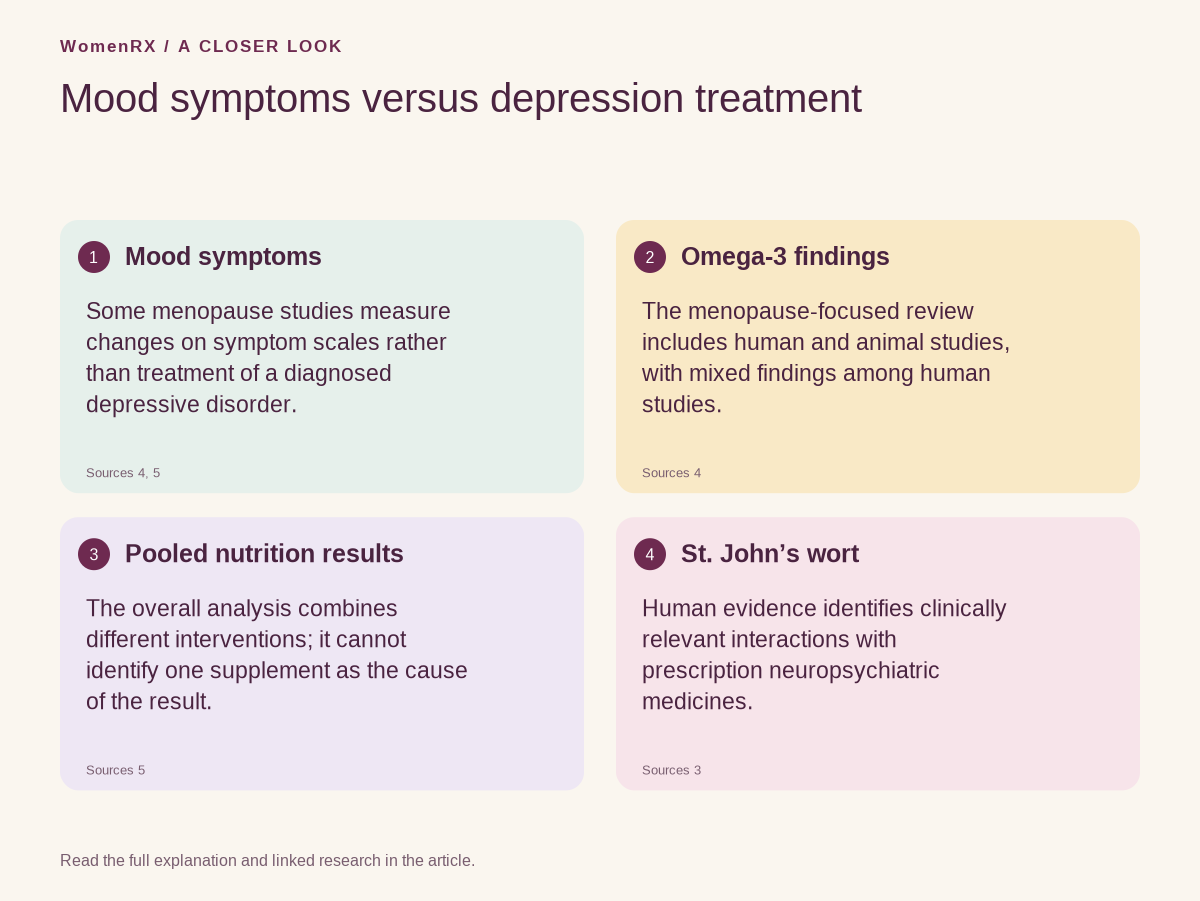
Mood symptoms versus depression treatment
Mood symptoms: Some menopause studies measure changes on symptom scales rather than treatment of a diagnosed depressive disorder.45
Omega-3 findings: The menopause-focused review includes human and animal studies, with mixed findings among human studies.4
Pooled nutrition results: The overall analysis combines different interventions; it cannot identify one supplement as the cause of the result.5
St. John’s wort: Human evidence identifies clinically relevant interactions with prescription neuropsychiatric medicines.3
Read the figure as text
These evidence distinctions help explain why promising mood findings don’t establish a supplement as treatment for diagnosed depression.- Mood symptoms: Some menopause studies measure changes on symptom scales rather than treatment of a diagnosed depressive disorder.45
- Omega-3 findings: The menopause-focused review includes human and animal studies, with mixed findings among human studies.4
- Pooled nutrition results: The overall analysis combines different interventions; it cannot identify one supplement as the cause of the result.5
- St. John’s wort: Human evidence identifies clinically relevant interactions with prescription neuropsychiatric medicines.3
Sources you can check
- Omega-3 Fatty Acids - Health Professional Fact SheetAccessed 2026-09-25Return to first citation
- Depression: MedlinePlusAccessed 2026-09-25Return to first citation
- Herb-drug Interactions in Neuropsychiatric Pharmacotherapy - A Review of Clinically Relevant Findings.Le TT, McGrath SR, Fasinu PS. · Current neuropharmacology · 2022Return to first citation
- n-3 PUFA Improve Emotion and Cognition during Menopause: A Systematic Review.Decandia D, Landolfo E, Sacchetti S, Gelfo F, Petrosini L, Cutuli D. · Nutrients · 2022Return to first citation
- Effects of nutritional interventions on the severity of depressive and anxiety symptoms of women in the menopausal transition and menopause: a systematic review, meta-analysis, and meta-regression.Grigolon RB, Ceolin G, Deng Y, Bambokian A, Koning E, Fabe J, Lima M, Gerchman F, Soares CN, Brietzke E, Gomes FA. · Menopause (New York, N.Y.) · 2023Return to first citation