What Diet Can Realistically Do for Joint Pain
A balanced diet and weight management may be useful parts of joint care, but the reviewed gut-focused osteoarthritis trials do not establish that a particular eating pattern relieves pain or protects cartilage.
If you have osteoarthritis, eating a balanced diet and, if you’re overweight, working toward weight loss are reasonable parts of joint care. 1 Trials of gut-focused approaches suggest possible pain and function benefits, but they pool dietary changes with probiotics and other interventions, so they don’t establish that a particular eating pattern helps. Nor do they show cartilage protection or a diet treatment for rheumatoid arthritis. 5
Food can be part of how you care for yourself with joint pain, but the evidence is narrower than claims that particular foods “fight inflammation” or cure arthritis. The clinical trials discussed here concern osteoarthritis (OA) and gut microbiome-targeted interventions. They suggest possible symptom relief across several approaches, not a demonstrated benefit from a particular eating pattern or a way to reverse joint damage. 5
What the osteoarthritis trials found
A 2026 systematic review and meta-analysis pooled 18 randomized trials involving 2,080 adults with OA. The interventions included probiotics, prebiotics, synbiotics, and dietary modifications. Across all these approaches, the pooled results favored the interventions for pain and some measures of physical function. The review also found reductions in some inflammation-related blood markers. Those combined findings should not be read as the effect of changing food alone. 5
That is a promising signal, not a simple food prescription. The interventions varied, and the review reported substantial remaining variation between studies. Probiotic interventions showed larger effects than dietary interventions, but the reported findings don’t establish which eating pattern, if any, would ease OA pain. The best intervention type, strain, and duration remain unclear. 5
The measures also need context. The review reported standardized differences, which combine results measured on different scales; they don’t translate directly into a predictable amount of pain relief for an individual. Certainty differed by outcome, ranging from high for one measure of function to very low for one pain measure. 5
Symptom changes aren’t the same as joint repair
The review found no significant difference in the cartilage-related marker COMP. That means the findings do not support a claim that these approaches protect cartilage or modify OA itself. Changes in blood markers such as hs-CRP, ESR, or IL-1β are also not, by themselves, proof that joint damage has slowed. The more relevant potential benefit in these trials is symptom relief, especially pain and function. 5
The review also found no significant changes in body weight or stiffness from the interventions it pooled. That weight finding doesn’t settle the separate question of whether diet-related weight changes could matter for your joints. General joint-pain guidance advises a balanced diet and weight loss if you’re overweight. It’s a practical reason to think about your overall eating habits, not evidence that the gut-focused interventions in this review produced weight loss. 1 5
Osteoarthritis and rheumatoid arthritis aren’t interchangeable
Rheumatoid arthritis (RA) is an autoimmune disease in which the immune system attacks the lining of joints; it can cause swelling and stiffness and can damage joints over time. The trials described above studied people with OA, not a demonstrated food treatment for RA. 2 5
For RA, early diagnosis and treatment matter because treatment can reduce symptoms and help prevent joint damage. A food change shouldn’t stand in for that care. Persistent swelling and stiffness, particularly in several joints on both sides of the body or stiffness that lasts well into the morning, are reasons to seek an assessment rather than assume diet is the answer. Those features can occur with RA, but symptoms alone don’t diagnose it. 3 4
What the evidence means for women
The OA findings presented here don’t establish whether effects differ for women or by life stage. If joint aches begin around perimenopause or menopause, that timing alone also doesn’t identify the cause: joint pain can have several explanations, and aching joints can occur around menopause. 1 5
A useful way to read food claims is to ask both what was changed and what was measured: an eating pattern or a probiotic; pain, daily function, a blood marker, body weight, or a sign of cartilage change. For OA, the pooled trials offer a possible symptom signal for gut-focused interventions, but not evidence that a food pattern cures arthritis or protects cartilage. For RA, these OA trials cannot tell us whether a dietary approach helps. 5
If you’re considering a diet change, treat it as an addition to, not a replacement for, figuring out what’s causing your pain and using appropriate care. That distinction matters most when pain is persistent or joints are swollen, because OA, RA, and other joint problems aren’t interchangeable. 1 3
Which joint-pain findings are about food?
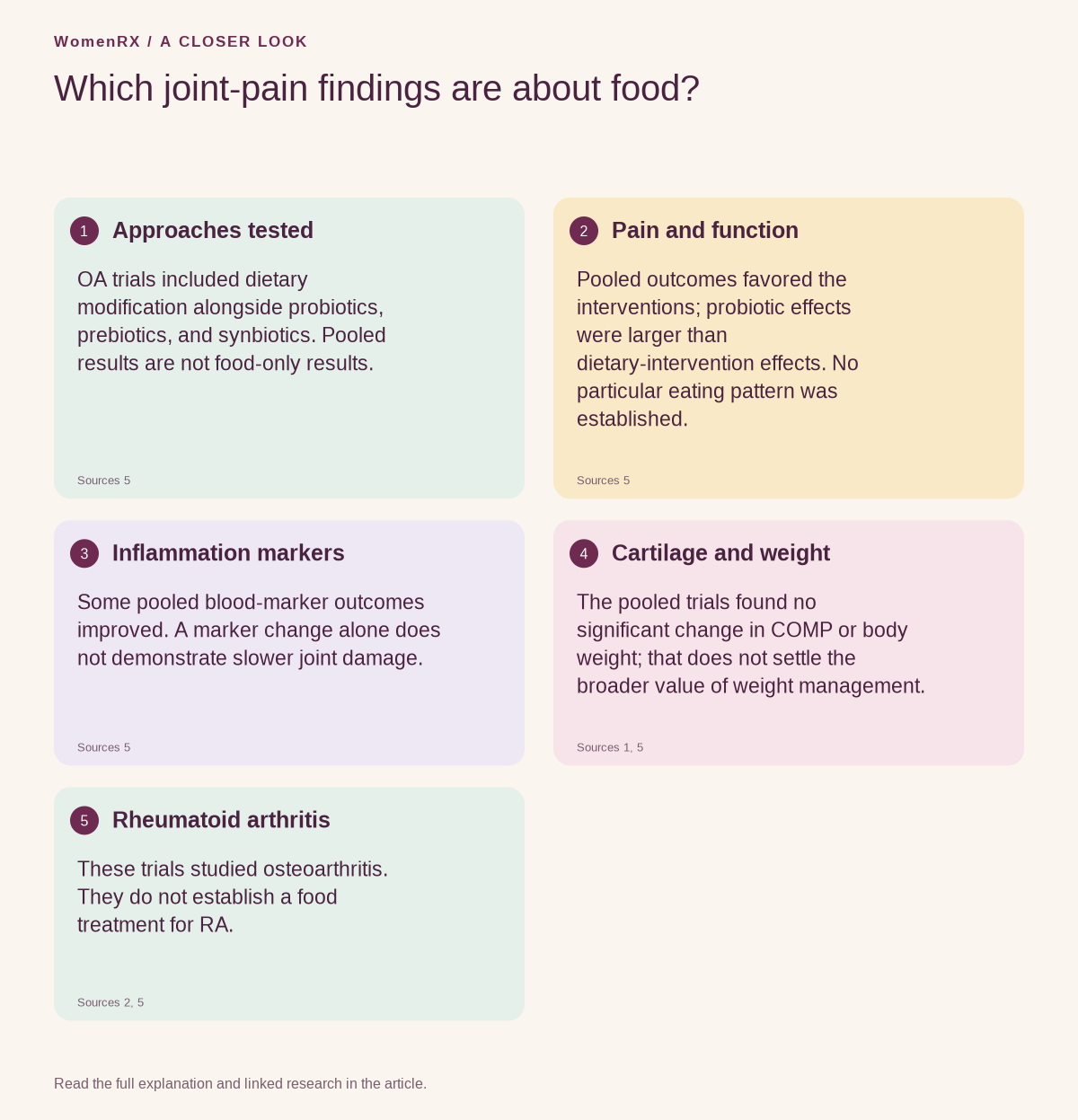
Approaches tested: OA trials included dietary modification alongside probiotics, prebiotics, and synbiotics. Pooled results are not food-only results.5
Pain and function: Pooled outcomes favored the interventions; probiotic effects were larger than dietary-intervention effects. No particular eating pattern was established.5
Inflammation markers: Some pooled blood-marker outcomes improved. A marker change alone does not demonstrate slower joint damage.5
Cartilage and weight: The pooled trials found no significant change in COMP or body weight; that does not settle the broader value of weight management.15
Rheumatoid arthritis: These trials studied osteoarthritis. They do not establish a food treatment for RA.25
Read the figure as text
The OA review combined several kinds of intervention. This map separates what was tested from what the pooled outcomes can show.- Approaches tested: OA trials included dietary modification alongside probiotics, prebiotics, and synbiotics. Pooled results are not food-only results.5
- Pain and function: Pooled outcomes favored the interventions; probiotic effects were larger than dietary-intervention effects. No particular eating pattern was established.5
- Inflammation markers: Some pooled blood-marker outcomes improved. A marker change alone does not demonstrate slower joint damage.5
- Cartilage and weight: The pooled trials found no significant change in COMP or body weight; that does not settle the broader value of weight management.15
- Rheumatoid arthritis: These trials studied osteoarthritis. They do not establish a food treatment for RA.25
More questions, answered
Do omega-3 or turmeric supplements protect joints?
A study of curcumin (the compound in turmeric) combined with omega-3 reported benefits in a rat model of OA and in laboratory-grown human cartilage cells. Those findings are not evidence that the combination relieves joint pain or protects cartilage in people. 6
Can diet replace treatment for rheumatoid arthritis?
The OA trials summarized here don’t establish a diet treatment for RA. RA can damage joints, and early diagnosis and treatment can help reduce symptoms and prevent damage. Food changes shouldn’t delay assessment or replace RA treatment. 2 3 5
Sources you can check
- Joint pain - NHSAccessed 2026-09-25Return to first citation
- Rheumatoid Arthritis | RA | MedlinePlusAccessed 2026-09-25Return to first citation
- Rheumatoid arthritis - NHSAccessed 2026-09-25Return to first citation
- Rheumatoid arthritis - Symptoms - NHSAccessed 2026-09-25Return to first citation
- Effects of gut microbiota-targeted interventions on pain, physical function, and inflammatory biomarkers in osteoarthritis: a systematic review and meta-analysis of randomized controlled trials.Li T, Long J, Zhang Y, Luo H, Yu J. · Frontiers in cellular and infection microbiology · 2026Return to first citation
- Curcumin and omega-3 ameliorate experimental osteoarthritis progression in terms of joint pain and mitochondrial dysfunction.Jhun J, Lee D, Na HS, Cho KH, Lee SY, Lee JS, Lee YJ, Kim SJ, Park SH, Cho ML. · Journal of inflammation (London, England) · 2025Return to first citation