What Flexitarian Eating Can Offer in Midlife
Flexitarian eating means making plant foods the mainstay while leaving room for animal foods; it has no single required ratio or guaranteed midlife benefit.
A flexitarian pattern is mostly vegetarian eating that may include meat or fish sometimes, but there’s no standard rule for how often. In practice, you can build meals around vegetables, fruit, whole grains, beans, or nuts, then include animal foods if you choose. The cited studies do not establish a flexitarian-specific weight-loss benefit for women in midlife, and they do not assess effects on midlife hormones. 2 3
What the label means at your table
“Flexitarian” describes a direction, not a prescribed plan: mostly vegetarian eating with occasional meat or fish. Researchers haven’t used one consistent definition. Some studies have called a pattern flexitarian when people eat meat on some days but not others; others used different limits. That makes it hard to compare results or point to one proven number of meat-free meals per week. 3
A useful way to make the idea practical is to start with what you want to eat more often, rather than counting how many times you’re allowed to eat meat. For example, a meal might center on beans, vegetables, and a whole grain, with eggs, dairy, fish, or meat included when you want them. Those are examples, not required ingredients or a fixed meal formula. 2 3
What the evidence can, and can’t, say
Research on plant-forward patterns offers some encouraging signals, but evidence about a specifically flexitarian diet is mixed in design and definition. A review of studies published through 2016 found emerging evidence of associations with body weight and some metabolic measures. One small study included 54 postmenopausal women in Korea; participants identified as semi-vegetarian had lower average weight, body mass index, body fat, glucose, and insulin than nonvegetarians. Because it was a cross-sectional comparison, it can’t show that eating this way caused those differences. 3
That study is relevant to postmenopause, but it isn’t enough to establish a distinct benefit for women in midlife. The cited studies do not establish a flexitarian-specific weight-loss benefit for women in midlife, and they do not assess whether this pattern affects midlife hormones. A short randomized crossover trial of 19 men at cardiometabolic risk compared diets with different proportions of plant protein. It can inform questions about plant protein, but its male participants and short duration don’t answer whether flexitarian eating improves health for women over 40. 1 3
So, the most useful distinction is between a label and the foods it represents. Making room for more plant foods can change the overall pattern of a diet; simply calling a diet flexitarian doesn’t tell you what’s on the plate or establish an outcome. 2 3
Build a pattern that still feels complete
Try an informal meal-pattern audit rather than aiming for a particular ratio:
- Are plant foods doing the main work? Think vegetables, fruit, whole grains, beans, and nuts. 2
- Do meals have a satisfying protein source? Beans and nuts are examples of plant foods used in plant-forward patterns; animal foods can remain an option too. 2 3
- Are you choosing animal foods intentionally? Flexitarian eating allows them. It doesn’t require avoiding every animal product or following a strict schedule. 3
- Has your eating become very restrictive? The more animal foods you exclude, the more attention nutrient adequacy may need. In a study of adults with a median age of 25 to 33, vitamin B12 status was lower in vegetarians than in flexitarians and omnivores. That finding doesn’t establish what any one woman needs, but it’s a reason not to assume every plant-forward pattern is nutritionally identical. 4
For example, if you enjoy fish or eggs, you can keep them in your routine while also trying a bean-based lunch. If you’d rather eat meat only occasionally, you can do that without treating a particular weekly count as a medical target. The pattern is flexible; the quality and variety of the foods still matter. 2 3
A realistic midlife takeaway
Flexitarian eating may be a workable way to eat more plant foods without giving up animal foods. A flexitarian label alone doesn’t establish that the pattern leads to weight loss or better health for women in midlife. If you choose this approach, focus on the foods you’re adding and whether the overall pattern feels nourishing and sustainable, rather than trying to meet an invented flexitarian quota. 2 3
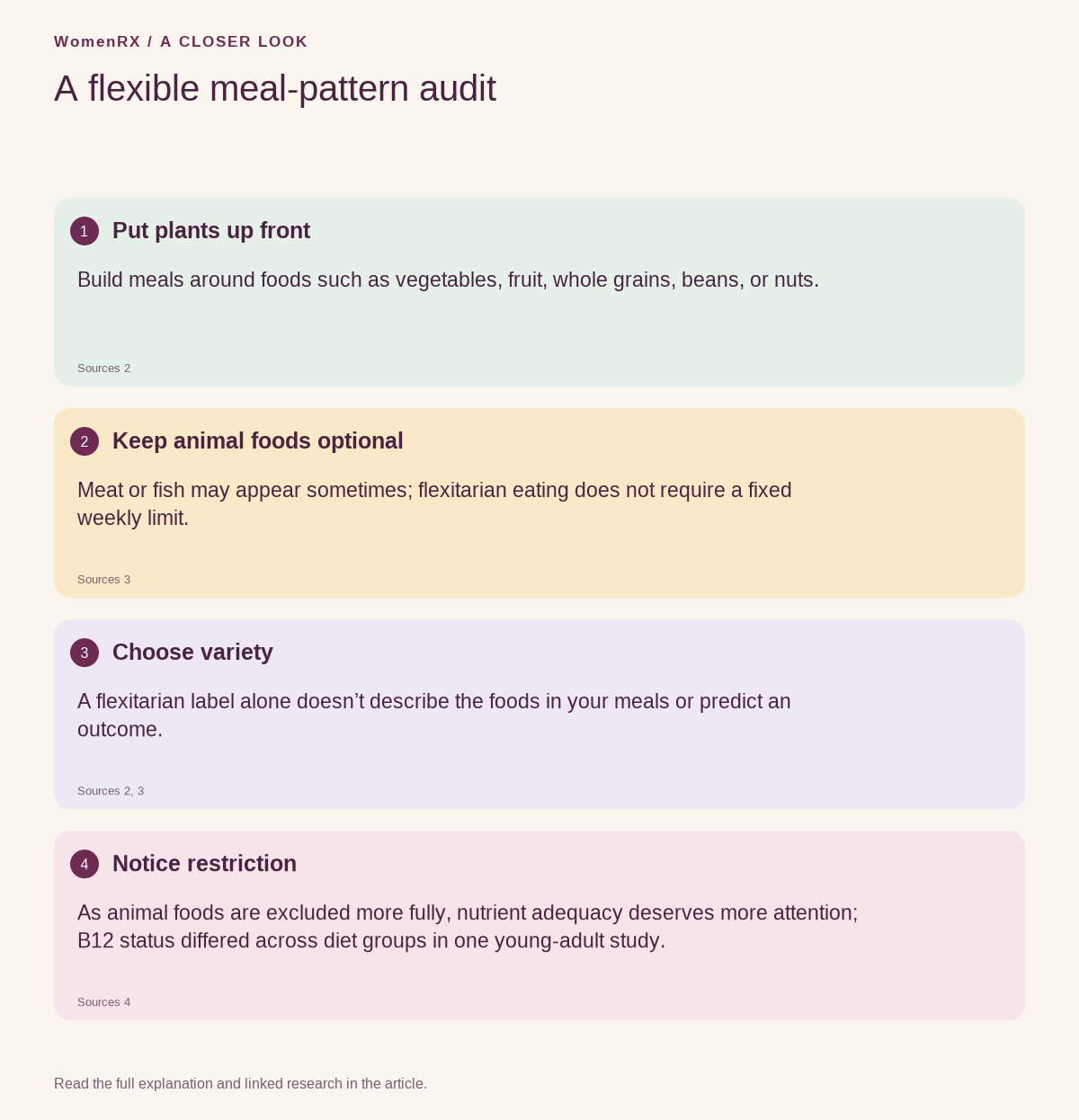
A flexible meal-pattern audit
Put plants up front: Build meals around foods such as vegetables, fruit, whole grains, beans, or nuts.2
Keep animal foods optional: Meat or fish may appear sometimes; flexitarian eating does not require a fixed weekly limit.3
Choose variety: A flexitarian label alone doesn’t describe the foods in your meals or predict an outcome.23
Notice restriction: As animal foods are excluded more fully, nutrient adequacy deserves more attention; B12 status differed across diet groups in one young-adult study.4
Read the figure as text
Use these prompts to picture a plant-forward pattern without treating it as a fixed prescription.- Put plants up front: Build meals around foods such as vegetables, fruit, whole grains, beans, or nuts.2
- Keep animal foods optional: Meat or fish may appear sometimes; flexitarian eating does not require a fixed weekly limit.3
- Choose variety: A flexitarian label alone doesn’t describe the foods in your meals or predict an outcome.23
- Notice restriction: As animal foods are excluded more fully, nutrient adequacy deserves more attention; B12 status differed across diet groups in one young-adult study.4
More questions, answered
Do I have to stop eating meat to be flexitarian?
No. Flexitarian eating is primarily vegetarian but allows occasional meat or fish. There isn’t a universally used threshold for what counts as “occasional.” 3
Does flexitarian eating guarantee weight loss?
No. Research has reported associations between some less meat-focused patterns and body weight, but it doesn’t establish that the flexitarian label itself causes weight loss. The evidence also includes observational comparisons that can’t establish cause and effect. 2 3
Sources you can check
- Increasing plant protein in the diet induces changes in the plasma metabolome that may be beneficial for metabolic health. A randomized crossover study in males.Lépine G, Mariotti F, Tremblay-Franco M, Courrent M, Verny MA, David J, Mathé V, Jame P, Anchisi A, Lefranc-Millot C, Perreau C, Guérin-Deremaux L, Chollet C, Castelli F, Chu-Van E... · Clinical nutrition (Edinburgh, Scotland) · 2024Return to first citation
- Flexitarian Diet and Weight Control: Healthy or Risky Eating Behavior?Forestell CA. · Frontiers in nutrition · 2018Return to first citation
- Flexitarian Diets and Health: A Review of the Evidence-Based Literature.Derbyshire EJ. · Frontiers in nutrition · 2016Return to first citation
- Nutrient Intake and Nutrition Status in Vegetarians and Vegans in Comparison to Omnivores - the Nutritional Evaluation (NuEva) Study.Dawczynski C, Weidauer T, Richert C, Schlattmann P, Dawczynski K, Kiehntopf M. · Frontiers in nutrition · 2022Return to first citation