Eat More Plants Without Overlooking Key Nutrients
A plant-forward dinner and a fully vegan diet call for different nutrient checks, especially when you replace dairy, eggs, or seafood.
Start with the foods you’re actually replacing. If you still eat some animal foods, check what your new meals provide rather than assuming you need supplements. If you eat fully vegan, make a dependable plan for vitamin B12 from fortified foods or a supplement. Then check iron, calcium, and iodine against your food choices and life stage. 67321
First, define what “more plant-based” means for you
Adding a bean-and-vegetable dinner each week is different from removing every animal food. A plant-forward pattern can still include eggs, dairy, or seafood. A vegan pattern excludes animal products entirely. That difference changes which nutrients you can count on getting from familiar foods. 7
You don’t need to audit every ingredient before making your first plant-based meal. Begin with the foods you’re taking out: meat, dairy, eggs, seafood, or some combination. Then look at what’s taking their place. Lentils in place of meat may contribute iron, while a calcium-fortified soy beverage in place of milk can contribute calcium. Neither swap, by itself, settles the question of vitamin B12 or iodine. 3261
If you eat vegan, give B12 its own plan
Natural food sources of vitamin B12 are limited to animal foods. That makes B12 different from nutrients you can usually address by adding another bean, grain, or vegetable. Foods fortified with B12, such as some nutritional yeasts, and B12 supplements can substantially reduce deficiency risk for people eating vegetarian or vegan diets. Check the label rather than assuming a plant-based product contains it. 6
If your diet includes eggs or dairy, they may provide B12, but their presence on an occasional menu doesn’t tell you whether your overall intake is enough. If you’re removing animal foods altogether, decide which reliable fortified foods or supplement will supply B12 as part of your regular routine. This deserves particular attention during pregnancy and breastfeeding: untreated B12 deficiency in infants can cause serious developmental and neurological harm. 6
Build iron into meals, then consider absorption
Beans, lentils, tofu, nuts, and iron-fortified grains can supply iron. Plant foods contain nonheme iron, which is generally less readily absorbed than the heme iron in meat and seafood. Vitamin C can improve nonheme iron absorption, so pairing an iron-rich food with a food that supplies vitamin C is a practical option. You don’t need to treat every cup of tea or every serving of beans as an obstacle; the effect of absorption enhancers and inhibitors on iron status is smaller in a varied overall diet. 3
Iron needs also change with life stage. If you menstruate and are ages 19-50, use the U.S. recommendation for women in that age group, 18 mg daily, when checking what your usual meals provide. The recommendation is 27 mg during pregnancy, 9 mg during lactation, and 8 mg from age 51 onward. Those are general reference values, not a guarantee that the same amount of iron in a vegetarian diet will be absorbed. Because plant iron is less available, the estimated iron requirement for people eating vegetarian diets is 1.8 times that for people eating diets that include animal products. That distinction matters when you review your food choices, particularly during pregnancy; it isn’t a reason to turn the pregnancy figure into a self-chosen supplement dose. 3
High-dose iron supplements can cause side effects, so more iron isn’t automatically a better backup plan. 3
Replace dairy thoughtfully: calcium and iodine aren’t the same check
If you stop drinking milk, a plant-based beverage may replace its calcium if that particular product is fortified. Calcium-fortified soy beverage and tofu made with calcium sulfate are useful examples; kale and bok choy contribute calcium too. Check the Nutrition Facts label and, for tofu, the ingredients. Tofu made with a different coagulant may contain much less calcium. Spinach contains calcium, but your body absorbs relatively little of it. 2
For women ages 19-50, the calcium recommendation is 1,000 mg daily, including during pregnancy and lactation. It rises to 1,200 mg from age 51. These are reasons to revisit your usual food choices over time, not reasons to assume a supplement is needed. Vitamin D also helps the body absorb calcium. 2
Iodine needs a separate look. Dairy, eggs, and seafood are common sources, while plant-based milk substitutes generally contain relatively little iodine. Iodized table salt can contribute iodine, but specialty salts usually aren’t iodized, and most salt in commercially prepared foods is not iodized either. Check whether your household salt is labeled iodized rather than assuming that salty food covers this nutrient. Seaweed contains iodine, but amounts vary greatly, so it’s not a predictable substitute. 1
The iodine recommendation rises from 150 mcg daily for nonpregnant adults to 220 mcg during pregnancy and 290 mcg during lactation. Not every prenatal supplement contains iodine, making its label worth checking if you’re pregnant or planning pregnancy. 1
A simple way to check your usual week
Picture your regular breakfasts, lunches, and dinners, not an idealized menu. Where do protein-containing foods such as beans, tofu, nuts, and seeds fit? Where are the iron-containing foods? If dairy is gone, which foods reliably provide calcium? If eggs, dairy, and seafood are all gone, what supplies iodine? And if you eat vegan, what’s your dependable B12 source? Vegetarian diets can meet nutrient needs, but variety and attention to protein, iron, calcium, zinc, and B12 matter. 73216
Food swaps are useful, but they aren’t all nutritionally equal. In a Dutch modeling study, replacing half the meat while retaining dairy largely preserved population-level nutrient adequacy; more extensive meat or dairy replacements had less favorable results for some nutrients. That study modeled Dutch adults’ diets, so it can’t grade your meals. Its practical lesson is to check the replacement, not just celebrate the food you removed. 4
Pregnancy and breastfeeding are especially good times to make that check specific to you. In two Irish early-pregnancy cohorts, higher scores for a mostly plant-based pattern were associated with higher reported iron, folate, and calcium intakes. That finding doesn’t show that every participant met her needs, and it wasn’t a test of a fully vegan diet. If you’re pregnant or breastfeeding and unsure whether your foods, fortified products, and supplements cover B12, iron, or iodine, an individualized review is more useful than assuming a plant-based label answers the question. 5631
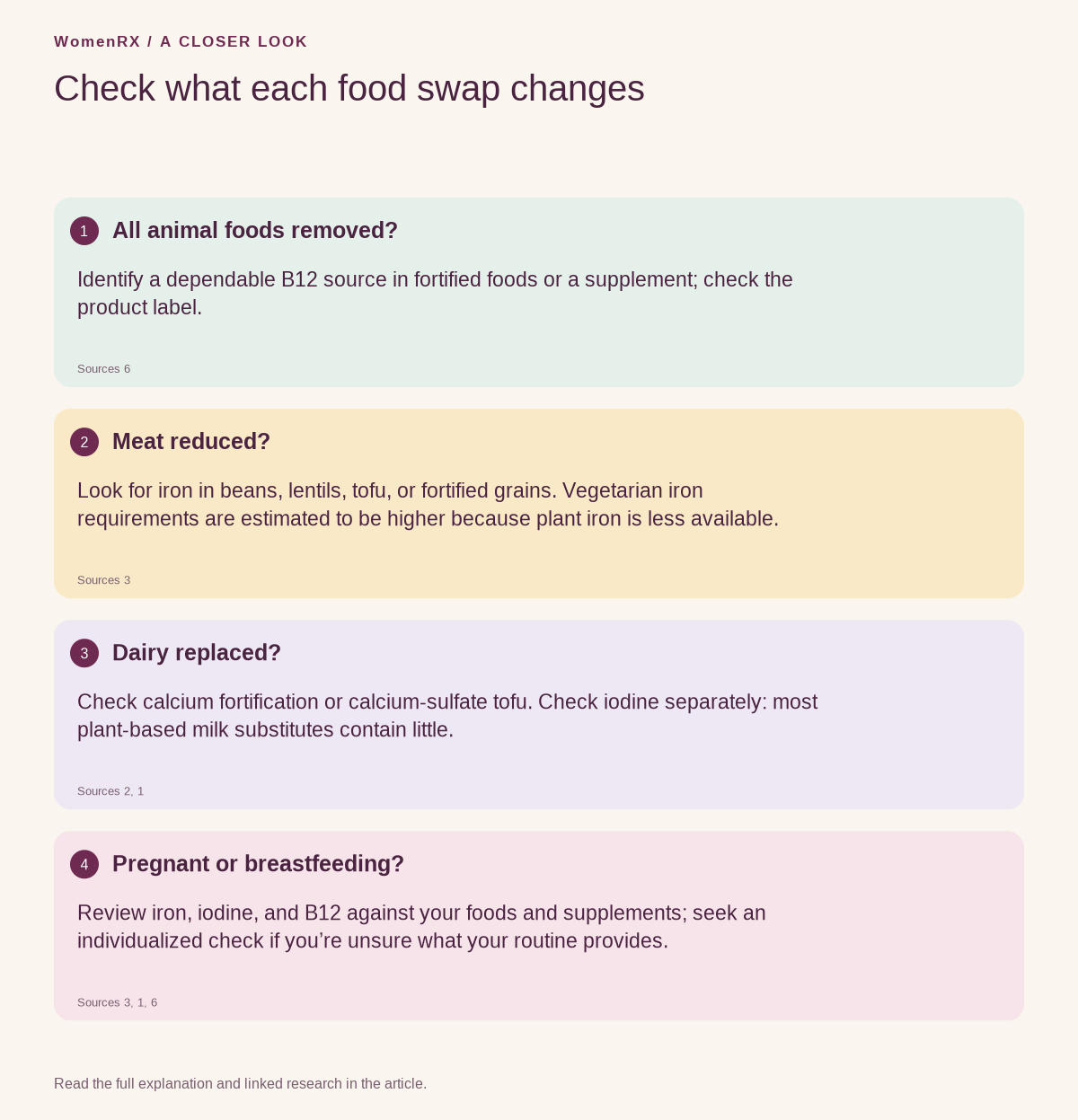
Check what each food swap changes
All animal foods removed?: Identify a dependable B12 source in fortified foods or a supplement; check the product label.6
Meat reduced?: Look for iron in beans, lentils, tofu, or fortified grains. Vegetarian iron requirements are estimated to be higher because plant iron is less available.3
Dairy replaced?: Check calcium fortification or calcium-sulfate tofu. Check iodine separately: most plant-based milk substitutes contain little.21
Pregnant or breastfeeding?: Review iron, iodine, and B12 against your foods and supplements; seek an individualized check if you’re unsure what your routine provides.316
Read the figure as text
Use these prompts for your usual meals. They are planning questions, not a deficiency test.- All animal foods removed?: Identify a dependable B12 source in fortified foods or a supplement; check the product label.6
- Meat reduced?: Look for iron in beans, lentils, tofu, or fortified grains. Vegetarian iron requirements are estimated to be higher because plant iron is less available.3
- Dairy replaced?: Check calcium fortification or calcium-sulfate tofu. Check iodine separately: most plant-based milk substitutes contain little.21
- Pregnant or breastfeeding?: Review iron, iodine, and B12 against your foods and supplements; seek an individualized check if you’re unsure what your routine provides.316
More questions, answered
Can a plant-based milk replace dairy nutritionally?
It depends on the product and the nutrient. A calcium-fortified plant-based beverage can supply calcium, but plant-based milk substitutes generally contain little iodine. Check calcium on the Nutrition Facts label and make a separate iodine plan if you’re removing dairy. 21
Do I need iron supplements if I eat vegetarian?
Not necessarily. Beans, lentils, tofu, and fortified grains can supply iron, but plant iron is less readily absorbed, and the estimated iron requirement for vegetarian diets is higher than for diets that include animal products. Review what your usual foods provide against the recommendation for your life stage rather than assuming you need a supplement; high-dose iron can cause side effects. 3
Sources you can check
- Iodine - Health Professional Fact SheetAccessed 2026-09-25Return to first citation
- Calcium - Health Professional Fact SheetAccessed 2026-09-25Return to first citation
- Iron - Health Professional Fact SheetAccessed 2026-09-25Return to first citation
- Replacing meat and dairy with plant-based alternatives in the Netherlands: trade-offs in environmental impacts and critical nutrient intake.Zhu Y, Politiek ACL, de Vet E, Ocké MC. · European journal of nutrition · 2026Return to first citation
- Alignment of the planetary health diet with pregnancy dietary guidelines: insights from two cohorts.Davis A, Callanan S, Corbett GA, O'Brien EC, Douglass AP, McAuliffe FM. · The British journal of nutrition · 2026Return to first citation
- Vitamin B12 - Health Professional Fact SheetAccessed 2026-09-25Return to first citation
- Vegetarian Diet: MedlinePlusAccessed 2026-09-25Return to first citation