What to Eat and Drink While Breastfeeding
Meals can stay flexible, while a few nutrients and fish choices deserve a closer look.
You don’t need a special menu to breastfeed. Eat varied meals that fit your appetite, preferences, and budget, and include drinks in your day.29 Breastfeeding generally increases calorie needs, though the amount varies.9 Choose lower-mercury fish, and check whether your usual foods cover iodine, choline, B12, and vitamin D. If you eat no animal foods, make a specific B12 plan.89
Start with meals, not a perfect menu
A useful meal can be simple: for example, eggs and toast with fruit, or beans, rice, and vegetables. A snack might be yogurt and fruit, or whatever combination is satisfying and available to you. The point isn’t to eat these particular foods. It’s to make room for different sources of protein, carbohydrates, fats, vitamins, and minerals across the foods you regularly eat. A healthy eating pattern can reflect your preferences, cultural traditions, and budget; it doesn’t require a strict list of approved foods.2
Breastfeeding generally takes more energy. For well-nourished parents, the CDC gives a general estimate of 330 to 400 additional calories a day compared with intake before pregnancy. That’s not a meal prescription: needs also vary with activity, body size, age, and how much of your baby’s feeding comes from breast milk.9 If you’re breastfeeding more than one baby, that general estimate isn’t a personalized target. Your feeding situation is worth discussing when you work out whether you’re getting enough to eat; the guidance here doesn’t establish a separate number for multiples.
Water is part of everyday nutrition.2 Keep water or another drink where you usually feed your baby if sitting down to nurse tends to make you realize you’re thirsty. That’s a convenience suggestion, not a measured fluid target.
Look beyond the usual meal ingredients
Iodine helps support thyroid hormone production. The recommended dietary allowance during lactation is 290 mcg a day. Seafood, dairy foods, and eggs are sources, but someone who eats few or none of those foods may need a closer look at their intake. Iodized salt is another source; salt in processed foods is usually not iodized. The American Thyroid Association and American Academy of Pediatrics recommend an iodine-containing supplement during lactation, yet not every prenatal supplement contains iodine. If you’re still taking one, check its label rather than assuming it covers this nutrient.6
Choline is another nutrient to look for across meals. The CDC recommends 550 mg a day during lactation. Eggs, meat, poultry, fish, and dairy foods are common sources; certain beans and cruciferous vegetables provide it too. A supplement isn’t a one-size-fits-all answer. If you exclude several of its usual food sources, consider what takes their place.97
Vitamin B12 needs a specific plan if you eat no animal foods. Low maternal B12 can leave an exclusively breastfed baby at risk of deficiency. Limited animal-source food intake, pernicious anemia, and prior gastric surgery are among reasons a breastfeeding parent may have low B12 stores.5 If any of those apply to you, ask about your B12 intake or status and whether you need a supplement; ask your baby’s clinician whether your baby needs assessment. The CDC specifically recommends individual supplement guidance for breastfeeding parents who eat a vegan or vegetarian diet.9 A generally varied diet isn’t enough to settle the B12 question when its usual sources or absorption are limited.59
Vitamin D is two related but separate questions. The recommended dietary intake for a breastfeeding adult ages 19 to 50 is 600 IU (15 mcg) a day. Few foods contain much vitamin D naturally; fatty fish and fortified milk, plant milks, or cereals are possible sources, depending on what you eat and what the label says.3 Whether you need a supplement depends on your circumstances and the vitamin D you’re already getting from foods or supplements. Check the amounts on any products you take rather than adding another one automatically: excessive vitamin D from supplements can be harmful.3
Don’t assume that your usual diet or vitamin D supplement replaces the recommendation for infant supplementation. Human milk alone ordinarily provides too little vitamin D to meet an infant’s needs. The American Academy of Pediatrics recommends vitamin D supplementation for exclusively and partially breastfed infants starting shortly after birth; ask your baby’s clinician how that recommendation applies to your feeding situation.3
Which foods actually need a second look?
An allergy-prevention guideline recommends balanced, diverse eating during lactation. It reports little or no demonstrated allergy-prevention benefit from greater dietary variety during breastfeeding.4 That finding doesn’t answer what to do if you have a food allergy yourself or your baby has symptoms you suspect are food-related. A specific concern deserves individual advice, rather than a broad restriction based on an allergy-prevention claim.
Fish is a choice to make thoughtfully, not a whole food group to avoid. For breastfeeding adults, FDA/EPA advice recommends 2 to 3 four-ounce servings a week from its lower-mercury “Best Choices” category. Salmon, sardines, shrimp, and canned light tuna are examples. Fish in its “Choices to Avoid” category should be avoided; if you don’t eat fish, other foods can supply its nutrients.8
A small amount of the caffeine you consume passes to your baby through breast milk. The CDC says low to moderate intake, about 300 mg or less a day, usually doesn’t adversely affect an infant. If your baby seems fussier after you’ve had a lot of caffeine, reducing your intake is worth considering. Preterm and younger newborn infants break down caffeine more slowly.9 Caffeine can come from coffee, energy drinks, and some medicines, and amounts vary by product.1
The useful split is this: let ordinary meals stay flexible, but pay attention to nutrients that your usual foods or supplements might miss. A food restriction should have a reason, not become one more rule simply because you’re breastfeeding.249
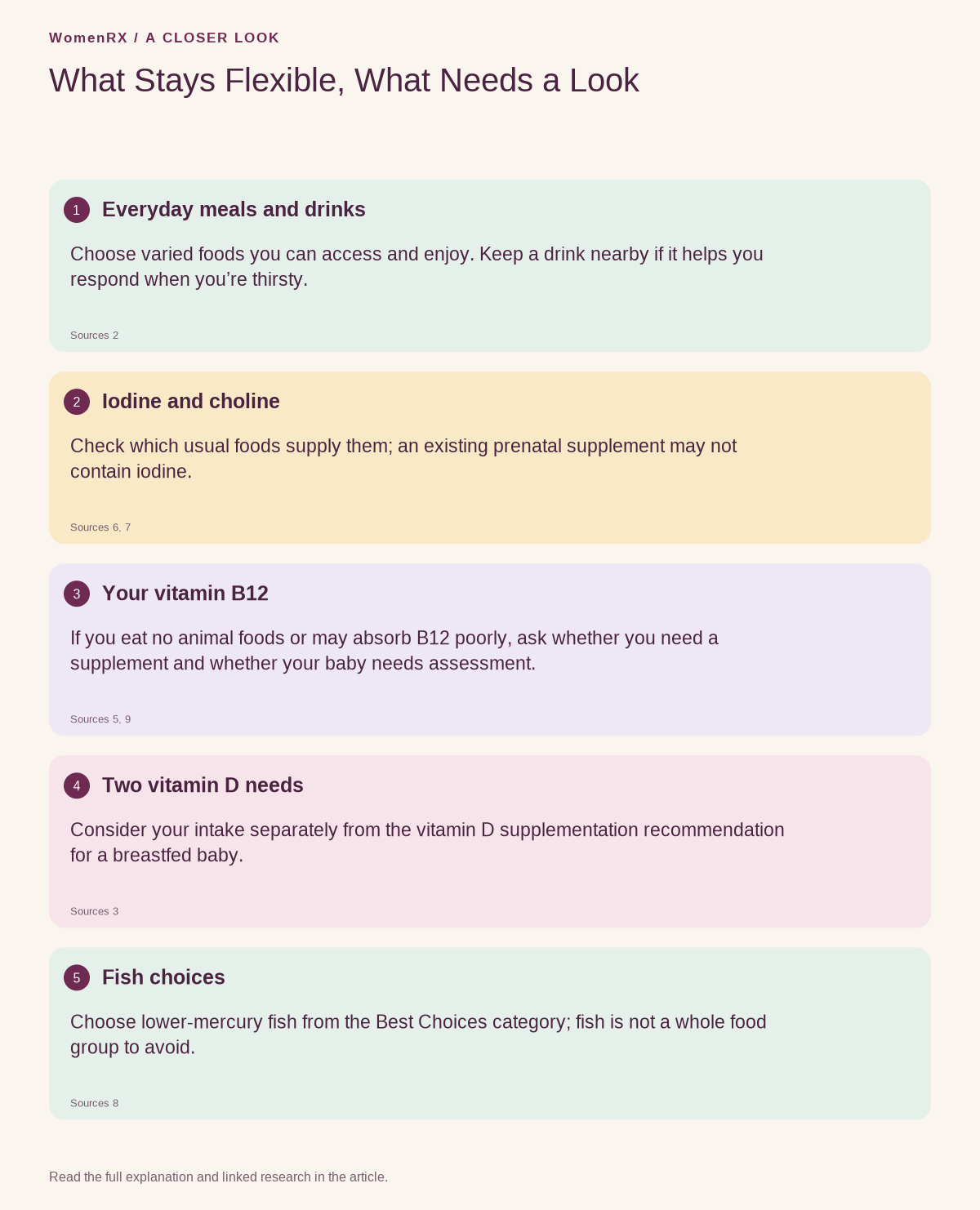
What Stays Flexible, What Needs a Look
Everyday meals and drinks: Choose varied foods you can access and enjoy. Keep a drink nearby if it helps you respond when you’re thirsty.2
Iodine and choline: Check which usual foods supply them; an existing prenatal supplement may not contain iodine.67
Your vitamin B12: If you eat no animal foods or may absorb B12 poorly, ask whether you need a supplement and whether your baby needs assessment.59
Two vitamin D needs: Consider your intake separately from the vitamin D supplementation recommendation for a breastfed baby.3
Fish choices: Choose lower-mercury fish from the Best Choices category; fish is not a whole food group to avoid.8
Read the figure as text
Use these distinctions to separate everyday food choices from nutrient needs and circumstances that may call for individual advice.- Everyday meals and drinks: Choose varied foods you can access and enjoy. Keep a drink nearby if it helps you respond when you’re thirsty.2
- Iodine and choline: Check which usual foods supply them; an existing prenatal supplement may not contain iodine.67
- Your vitamin B12: If you eat no animal foods or may absorb B12 poorly, ask whether you need a supplement and whether your baby needs assessment.59
- Two vitamin D needs: Consider your intake separately from the vitamin D supplementation recommendation for a breastfed baby.3
- Fish choices: Choose lower-mercury fish from the Best Choices category; fish is not a whole food group to avoid.8
More questions, answered
Does taking vitamin D myself replace vitamin D for my breastfed baby?
Don’t assume it does. Human milk alone ordinarily provides too little vitamin D to meet an infant’s needs, and the American Academy of Pediatrics recommends supplementation for exclusively and partially breastfed infants. Ask your baby’s clinician about the plan for your baby.3
Is there a separate calorie target if I’m breastfeeding twins?
The CDC’s general calorie estimate accounts for whether breastfeeding is exclusive or combined with formula, but it doesn’t give a separate target for multiples. Treat the estimate as a starting point for an individual conversation about how much you’re feeding and eating, not as a twins-specific rule.9
Sources you can check
- Caffeine: MedlinePlusAccessed 2026-09-25Return to first citation
- Nutrition: MedlinePlusAccessed 2026-09-25Return to first citation
- Vitamin D - Health Professional Fact SheetAccessed 2026-09-25Return to first citation
- S3 guideline Allergy Prevention.Kopp MV, Muche-Borowski C, Abou-Dakn M, Ahrens B, Beyer K, Blümchen K, Bubel P, Chaker A, Cremer M, Ensenauer R, Gerstlauer M, Gieler U, Hübner IM, Horak F, Klimek L, Koletzko BV, ... · Allergologie select · 2022Return to first citation
- Vitamin B12 Deficiency in the Diagnostic Work-Up of Global Developmental Delay: A Treatable and Time-Sensitive Condition.Pancheva R, Dzhogova M, Dimitrov L, Nikolova M, Mihaylova G, Panayotova V, Dobreva DA, Peycheva K, Galunska B, Merdzhanova A. · Nutrients · 2026Return to first citation
- Iodine - Health Professional Fact SheetAccessed 2026-09-25Return to first citation
- Choline - Health Professional Fact SheetAccessed 2026-09-25Return to first citation
- Questions & Answers from the FDA/EPA Advice about Eating Fish for Those Who Might Become or Are Pregnant or Breastfeeding and Children Ages 1 to 11 Years | FDAAccessed 2026-09-25Return to first citation
- Maternal Diet and Breastfeeding | Breastfeeding special circumstances | CDCAccessed 2026-09-25Return to first citation