A Flexible Way to Build Meals During Perimenopause
Start with varied, satisfying foods you like; dietary changes aren’t recommended as a treatment for hot flashes.
You don’t need a strict perimenopause meal plan. Build meals from a mix of vegetables or fruit, whole grains, and protein-rich foods, then adapt the ingredients, portions, and timing to your appetite, preferences, budget, and routine. That’s general healthy-eating guidance, not a proven menopause-specific formula, and diet shouldn’t be counted on to treat hot flashes. 12
Begin with a flexible pattern, not a prescription
Perimenopause doesn’t call for a single set of foods or a rigid eating schedule. General nutrition guidance favors variety, including vegetables, fruit, and whole grains, while making room for your preferences, cultural traditions, and budget. A healthy pattern also doesn’t require giving up every favorite food. 1
A useful way to put that into practice is to build a meal around a few different food groups: a vegetable or fruit, a grain or other filling staple, and a protein-rich food. This is a practical template, not a rule about exact portions; menopause nutrition reviews discuss broad guidance rather than establishing a specific perimenopause meal formula. 34
For example, you might have oatmeal with fruit and nuts; a grain bowl with beans, vegetables, and a dressing you enjoy; or eggs with whole-grain toast and fruit. These are mix-and-match ideas, not a prescribed menu. Choose what suits your appetite, cooking time, and budget, and swap ingredients freely.
What menopause-specific evidence can, and can’t, tell you
There’s a difference between sound general nutrition advice and proof that a particular diet works especially well during perimenopause. A review focused on nutrition in perimenopause and menopause describes nutrition as part of supporting health, including when someone has an existing condition. But it doesn’t establish one meal plan as the right choice for every person in this life stage. 3
A separate cardiovascular nutrition review discusses the menopause transition, but says data on DASH and Mediterranean-style diets specifically in women following menopause are limited. It discusses possible benefits for cardiovascular risk markers. That limited-data statement concerns postmenopausal women, and the review does not establish a perimenopause meal plan or show that either pattern prevents weight gain or relieves perimenopause symptoms. 4
If hot flashes are the reason you’re considering a food plan, keep expectations realistic. The Menopause Society’s evidence review does not recommend dietary modification as a treatment for vasomotor symptoms, rating it Level III (consensus and expert opinion). Soy foods also aren’t recommended as a hot-flash treatment in that statement; they receive a Level II rating (limited or inconsistent evidence). You can still include foods you enjoy, but don’t assume a diet will stop the symptoms. 2
Adapt meals to the day you’re having
Your routine and appetite may vary, so start with a meal you like and change its size or ingredients to fit the day. If a grain bowl feels like too much, have a smaller bowl of beans, grain, and vegetables, then save fruit or another part of the meal for a snack. On a busy day, canned beans and ready-to-eat vegetables can replace cooked beans and chopped vegetables; whole-grain toast can replace a grain you would otherwise cook. These are ways to make the same meal idea workable, not symptom treatments.
A plan is more useful when you can keep using it. MedlinePlus recommends taking preferences and budget into account, and says healthy eating doesn’t mean avoiding every less-healthy favorite. 1 You can make a meal more familiar or convenient without expecting each ingredient to perform a special hormone-balancing role.
If a health condition affects what you can eat, keep the meal idea flexible rather than assuming every suggested ingredient fits. For example, you could start with the bean-and-grain bowl, then choose a protein or staple that fits your individual dietary needs instead of copying the example exactly. A review of menopause nutrition describes tailored dietary therapy as part of care for existing disease and highlights dietitian support. 3
An example day you can adapt
Here’s one illustrative day, not a prescribed perimenopause menu or portion guide. Change the foods, amounts, or timing to suit your appetite and routine.
- Breakfast: Oatmeal with fruit and nuts.
- Lunch: A grain bowl with beans, vegetables, and a dressing you enjoy.
- Dinner: Eggs with whole-grain toast and vegetables.
- Optional snack: Fruit or yogurt, if you want something between meals.
Choose two or three combinations you’d actually eat, such as oats with fruit and nuts or eggs with toast and fruit. For each, think of one smaller version and one quick version using ingredients you usually have. Keep favorite foods in the rotation. This gives you options when appetite or time changes without promising weight loss.
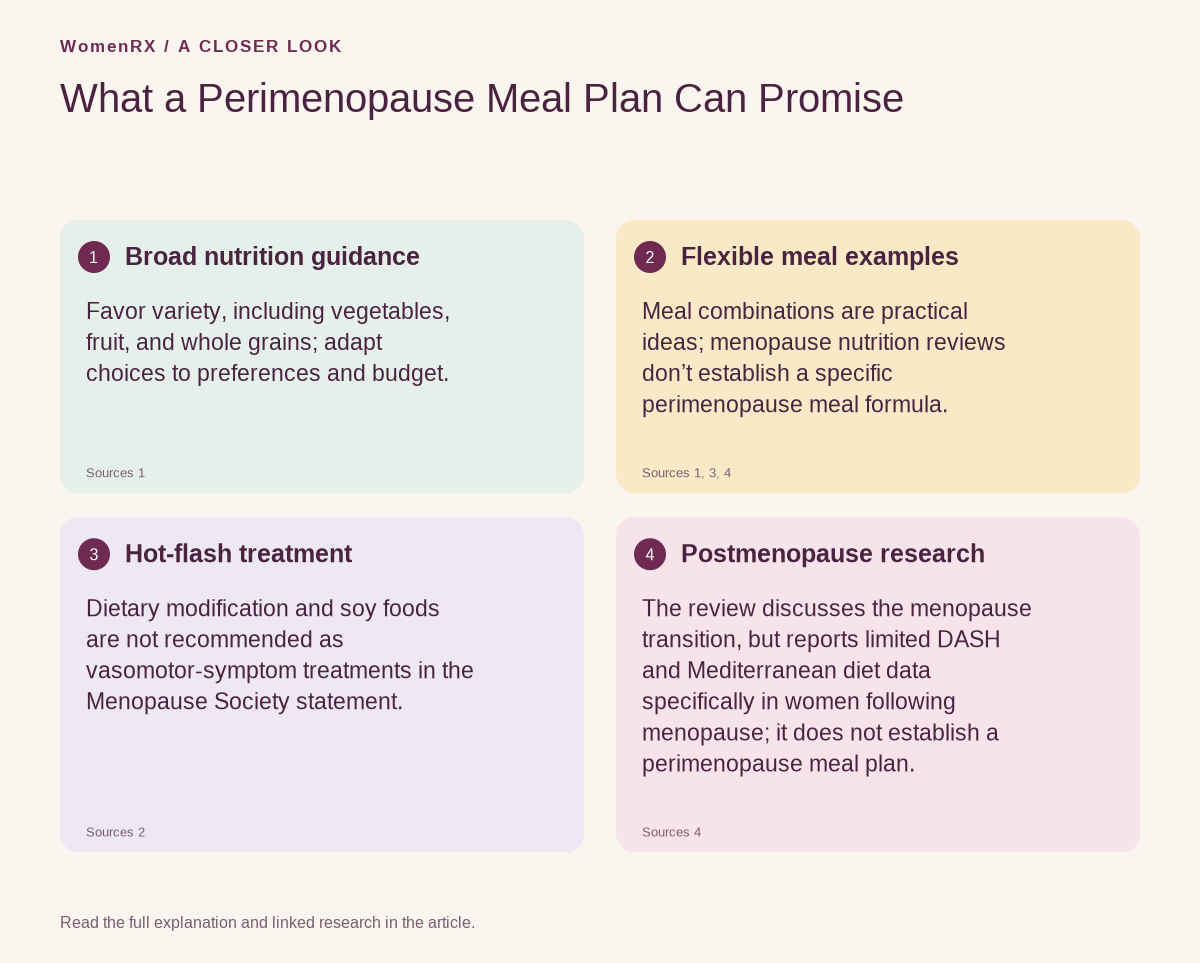
What a Perimenopause Meal Plan Can Promise
Broad nutrition guidance: Favor variety, including vegetables, fruit, and whole grains; adapt choices to preferences and budget.1
Flexible meal examples: Meal combinations are practical ideas; menopause nutrition reviews don’t establish a specific perimenopause meal formula.134
Hot-flash treatment: Dietary modification and soy foods are not recommended as vasomotor-symptom treatments in the Menopause Society statement.2
Postmenopause research: The review discusses the menopause transition, but reports limited DASH and Mediterranean diet data specifically in women following menopause; it does not establish a perimenopause meal plan.4
Read the figure as text
Separate broadly useful meal-planning principles from symptom-treatment claims and evidence that is limited or drawn from postmenopausal women.- Broad nutrition guidance: Favor variety, including vegetables, fruit, and whole grains; adapt choices to preferences and budget.1
- Flexible meal examples: Meal combinations are practical ideas; menopause nutrition reviews don’t establish a specific perimenopause meal formula.134
- Hot-flash treatment: Dietary modification and soy foods are not recommended as vasomotor-symptom treatments in the Menopause Society statement.2
- Postmenopause research: The review discusses the menopause transition, but reports limited DASH and Mediterranean diet data specifically in women following menopause; it does not establish a perimenopause meal plan.4
More questions, answered
Can a perimenopause diet stop hot flashes?
Don’t count on a meal plan to treat hot flashes. The Menopause Society’s review does not recommend dietary modification for vasomotor symptoms; it rates that recommendation Level III, meaning consensus and expert opinion. 2
Do I have to cut out favorite foods?
No. General healthy-eating guidance allows for favorite foods; the emphasis is on variety and a pattern that fits your preferences and budget, not strict avoidance. 1
Sources you can check
- Nutrition: MedlinePlusAccessed 2026-09-25Return to first citation
- The 2023 nonhormone therapy position statement of The North American Menopause Society.Menopause (New York, N.Y.) · 2023Return to first citation
- The Importance of Nutrition in Menopause and Perimenopause-A Review.Erdélyi A, Pálfi E, Tűű L, Nas K, Szűcs Z, Török M, Jakab A, Várbíró S. · Nutrients · 2023Return to first citation
- Precision Nutrition for Management of Cardiovascular Disease Risk during Menopause.Cabre HE, Woolf EK, Redman LM. · Lifestyle genomics · 2024Return to first citation