Build Flexible, Balanced Meals With PCOS
You don’t need a named PCOS diet to plan a day of satisfying meals around foods you enjoy and can afford.
Start with meals you already like, then look for a mix of vegetables or fruit, a filling carbohydrate, and a protein food across your day. For example, breakfast could be eggs and toast with fruit, lunch a bean-and-rice bowl, and dinner chicken or tofu with vegetables and a grain. It’s a flexible planning example, not a PCOS treatment or a weight-loss plan. 1 2
Start with a mix, not a rulebook
A useful meal-planning structure is to choose from a few broad groups: vegetables or fruit; grains or another filling carbohydrate; and a protein food. Add a fat or familiar extra if it makes the meal more satisfying. Think of this as a way to make varied meals, not a formula you need to follow perfectly. Healthy eating can include favorite foods, and a plan should fit your preferences, cultural traditions, and budget. 2
For example, you might combine beans, frozen vegetables, and rice; eggs with toast and fruit; or chicken, a grain, and vegetables. These are illustrations, not PCOS-specific prescriptions. Use fresh, frozen, canned, or ready-to-eat options that work for your time and budget. If a food doesn’t suit your appetite, culture, or needs, swap it for another choice from the same broad group.
What PCOS evidence can, and can’t, tell you
Insulin resistance can be one factor in PCOS, but the condition is varied, and people can have different symptoms and health needs. That’s a reason to take nutrition seriously without assuming every person with PCOS needs the same food rules or has the same goal. 1 5
Research on named diets is not a shortcut to a universal plan. In a retrospective, cross-sectional study of 420 women with PCOS who had received nutrition therapy, Mediterranean-diet adherence had generally weak associations with the measured metabolic and body-composition markers. That kind of study can identify associations, but it can’t show that the eating pattern caused them. It doesn’t establish that a Mediterranean-style plan is best for you, or that another approach is harmful. 4
A review discusses low-glycemic-index eating in relation to glucose control and PCOS, but it doesn’t make a strict rule appropriate for everyone. You can build meals around foods you like without counting a score or banning an entire food group. If you’ve received specific nutrition guidance for blood sugar or another condition, use that advice to personalize the broad framework. 5
Make the plan fit your actual week
Choose a small number of meals you can repeat or adapt. For instance, if cooking feels like too much, pair a ready-to-eat protein food with a grain and convenient vegetables or fruit. If cost is tight, choose whichever options in those groups are affordable and accessible where you shop. The goal is a workable meal, not a perfect plate.
Here’s one illustrative day, not a prescribed menu. For breakfast, have eggs with toast and fruit; if eggs aren’t your preference, use another protein food you enjoy. For lunch, make the bean-and-rice bowl below. For dinner, combine chicken or tofu with a grain and vegetables, using leftovers or convenient options if that suits your evening. If you want a snack, fruit with yogurt is one option. Change the foods and amounts to fit your appetite and any individual nutrition advice you’ve received. The examples put variety into practice; they haven’t been tested as a PCOS meal plan. 2
One-serving bean-and-rice bowl: Gather ½ cup cooked rice, ½ cup drained and rinsed canned beans, 1 cup frozen mixed vegetables, and 1 teaspoon olive oil. Warm the vegetables and beans in a skillet until hot, stirring in the oil. Spoon them over the rice. This makes one bowl, or one serving. You could use a different cooked grain, another kind of bean, or vegetables you already have. Those swaps change the meal, but not the basic planning idea.
Your appetite, food preferences, symptoms, and goals may change what feels useful. If you’re trying to conceive, managing another health condition, or already following nutrition advice, a general meal template shouldn’t replace guidance tailored to that situation. In one web-based cross-sectional study of 330 Turkish women with self-reported PCOS, nutrition knowledge was associated with healthier diet-related preferences but not with symptom burden or quality of life. The study did not measure what participants ate. 3
A good starting point is one meal you already eat: add a fruit or vegetable if that’s missing, include a filling carbohydrate if you want one, and choose a protein food that fits your routine. Keep what works, change what doesn’t, and don’t treat weight loss as a requirement for eating well.
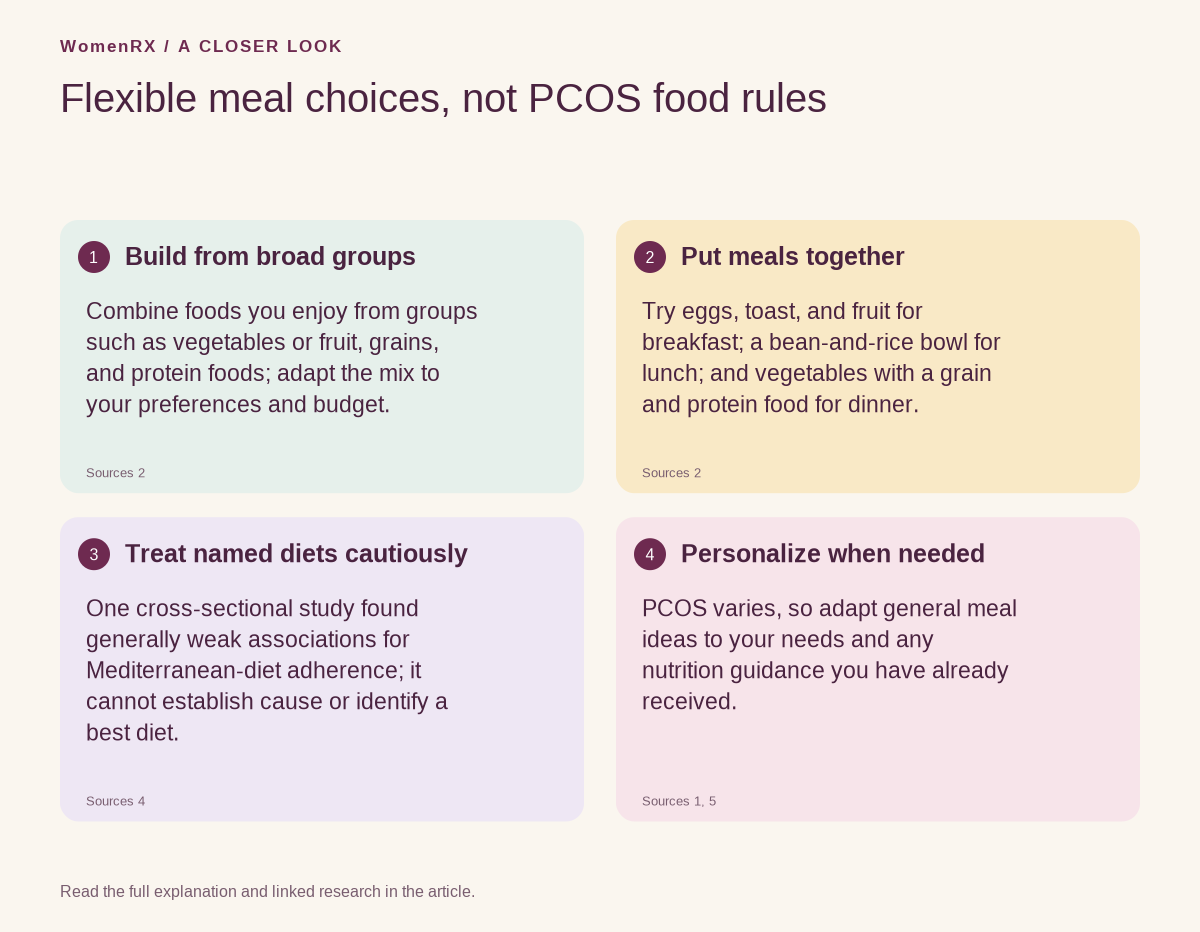
Flexible meal choices, not PCOS food rules
Build from broad groups: Combine foods you enjoy from groups such as vegetables or fruit, grains, and protein foods; adapt the mix to your preferences and budget.2
Put meals together: Try eggs, toast, and fruit for breakfast; a bean-and-rice bowl for lunch; and vegetables with a grain and protein food for dinner.2
Treat named diets cautiously: One cross-sectional study found generally weak associations for Mediterranean-diet adherence; it cannot establish cause or identify a best diet.4
Personalize when needed: PCOS varies, so adapt general meal ideas to your needs and any nutrition guidance you have already received.15
Read the figure as text
Compare a practical way to assemble meals with the limits of what PCOS diet research can establish.- Build from broad groups: Combine foods you enjoy from groups such as vegetables or fruit, grains, and protein foods; adapt the mix to your preferences and budget.2
- Put meals together: Try eggs, toast, and fruit for breakfast; a bean-and-rice bowl for lunch; and vegetables with a grain and protein food for dinner.2
- Treat named diets cautiously: One cross-sectional study found generally weak associations for Mediterranean-diet adherence; it cannot establish cause or identify a best diet.4
- Personalize when needed: PCOS varies, so adapt general meal ideas to your needs and any nutrition guidance you have already received.15
More questions, answered
Do I need to follow a Mediterranean or low-carb diet?
You don’t need to choose either as a default meal-planning rule. In one cross-sectional PCOS study, associations between Mediterranean-diet adherence and measured health markers were generally weak; the study couldn’t establish a benefit caused by the diet. 4 Low-carb eating restricts the amount of carbohydrate, while low-glycemic-index eating focuses on how carbohydrate foods affect blood sugar. The PCOS review discusses glycemic index and glucose control, not whether everyone should restrict carbohydrate amounts. 5
Does a balanced meal plan replace PCOS treatment?
No. Eating well can be part of PCOS care, but meal planning doesn’t replace treatment for symptoms or other individual health needs. Keep any treatment or individualized nutrition advice you’ve received in view as you plan meals. 1
Sources you can check
- PCOS | Polycystic Ovary Syndrome | MedlinePlusAccessed 2026-09-25Return to first citation
- Nutrition: MedlinePlusAccessed 2026-09-25Return to first citation
- Associations of nutrition knowledge with dietary preferences, symptom burden, and quality of life in women with polycystic ovary syndrome.Yalçın Çeliktaş B, Altıntaş E, Çelikayar MN, Dinmez S. · Frontiers in nutrition · 2026Return to first citation
- Mediterranean diet adherence and metabolic parameters in women with polycystic ovary syndrome: a retrospective cross-sectional study.Yurtseven K, Akbaba AK, Pınarlı Falakacılar Ç, İbanoğlu MC, Engin-Üstün Y. · BMC women's health · 2026Return to first citation
- The Role of Diet, Glycaemic Index and Glucose Control in Polycystic Ovary Syndrome (PCOS) Management and Mechanisms of Progression.Johnson C, Garipoğlu G, Jeanes Y, Frontino G, Costabile A. · Current nutrition reports · 2025Return to first citation