How to Review Supplements While Breastfeeding
The best answer depends on why you want a supplement, what’s in the exact product, and what’s known about that ingredient during breastfeeding.
There isn’t one safety answer for all supplements. Start with your reason for taking it, then check the full ingredient list and daily amount, what’s known about that ingredient in breast milk, and whether your baby’s age or prematurity matters. Product quality is another question: independent verification can help assess contents, but it doesn’t prove safety or effectiveness. 1 5 6
Begin with what you need
Breastfeeding doesn’t automatically mean you need a supplement, and being postpartum doesn’t by itself answer whether a product is appropriate. Start by naming your goal: are you addressing a known nutrient need, managing a restricted diet, supporting recovery, or hoping to increase milk supply? Vitamins can usually come from food, though supplements may be useful in some circumstances, and high doses of some vitamins can cause problems. 3
Your own circumstances belong in the conversation, too. For example, mention a restricted diet, blood loss during birth, or other supplements you already take. These details help a clinician or pharmacist consider your situation rather than treating “postpartum” as one-size-fits-all. They don’t, on their own, establish that a particular supplement is needed.
Check the exact ingredients and amount
Look at the full label, not just the product name or its main advertised ingredient. Write down each ingredient, including herbs, extracts, and ingredients in blends, along with the amount you would take in a day. Breastfeeding information is specific to the substance: some substances can pass into breast milk, and the evidence for one ingredient can’t answer the question for another. 1 4
Product quality and breastfeeding safety are separate questions. A supplement’s contents or amounts may differ from what its label lists. Independent quality verification may address product quality, but it doesn’t certify safety or effectiveness; findings about one product also may not apply to a different product. 5
Use examples to see why blanket lists fall short
- Iodine: Iodine is needed to make thyroid hormones, which are required for proper infant development. That makes iodine relevant to breastfeeding, but this fact alone doesn’t show that you need an iodine supplement. Your intake and individual circumstances still matter. 2
- Melatonin: Melatonin is naturally present in breast milk, but there are no data on the safety of maternal melatonin use during breastfeeding. The LactMed summary says short-term use of usual evening doses is unlikely to adversely affect a breastfed infant, while also noting that some authors advise against use because of the data gap and melatonin’s relatively long half-life in preterm neonates. That is a qualified assessment, not proof of safety for every product, amount, or infant. 6
- Herbs marketed for mood or milk supply: “Natural” doesn’t mean interaction-free. A review describes variability in herbal preparations and reports that St. John’s wort can reduce the effectiveness of some medicines. For stinging nettle, scientific support for increasing milk supply is minimal. The LactMed summary also says it’s probably best not to apply nettle to the breast: an allergic rash was reported in a breastfed infant after the mother applied it to her nipple. 4 7
These examples aren’t a complete compatibility list. They show why a claim about an ingredient, amount, or product shouldn’t be generalized to every supplement in its category.
Bring the decision into your care
When you review a product, ask whether the information concerns the exact ingredients and amount you plan to use, and whether it addresses breastfeeding. Include your baby’s age and whether your baby was born preterm; those details can matter when an evidence summary raises a concern specific to preterm infants, as it does for melatonin. 6
It also helps to separate “might be safe” from “is likely to help.” A supplement marketed to increase milk supply doesn’t establish that it works. For stinging nettle, the cited evidence describes minimal support for that use. The LactMed summary says galactagogues shouldn’t replace evaluation and counseling about modifiable factors that affect milk production. 7
Bring the container or a clear photo of its full label, and share your reason for considering it, the amount you’d take, other supplements and medicines you use, relevant postpartum history, and your baby’s age and health. Useful questions include: Is there a clear reason I need this? What is known about this ingredient during breastfeeding at this amount? Could it affect a medicine I take? What does any product-quality verification actually cover?
That gives you a more specific basis for deciding than either assuming all supplements are fine or avoiding them all.
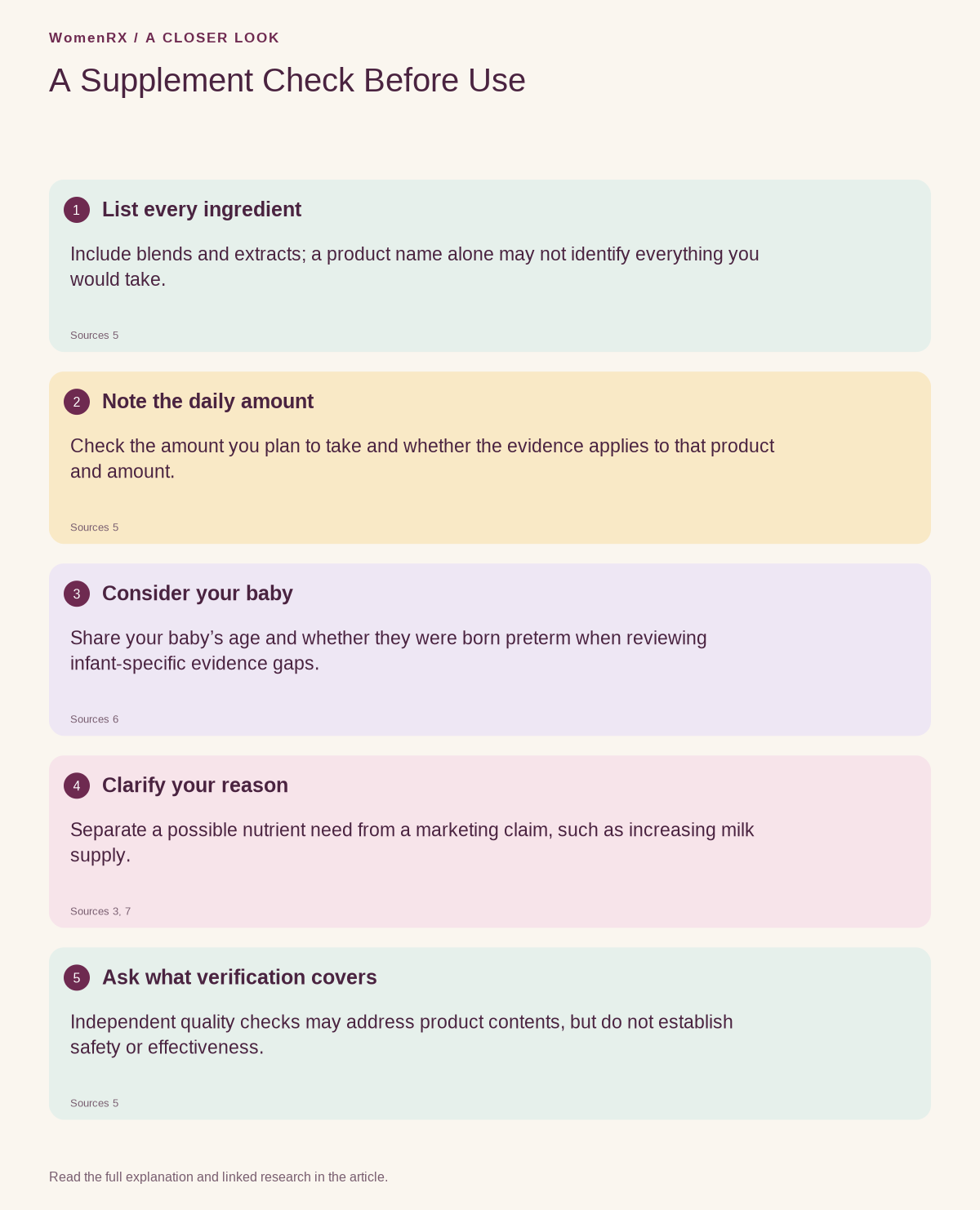
A Supplement Check Before Use
List every ingredient: Include blends and extracts; a product name alone may not identify everything you would take.5
Note the daily amount: Check the amount you plan to take and whether the evidence applies to that product and amount.5
Consider your baby: Share your baby’s age and whether they were born preterm when reviewing infant-specific evidence gaps.6
Clarify your reason: Separate a possible nutrient need from a marketing claim, such as increasing milk supply.37
Ask what verification covers: Independent quality checks may address product contents, but do not establish safety or effectiveness.5
Read the figure as text
Use these checks to keep the decision specific to your reason, the product, and your breastfeeding situation.- List every ingredient: Include blends and extracts; a product name alone may not identify everything you would take.5
- Note the daily amount: Check the amount you plan to take and whether the evidence applies to that product and amount.5
- Consider your baby: Share your baby’s age and whether they were born preterm when reviewing infant-specific evidence gaps.6
- Clarify your reason: Separate a possible nutrient need from a marketing claim, such as increasing milk supply.37
- Ask what verification covers: Independent quality checks may address product contents, but do not establish safety or effectiveness.5
Sources you can check
- Breastfeeding | Benefits of Breastfeeding | MedlinePlusAccessed 2026-09-25Return to first citation
- Iodine - Health Professional Fact SheetAccessed 2026-09-25Return to first citation
- Vitamins: MedlinePlusAccessed 2026-09-25Return to first citation
- Supplementary approaches to perinatal depression: a review of pathogenesis, herbal interventions, and dietary supplements.Yang Q, Lv Y, Gao S, Zhang Y, Zhai X. · Frontiers in psychology · 2025Return to first citation
- Codonopsis pilosula2006Return to first citation
- Melatonin2006Return to first citation
- Stinging Nettle2006Return to first citation