Low-Carb or Balanced Eating: What Should You Compare?
Diet labels don’t define one standard menu, and weight-loss results depend on more than the label.
Low-carb and balanced aren’t standardized study diets. Trials compare different versions and sometimes provide different kinds of support alongside the diets. One low-carb program produced more weight loss than a low-fat app program, but its users also received breath-biofeedback support, so the result doesn’t isolate the diet’s effect. Compare the actual plan, your health goal, and its fit with your routine. 1 5
Start with what the label means
“Low-carb” doesn’t describe one fixed menu. In the studies here, it includes a low-carbohydrate, high-protein diet, a very-low-carbohydrate ketogenic diet, and a Mediterranean-style diet that also promotes carbohydrate restriction. The comparison diets vary too: some are Mediterranean-style, some low-fat, and some use standard nutrition recommendations. So two studies with a “low-carb” arm may not be testing the same approach. 1 2 5
“Balanced” is less precise still. It can be a convenient way to describe a varied eating pattern, but it isn’t a single recipe or consistent trial category in these studies. One trial describes its Mediterranean pattern as emphasizing plant foods and olive oil, with moderate fish and dairy. A separate trial studied a Mediterranean-style low-carb approach; that label alone doesn’t establish that it used the same specific food composition. 1 5
A useful comparison starts with what each plan actually asks you to eat or limit, and what outcome the study measured. Weight, liver fat, blood sugar control, and visceral fat are different outcomes; a result for one doesn’t automatically mean a diet is better for all of them.
Weight loss and health results aren’t interchangeable
A 2026 randomized trial in people with obesity and metabolic concerns compared very-low-carbohydrate ketogenic, Mediterranean, and very-low-fat plant-forward diets while participants lost about 10% of their body weight. Muscle insulin sensitivity improved in all three groups. The ketogenic group had greater improvements in some liver-related measures, including hepatic insulin sensitivity, liver fat, and blood sugar markers. Those results point to a possible advantage for certain metabolic outcomes in this study population, not proof that low-carb leads to more weight loss or is best for everyone. The abstract doesn’t report results by sex, so it can’t tell us whether women had the same response. 2
A separate trial followed people with metabolic dysfunction-associated steatotic liver disease for six months. Participants received a low-carb, high-protein diet, a Mediterranean diet, or standard nutritional recommendations. Among the 148 of 173 participants who completed the study, all groups improved in weight and several health measures; the study reported no significant between-group differences in liver fat. It’s another reminder that improvements within a group don’t establish that its diet outperformed the others. The reported findings don’t give outcomes by sex. 1
For women specifically, one 12-month trial offers a narrower comparison. Among 449 participants, 60% of whom were women, estimated visceral fat decreased more with a healthy low-carb diet than with a healthy low-fat diet at both six and 12 months. Men had greater low-carb-associated visceral-fat loss than women. This finding is about estimated visceral fat, not proof of greater overall weight loss for women, and the comparison was low-carb versus low-fat, not low-carb versus every kind of balanced eating. 4
Food quality still matters
A lower carbohydrate intake doesn’t automatically make a diet high-quality, just as a broader or “balanced” label doesn’t guarantee good food choices. One study of adults entering a weight-loss trial found that participants’ reported diets were, on average, low in fiber and high in saturated fat. It was a cross-sectional look at starting diets, not a test of which diet produces better weight loss, but it illustrates why food quality deserves attention alongside calorie intake and macronutrient labels. 3
When comparing plans, look at the foods they make room for and the ones they crowd out. A Mediterranean-style pattern can emphasize plant foods and olive oil, while a separate trial has studied a Mediterranean-style approach that also promotes carbohydrate restriction. Those descriptions don’t establish that the two patterns use the same specific food composition. 1 5
Choose by the trade-off you care about
If your main goal is weight loss, there is a relevant head-to-head result, but it needs a careful reading. In a 48-week randomized trial of 155 adults with overweight or obesity, 71% of whom were women, a Mediterranean-style low-carb program delivered through an app with breath-biofeedback support produced an estimated 9.54 kg weight loss, compared with 2.68 kg in a calorie-restricted low-fat app group. The between-group difference was 6.9 kg. Because the programs differed in both dietary approach and biofeedback support, the trial cannot tell us how much of that difference came from carbohydrate restriction itself. It also doesn’t report a separate weight-loss result for women. 5
If you’re considering a diet for a specific metabolic concern, some trial results suggest that carbohydrate restriction may affect particular liver or blood-sugar measures, but those findings come from defined groups and don’t settle the question for every woman. 1 2
For a practical decision, compare the actual plan against your routine: which foods it asks you to limit, whether its preferred foods suit your tastes and usual meals, and whether you can follow it without making meals feel unworkable. Treat the name as a starting description, not a guarantee of results. These studies don’t establish an ideal plan for pregnancy or breastfeeding, so their findings shouldn’t be used to set a restrictive weight-loss plan for those life stages.
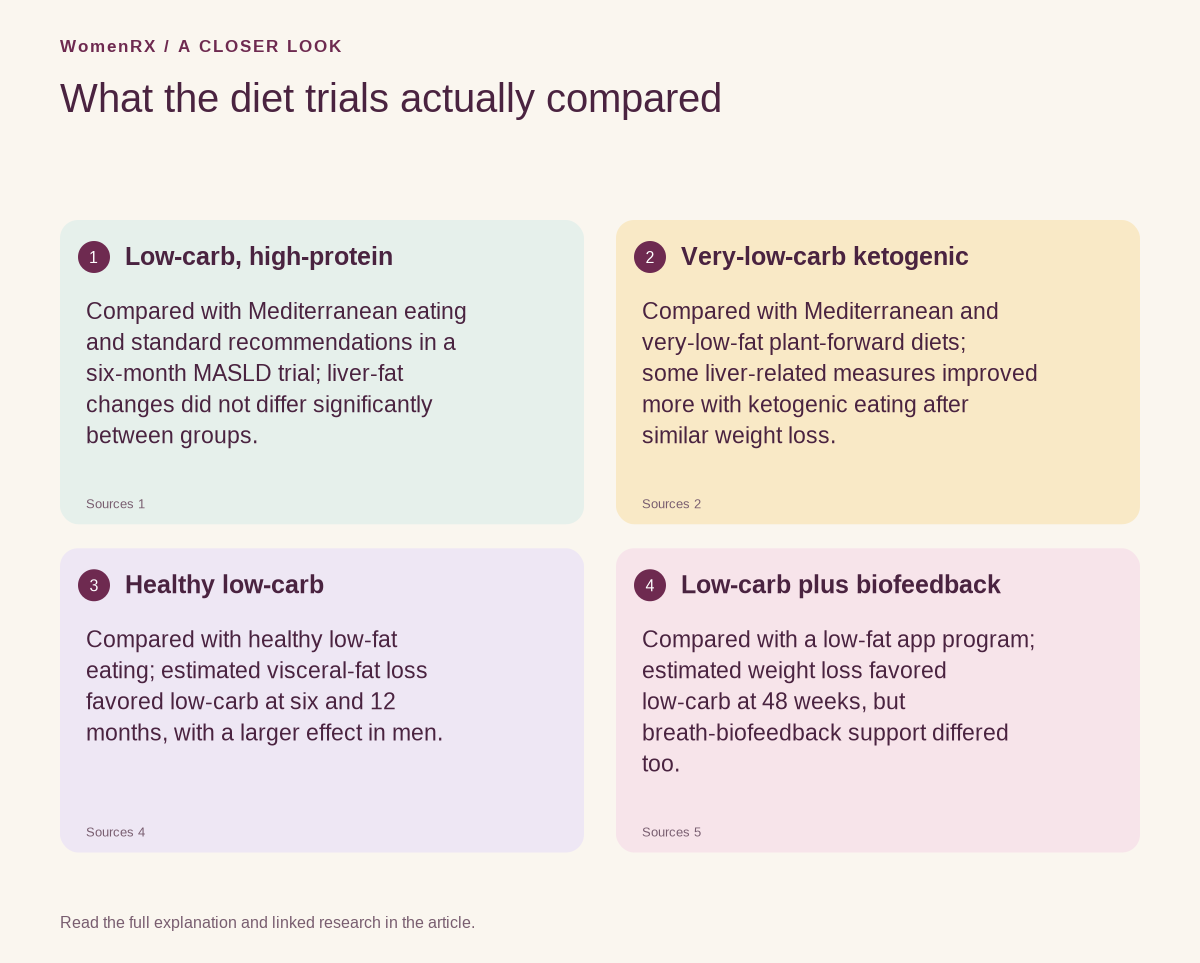
What the diet trials actually compared
Low-carb, high-protein: Compared with Mediterranean eating and standard recommendations in a six-month MASLD trial; liver-fat changes did not differ significantly between groups.1
Very-low-carb ketogenic: Compared with Mediterranean and very-low-fat plant-forward diets; some liver-related measures improved more with ketogenic eating after similar weight loss.2
Healthy low-carb: Compared with healthy low-fat eating; estimated visceral-fat loss favored low-carb at six and 12 months, with a larger effect in men.4
Low-carb plus biofeedback: Compared with a low-fat app program; estimated weight loss favored low-carb at 48 weeks, but breath-biofeedback support differed too.5
Read the figure as text
The trials used different comparison diets, measured different outcomes, and sometimes paired a diet with additional support. Their labels don’t provide enough menu detail to compare typical food choices.- Low-carb, high-protein: Compared with Mediterranean eating and standard recommendations in a six-month MASLD trial; liver-fat changes did not differ significantly between groups.1
- Very-low-carb ketogenic: Compared with Mediterranean and very-low-fat plant-forward diets; some liver-related measures improved more with ketogenic eating after similar weight loss.2
- Healthy low-carb: Compared with healthy low-fat eating; estimated visceral-fat loss favored low-carb at six and 12 months, with a larger effect in men.4
- Low-carb plus biofeedback: Compared with a low-fat app program; estimated weight loss favored low-carb at 48 weeks, but breath-biofeedback support differed too.5
More questions, answered
Does low-carb mean cutting out all nutritious carbohydrate foods?
No. Reducing carbohydrates isn’t the same as eliminating every food that contains them. “Low-carb” covers different approaches in these trials, and the diet labels alone don’t tell you which particular foods a plan includes. Check the plan’s food choices rather than assuming the label answers that question. 1 2 5
Do low-carb study results apply equally to women?
Not necessarily. One trial with 60% women found greater estimated visceral-fat loss with healthy low-carb than healthy low-fat eating, but men had a larger low-carb-associated effect. The reported findings from other relevant trials don’t give separate outcomes by sex, leaving important gaps. 1 2 4 5
Sources you can check
- Impact of weight loss and reduction of ultra-processed foods on liver fat content in MASLD: A randomized controlled trial.Bo S, Armandi A, Castelnuovo G, Goitre I, Bioletto F, Guariglia M, Diaz Del Campo NP, Dileo E, Ponzo V, Saba F, Rosso C, Caviglia GP, Bugianesi E. · JHEP reports : innovation in hepatology · 2026Return to first citation
- Effect of diet macronutrient content on the cardiometabolic response to weight loss: A randomized clinical trial.Petersen MC, Smith GI, Farabi SS, Palacios HH, Shankaran M, Hellerstein MK, Patterson BW, Klein S. · Cell metabolism · 2026Return to first citation
- A cross-sectional analysis of baseline diet quality among participants enrolled in delicious eating for life in the southern homes weight loss randomized trial.Saraiya VM, Fung TT, Pitts SBJ, Wu Q, Berkowitz SA, Skinner HG, Thaxton CK, Alick CL, Sotres-Alvarez D, Evenson KR, Samuel-Hodge CD, Keyserling TC. · Nutrition and health · 2026Return to first citation
- Effect of low-carbohydrate vs low-fat diet intervention on visceral fat estimated from dual energy X-ray absorptiometry in a 12-month randomized controlled trial.Follis S, Landry MJ, Cunanan KM, Stefanick ML, Ward CP, Gardner CD. · International journal of obesity (2005) · 2026Return to first citation
- Long-Term Weight Loss in Adults With Overweight or Obesity Using a Breath Biofeedback mHealth App: A One-Year Follow-Up of a Randomized Trial.Falkenhain K, Lowe DA, Locke SR, Singer J, Weiss EJ, Little JP. · Obesity science & practice · 2025Return to first citation