Low-Carb vs Low-Fat: What the Trials Really Compare
Both approaches can support weight loss, but the results depend on the exact eating pattern, the people studied, and how long researchers follow them.
Head-to-head studies don’t show that low-carb or low-fat eating wins for every woman. Some trials find differences in particular outcomes, such as visceral fat or liver metabolism, while a weight-loss comparison found a larger loss with a low-carb Mediterranean-style program that also included an app and breath-feedback device. That bundled design makes it hard to credit the result to carbohydrate restriction alone. 1 3 4
The diet label leaves out the food
“Low-carb” and “low-fat” describe what a diet limits, not everything a person eats. A low-carb pattern can still differ in food quality from another low-carb pattern, just as two low-fat diets can be built differently. In one trial, the low-carb approach was Mediterranean-style and emphasized vegetables, unsaturated fats, and lean protein while reducing refined carbohydrates. Another comparison included a very-low-fat, plant-forward diet. Those are meaningfully different menus, not just different percentages on a nutrition label. 3 4
Low-fat doesn’t necessarily mean keeping every other food choice the same. In two trials that included low-fat and Mediterranean-style approaches, all the diets increased vegetables and restricted refined carbohydrates and trans fats. That makes it harder to attribute an outcome to the amount of fat alone. 2
That matters when reading a diet study. If participants cut one macronutrient but also change food quality, activity, or support, the outcome reflects the whole program. A study comparing a low-carb plan with an app and breath-feedback device against a low-fat diet app, for example, tests more than carbohydrate versus fat. 4
Weight loss: compare the whole program
In that 48-week randomized trial, 155 adults with overweight or obesity were assigned to one of the two app-based programs; 71% were women. The low-carb Mediterranean-style program included breath-acetone feedback. Its group lost an average of 9.54 kg, while the low-fat app group lost 2.68 kg on average, a difference between groups of 6.9 kg. The low-fat group’s change was not statistically significant. Because diet guidance and technology differed together, this result can’t tell us how much of the difference came from the eating pattern itself. The reported weight-loss results were not separated for women and men. 4
A different way to compare diets is to hold weight loss roughly constant and ask whether health markers change differently. In a trial among people with metabolically unhealthy obesity, including prediabetes and fatty liver, participants lost about 10% of their weight on very-low-carb ketogenic, Mediterranean, or very-low-fat plant-forward diets. The very-low-carb group had larger improvements in some liver-related measures, including hepatic insulin sensitivity and liver fat. Muscle insulin sensitivity improved across all three groups, and LDL cholesterol, apolipoprotein B, and daily triglyceride concentrations did not differ between groups. This is a specific result in a specific population, not proof that a ketogenic diet is best for everyone. 3
The outcome may depend on what you measure
A 12-month analysis of 449 participants in the DIETFITS trial, 60% of whom were women, compared healthy low-carb and healthy low-fat diets. The low-carb group had greater estimated visceral-fat loss at six months and 12 months. Men had greater low-carb-associated visceral-fat loss than women. That finding concerns visceral fat, not a general claim that women lose more weight on one diet; the reported results do not separate weight loss for women and men. 1
Longer follow-up also deserves careful interpretation. In a five- and 10-year follow-up of participants from two 18-month trials, participants had regained the weight they lost, yet some reductions in waist circumference and abdominal fat depots were partly retained. The follow-up combined people from different diet groups, so it doesn’t establish a long-term winner between low-carb and low-fat eating. It does show why a single scale measurement may not capture every outcome researchers track. 2
How to use the comparison for your own choice
Instead of asking which label is better, look at what the pattern asks you to change and whether the study’s version resembles yours. Does it reduce refined carbohydrates while keeping vegetables and unsaturated fats in the picture? Is it very low in fat and plant-forward? Does it also include a device, app, or structured exercise? These details help explain why a result from one trial may not transfer to a different version of the diet. 2 3 4
Adherence matters too, but a larger weight change in the 48-week app trial doesn’t tell you whether low-carb eating was easier to stick with than low-fat eating. The programs differed in their tools as well as their diet guidance. 4
The fairest takeaway is that weight loss and health markers can differ across particular diet programs, but these trials do not identify one universal winner for women. The trials provide limited life-stage detail, and several do not report outcomes separately for women. If you’re comparing plans, pay attention to the foods being emphasized, the support attached to the program, the outcome measured, and the follow-up period, not just the words “low-carb” or “low-fat.”
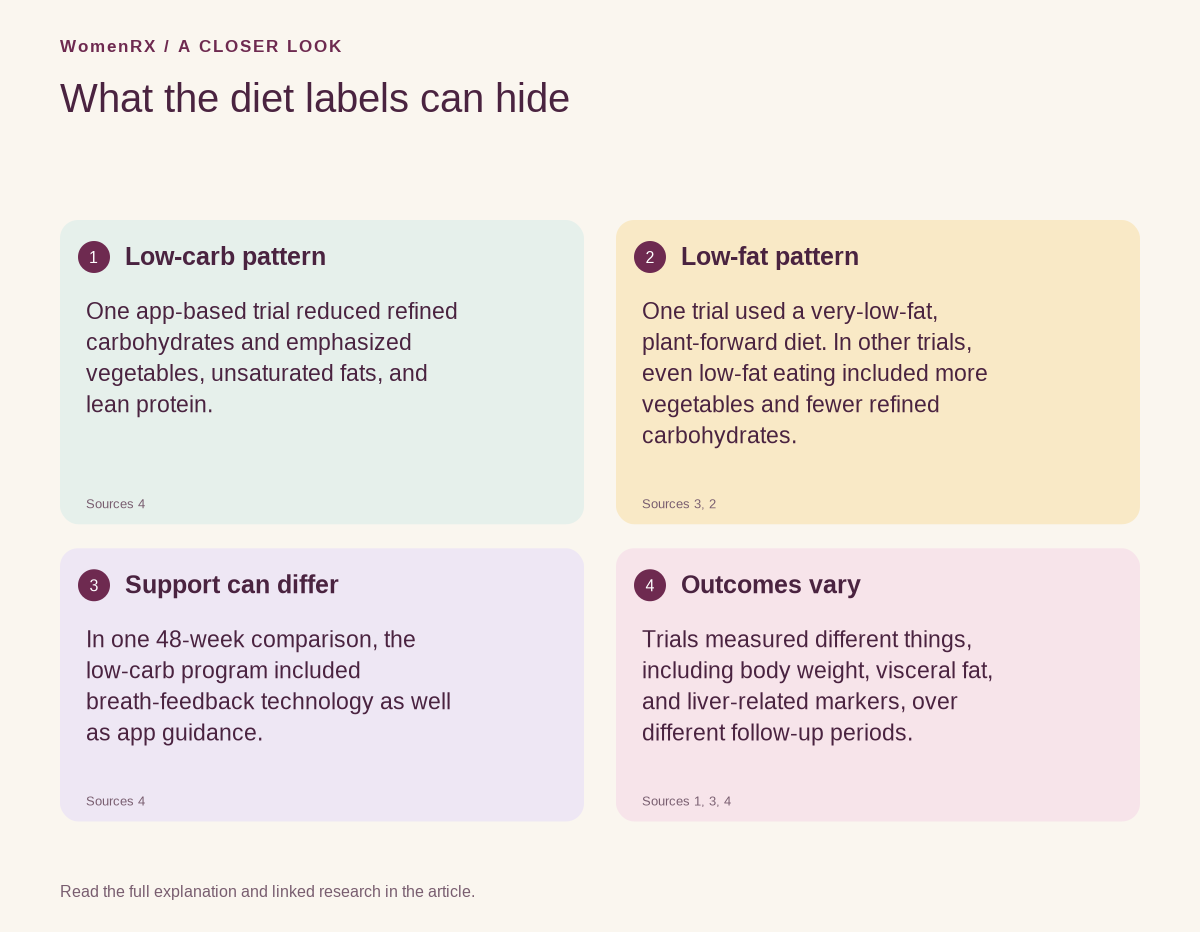
What the diet labels can hide
Low-carb pattern: One app-based trial reduced refined carbohydrates and emphasized vegetables, unsaturated fats, and lean protein.4
Low-fat pattern: One trial used a very-low-fat, plant-forward diet. In other trials, even low-fat eating included more vegetables and fewer refined carbohydrates.32
Support can differ: In one 48-week comparison, the low-carb program included breath-feedback technology as well as app guidance.4
Outcomes vary: Trials measured different things, including body weight, visceral fat, and liver-related markers, over different follow-up periods.134
Read the figure as text
These comparisons show why the foods, added support, study population, and outcome matter alongside the low-carb or low-fat label.- Low-carb pattern: One app-based trial reduced refined carbohydrates and emphasized vegetables, unsaturated fats, and lean protein.4
- Low-fat pattern: One trial used a very-low-fat, plant-forward diet. In other trials, even low-fat eating included more vegetables and fewer refined carbohydrates.32
- Support can differ: In one 48-week comparison, the low-carb program included breath-feedback technology as well as app guidance.4
- Outcomes vary: Trials measured different things, including body weight, visceral fat, and liver-related markers, over different follow-up periods.134
More questions, answered
Do these comparisons show a different best diet for women?
Not as a general rule. One trial found greater estimated visceral-fat loss with low-carb eating in men than women, but that is not the same as showing that low-fat eating produces better weight loss for women. The studies summarized here provide little information about life-stage differences. 1
Does a low-carb diet always improve cholesterol more?
No broad conclusion follows from these trials. In one study of people with metabolically unhealthy obesity, LDL cholesterol and apolipoprotein B did not differ between very-low-carb, Mediterranean, and very-low-fat groups after similar weight loss. That result applies to that trial and population. 3
Sources you can check
- Effect of low-carbohydrate vs low-fat diet intervention on visceral fat estimated from dual energy X-ray absorptiometry in a 12-month randomized controlled trial.Follis S, Landry MJ, Cunanan KM, Stefanick ML, Ward CP, Gardner CD. · International journal of obesity (2005) · 2026Return to first citation
- Lifestyle-Induced Visceral Fat Loss as a Key Target for Durable Cardiometabolic Health: MRI-Assessed 5- and 10-Year Follow-Up After 2 Clinical Trials.Klein H, Alufer L, Goldberg Toren DT, Pachter D, Kamer O, Ebstein Karamani N, Chassidim Y, Shelef I, Rudich A, Yoel U, Ben-Arie G, Zelicha H, Yaskolka Meir A, Tsaban G, Bartal C, B... · Circulation · 2026Return to first citation
- Effect of diet macronutrient content on the cardiometabolic response to weight loss: A randomized clinical trial.Petersen MC, Smith GI, Farabi SS, Palacios HH, Shankaran M, Hellerstein MK, Patterson BW, Klein S. · Cell metabolism · 2026Return to first citation
- Long-Term Weight Loss in Adults With Overweight or Obesity Using a Breath Biofeedback mHealth App: A One-Year Follow-Up of a Randomized Trial.Falkenhain K, Lowe DA, Locke SR, Singer J, Weiss EJ, Little JP. · Obesity science & practice · 2025Return to first citation