What an Anti-Inflammatory Eating Pattern Really Means
The clearest diet research looks at everyday eating patterns and blood markers, not a single miracle food or a promise to treat disease.
An anti-inflammatory eating pattern usually means regularly choosing more vegetables, fruit, beans, whole grains, nuts, and unsaturated fats, rather than relying on one “superfood.” A review focused on adults with at least one chronic condition found support for Mediterranean-style patterns and markers such as C-reactive protein (CRP) and interleukin-6. Certainty varies, and lower marker levels do not prove a diet treats a condition. 2
What researchers mean by “inflammation”
In diet studies, inflammation is often represented by measurements in blood. C-reactive protein (CRP) and interleukin-6 (IL-6) are inflammatory markers studied in dietary-pattern research. The studies report effects or associations involving these markers, not whether a diet improves symptoms or treats disease. 12
That distinction matters: an eating pattern can be associated with, or may change, a biomarker without being proven to prevent or treat autoimmune disease, chronic pain, or another specific condition.
The pattern matters more than a single food
A broad review of research involving adults with at least one chronic condition found the most consistent support for Mediterranean-style eating patterns and some support for vegetarian patterns. The Mediterranean pattern typically emphasizes vegetables, fruit, legumes, whole grains, nuts, and olive oil, with fish and poultry included in moderation. Across the reviews, Mediterranean-style patterns had reported effects or associations involving CRP, IL-6, and adiponectin, although confidence in the findings ranged from high to low. Findings for vegetarian eating and CRP were less certain. These conclusions may not apply in the same way to adults without a chronic condition. 2
A separate meta-analysis of randomized trials found lower CRP with plant-based patterns compared with omnivorous patterns. But it included only seven trials, with 541 participants in total, and the authors rated the certainty as low and noted substantial variation between studies. That is a reason for interest, not a guarantee that an individual will see the same change. 1
Researchers study whole patterns because foods are eaten together. A pattern-level result does not show that one ingredient, food, or supplement is responsible for the effect, or that taking a supplement will reproduce it. 2
A realistic place to start
You don’t need a special “inflammation diet” label to try a pattern supported by this research. At meals you already eat, you could:
- Add a vegetable or fruit you enjoy.
- Choose beans, lentils, or whole grains more often when they suit the meal.
- Use nuts or olive oil as sources of unsaturated fat.
- Include fish or poultry if you eat them, while keeping the overall pattern plant-forward.
These are practical examples based on the foods that characterize Mediterranean-style patterns in the review, not a required menu or a treatment plan. The aim is a repeatable overall pattern, not perfect meals or the elimination of every processed food. 2
What the evidence says about women
The large review and the plant-based trial meta-analysis report overall adult findings, not a women-specific effect estimate in their reported results. So they don’t establish that the effects are different for women, or that a particular life stage requires a different anti-inflammatory diet. 12
One study looked specifically at 1,426 postmenopausal women. A dietary score marked by more processed meat, sweetened drinks, and refined grains, and fewer plant foods, fish, and whole grains, was associated with higher CRP, IL-6, and another inflammatory marker. This observational association cannot show that the diet caused the marker differences. Its exploratory findings about earlier menopause also need validation. 3
The useful takeaway is modest: a plant-forward pattern has some evidence for affecting certain blood markers, but research has not established a women-only formula or a diet that treats a condition. Choose changes you can sustain, and judge them by how well they fit your life and nutritional needs, not by a promise to “switch off” inflammation.
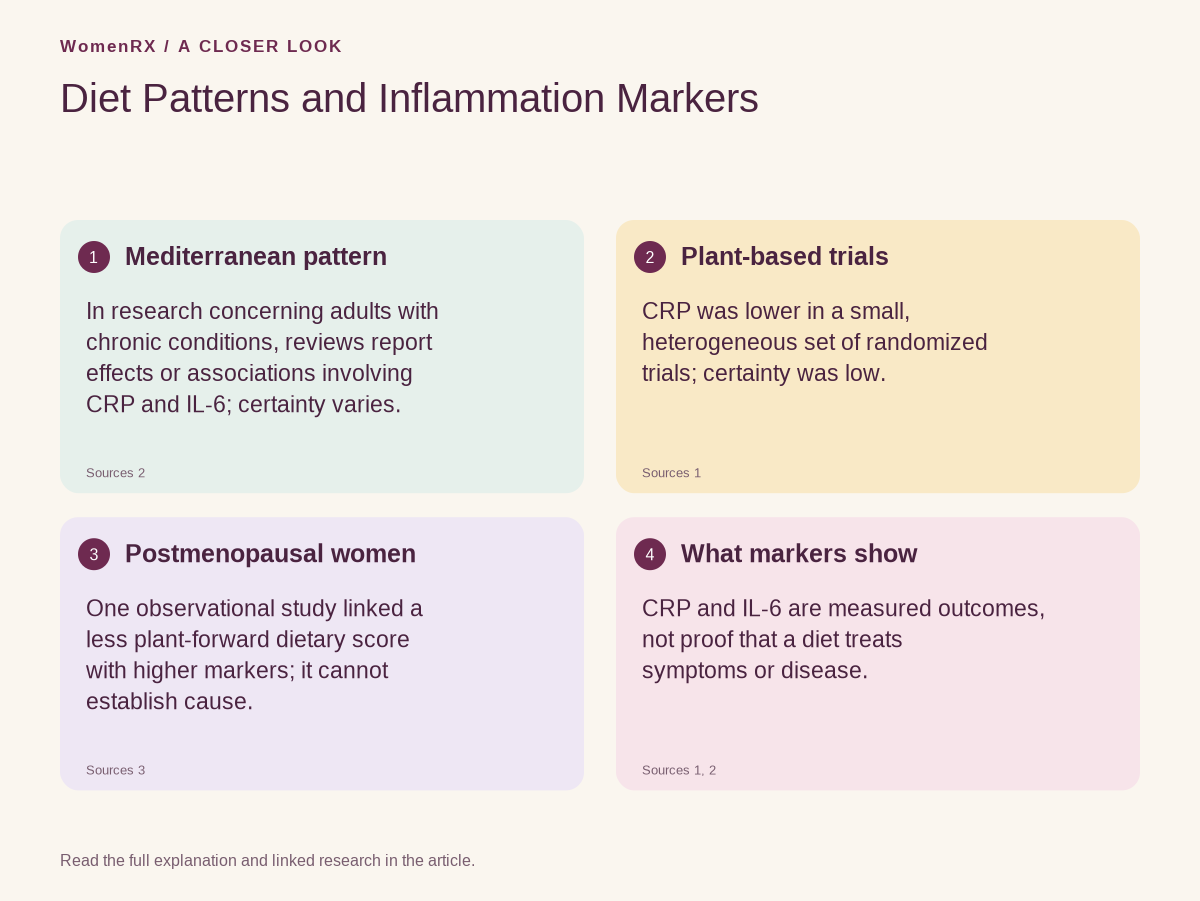
Diet Patterns and Inflammation Markers
Mediterranean pattern: In research concerning adults with chronic conditions, reviews report effects or associations involving CRP and IL-6; certainty varies.2
Plant-based trials: CRP was lower in a small, heterogeneous set of randomized trials; certainty was low.1
Postmenopausal women: One observational study linked a less plant-forward dietary score with higher markers; it cannot establish cause.3
What markers show: CRP and IL-6 are measured outcomes, not proof that a diet treats symptoms or disease.12
Read the figure as text
This map separates findings about blood markers from conclusions about symptoms or disease treatment.- Mediterranean pattern: In research concerning adults with chronic conditions, reviews report effects or associations involving CRP and IL-6; certainty varies.2
- Plant-based trials: CRP was lower in a small, heterogeneous set of randomized trials; certainty was low.1
- Postmenopausal women: One observational study linked a less plant-forward dietary score with higher markers; it cannot establish cause.3
- What markers show: CRP and IL-6 are measured outcomes, not proof that a diet treats symptoms or disease.12
More questions, answered
Does a lower CRP mean I have less disease?
Not by itself. CRP is a marker researchers use to assess inflammation, but a change in one blood measurement does not prove a diet has treated a disease or improved symptoms. The dietary studies summarized here primarily address inflammatory markers, not proof of treatment for a specific condition. 12
Is an anti-inflammatory diet different after menopause?
Current research does not establish a separate postmenopausal eating pattern. One study in postmenopausal women found associations between a dietary score and several markers, but its observational design cannot show cause and effect. 3
Sources you can check
- The effect of plant-based dietary patterns on C-reactive protein: A systematic review and meta-analysis of randomised controlled trials.Bell L, Gibbs J, Cappuccio FP. · Nutrition, metabolism, and cardiovascular diseases : NMCD · 2026Return to first citation
- Dietary Patterns Associated With Anti-inflammatory Effects: An Umbrella Review of Systematic Reviews and Meta-analyses.Reyneke GL, Lambert K, Beck EJ. · Nutrition reviews · 2026Return to first citation
- Inflammation-oriented dietary pattern and menopause timing in postmenopausal women: evidence from the Health and Retirement Study.Liang Y, Huang Z, Li Z, Li H, Lu J, Zhong K, Shi W, Ou Y. · Frontiers in nutrition · 2026Return to first citation