Eating With PCOS: Choose a Pattern That Fits Your Life
Reviews of PCOS eating approaches haven’t identified a best pattern for everyone, so your goals and daily life matter in the choice.
You don’t need to choose a diet by its label or make weight loss the goal. Reviews of PCOS eating approaches don’t identify a pattern that’s best for everyone, and they call for longer-term studies. A useful starting point is an approach you can afford and live with that fits your priorities, whether those are metabolic health, fertility care, or less food-related stress. 234
Start with the goal, not the diet label
PCOS can involve reproductive, metabolic, and emotional concerns, but that doesn’t mean every person needs the same eating plan. A useful first question is what you want your eating pattern to help with right now: for example, supporting general metabolic health, fitting alongside fertility treatment, or making food feel less stressful. Your answer can guide your choices without assuming weight loss is necessary or wanted.
Reviews of PCOS eating approaches don’t identify one named diet as best for everyone, and they call for longer-term research. Studies of ketogenic diets have reported short-term changes in metabolic and hormonal measures, but the research included different kinds of studies, lasted 6 to 24 weeks, and focused on women with overweight or obesity. The ketogenic review also describes variation between study protocols and challenges with adherence. Those findings may not tell you how a restrictive plan would work over time or compare with a less restrictive choice. 24
Compare the tradeoffs
A flexible, heart-conscious pattern can be built around a variety of nutritious foods, including fruits, vegetables, and whole grains, while limiting saturated and trans fats. This is general metabolic-health guidance, not proof of a PCOS-specific treatment effect. It leaves room to use foods you can find and afford in meals you already enjoy, rather than following a fixed menu. 1
A lower-glycemic approach focuses on carbohydrate choices intended to lower the demand for insulin, rather than sharply limiting carbohydrates as a ketogenic diet does. A review discusses improvements in metabolic and hormonal measures with lower-glycemic diets in PCOS, while calling for stronger long-term trials. If you like some of the meals you already eat, consider whether this approach lets you adjust them without making every meal a project. 24
A Mediterranean-style approach may appeal if you’d rather work with a broad eating pattern than a strict carbohydrate limit. A PCOS review discusses changes in gut microbial diversity with this approach, but those findings don’t establish that it improves your PCOS symptoms. Its practical fit depends on whether you can build it from foods you enjoy and can regularly buy. 4
A ketogenic approach is more restrictive because it sharply limits carbohydrates. A systematic review found short-term metabolic and hormonal improvements in studies of women with PCOS and overweight or obesity, but the underlying studies were varied and long-term sustainability remains uncertain. Consider what that limit would mean for your usual meals, shared food, and budget. The findings don’t establish that keto is the best choice, or that it improves fertility or pregnancy outcomes for an individual. 2
A less rule-driven approach may be worth considering if food rules or weight-focused advice are adding stress. In a US online survey of 342 adults ages 18 to 40 who reported PCOS, intuitive-eating scores were associated with more favorable measures of body appreciation, quality of life, and diet quality, and fewer psychological symptoms. Because the study was cross-sectional, it can’t show that intuitive eating caused those differences or prove it changes PCOS symptoms. This approach may give you more room around meals, but the survey didn’t test it as a treatment. 3
Make the choice workable
A plan is only useful if it fits your actual days. Before adopting a set of rules, ask yourself:
- Can I afford and find the foods this pattern relies on?
- Can it fit meals I already enjoy and share with other people?
- Does it feel manageable on busy days, not just on an ideal week?
- Am I choosing it for a goal that matters to me, or because I feel pressured to lose weight?
- Would its restrictions make eating more stressful?
These are practical decision questions, not a validated PCOS score. If a plan feels too demanding, that’s relevant information. You might keep the parts that work and loosen the rest rather than starting over with a stricter diet.
Keep fertility and food stress in view
If fertility is your priority, don’t treat reported changes in periods or ovulation as a promise of pregnancy. The ketogenic-diet review notes that pregnancy outcomes came from small, uncontrolled cohorts and should be interpreted cautiously. 2
If eating rules are causing distress, the survey finding on intuitive eating may offer a reason to explore a gentler approach, but it is not evidence that one specific method treats PCOS or disordered eating. You could ask a registered dietitian or your care team for help finding an approach that respects your health priorities and relationship with food. The key is not to earn the “right” diet; it’s to find a pattern that supports your needs without taking over your life.
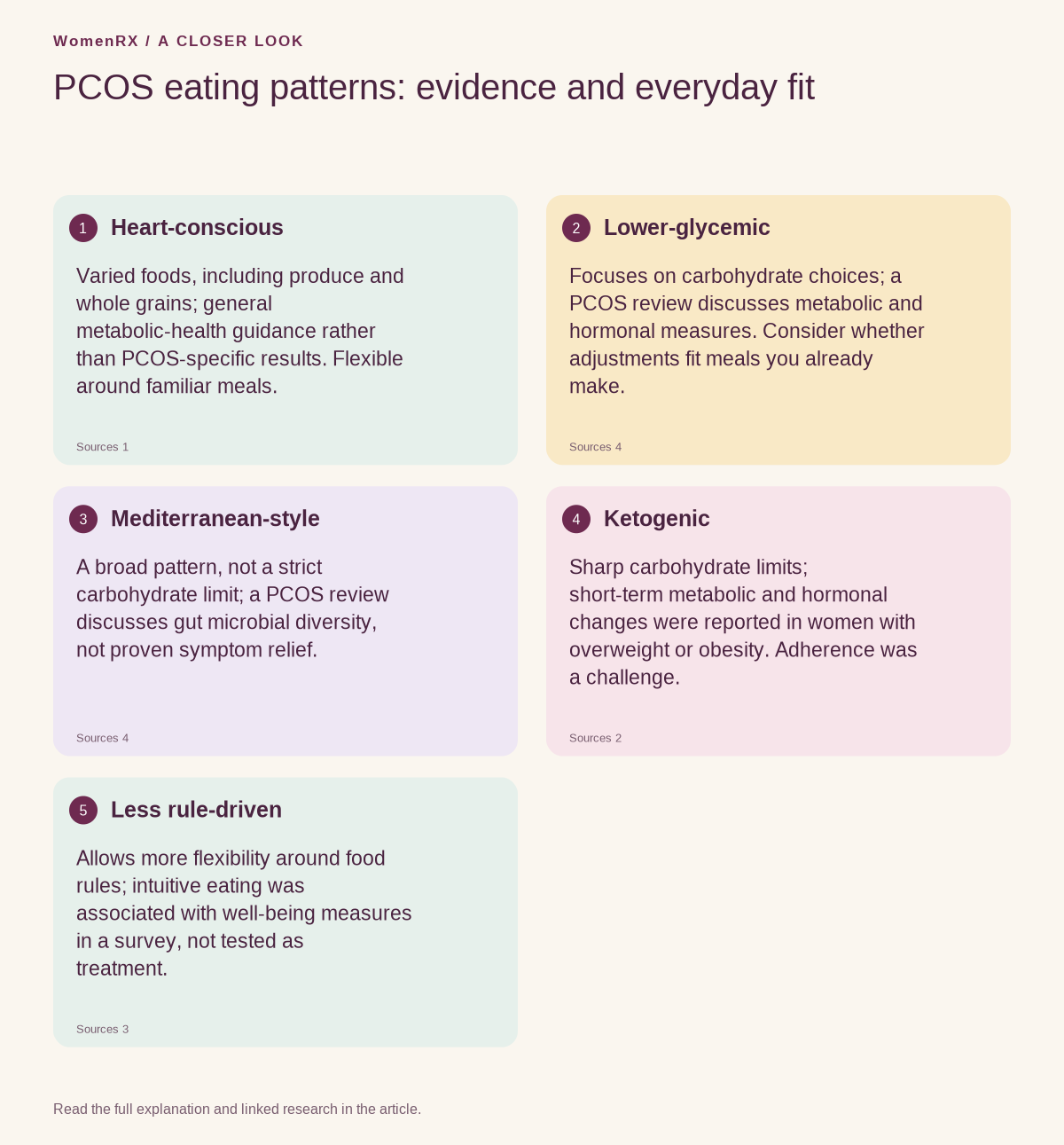
PCOS eating patterns: evidence and everyday fit
Heart-conscious: Varied foods, including produce and whole grains; general metabolic-health guidance rather than PCOS-specific results. Flexible around familiar meals.1
Lower-glycemic: Focuses on carbohydrate choices; a PCOS review discusses metabolic and hormonal measures. Consider whether adjustments fit meals you already make.4
Mediterranean-style: A broad pattern, not a strict carbohydrate limit; a PCOS review discusses gut microbial diversity, not proven symptom relief.4
Ketogenic: Sharp carbohydrate limits; short-term metabolic and hormonal changes were reported in women with overweight or obesity. Adherence was a challenge.2
Less rule-driven: Allows more flexibility around food rules; intuitive eating was associated with well-being measures in a survey, not tested as treatment.3
Read the figure as text
Compare what each approach emphasizes, which outcomes the research discusses, and what it may ask of your daily meals.- Heart-conscious: Varied foods, including produce and whole grains; general metabolic-health guidance rather than PCOS-specific results. Flexible around familiar meals.1
- Lower-glycemic: Focuses on carbohydrate choices; a PCOS review discusses metabolic and hormonal measures. Consider whether adjustments fit meals you already make.4
- Mediterranean-style: A broad pattern, not a strict carbohydrate limit; a PCOS review discusses gut microbial diversity, not proven symptom relief.4
- Ketogenic: Sharp carbohydrate limits; short-term metabolic and hormonal changes were reported in women with overweight or obesity. Adherence was a challenge.2
- Less rule-driven: Allows more flexibility around food rules; intuitive eating was associated with well-being measures in a survey, not tested as treatment.3
More questions, answered
Does a PCOS diet have to focus on weight loss?
No. PCOS affects people across body sizes, yet lifestyle advice often focuses on weight loss. You can start with a priority that matters to you, such as supporting metabolic health or making eating less stressful. 3
Can a ketogenic diet improve fertility with PCOS?
A review reported reproductive changes in some studies, but pregnancy outcomes came from small, uncontrolled cohorts. That is not enough to promise that keto improves your chance of pregnancy. 2
Sources you can check
- Metabolic Syndrome | MedlinePlusAccessed 2026-09-25Return to first citation
- Effects of Ketogenic Diet (KD) on Metabolic, Endocrine, and Reproductive Outcomes in Overweight/Obese Women With Polycystic Ovary Syndrome (PCOS): A Systematic Review.Diha AM, Uddin MSS, Anha KM, Bekele FD, Naima J, Al-Khulaifi AAS, Nassar AA, Huq MS. · Cureus · 2026Return to first citation
- Intuitive eating is positively associated with body appreciation and other biopsychosocial measures in individuals with polycystic ovary syndrome (PCOS)/polyendocrine metabolic ovarian syndrome (PMOS): A cross sectional study.Herbert S, Squires A, Gilligan C, Woolf K. · Journal of the Academy of Nutrition and Dietetics · 2026Return to first citation
- Dietary interventions for modulating the gut microbiome in PCOS management.Patel E. · Frontiers in endocrinology · 2026Return to first citation