Emotional Eating: Notice the Pattern, Choose a Response
A simple, nonjudgmental record of what happened before and after eating can help you spot what you need, without turning food into a set of rules.
Emotional eating describes a pattern, not a failure of willpower. Try noting the situation, feeling, body cues, urge, and what happened next. Then choose what would help in that moment: eating, addressing the stressor, or both. If eating feels hard to control, causes distress, or disrupts daily life, you can ask for support without first deciding on a diagnosis.
Start with curiosity, not a food rule
Eating can offer comfort or distraction when you’re stressed, sad, lonely, bored, or overwhelmed. That connection is worth noticing, but it doesn’t mean you’ve done something wrong. The goal isn’t to label a food as “good” or “bad,” or to prove you can resist an urge. It’s to understand what was going on and find a response that fits.
Emotions and physical hunger can overlap. You might be hungry and stressed at the same time. Rather than using hunger as a test you have to pass, treat it as one useful cue among several. A short record can help you see patterns without imposing a rigid eating plan.
A five-part trigger-and-response worksheet
After a moment you want to understand, jot down a few words for each prompt. You don’t need to record every meal or count anything. One example might be: “After a tense work call; anxious and tired; wanted something comforting; ate a snack while scrolling; felt calmer briefly, then still tense.” That’s information, not a verdict.
- What was happening? Note the situation, place, or event.
- What were you feeling? Name one or two emotions, if you can.
- What did you notice in your body? You might record hunger, fullness, tension, tiredness, or no clear cue.
- What did you want, and what did you do? Include eating if that’s what happened. Don’t grade the choice.
- What helped, even a little, and what do you need now? The answer might be food, rest, company, a break, or help with the problem itself.
Look for repeating situations, not a single “cause.” For example, you may notice the urge tends to show up after poor sleep, conflict, or a long stretch of pressure. In a cross-sectional study of 1,297 university students in Greece, higher perceived stress and poorer sleep quality were associated with higher emotional-eating categories. Because the study measured these factors at one point in time, it can’t show that stress or sleep problems caused the eating pattern. 4
Choose a response that leaves room for food
Once you spot a pattern, pause briefly and ask: “What would help right now?” You could decide to eat and give yourself time to notice the experience. Or you might first try a response to the feeling, such as stepping away from a stressful task, resting, or reaching out to someone. You can also do both. These are options for learning what works for you, not rules for earning or denying food.
If the situation is something you can change, a practical response might be to address it directly. If it’s an emotion that needs room, you might name it or talk it through. The point isn’t to replace eating every time. It’s to expand your choices so food doesn’t have to carry the whole job of coping.
Mindful-eating programs are one possible form of structured support, but results from small or specific studies don’t guarantee an individual outcome. In a randomized trial of 46 Hong Kong university students, 42 of them female, a 10-week mindfulness-based eating program reduced reported emotional eating more than a waitlist comparison. 1 In another trial of adults with overweight or obesity, 46 participants were included in the analysis; a structured mindfulness program led to greater improvement in emotional eating than an intuitive-eating education program, but did not produce a between-group difference in weight at the short-term follow-up. 3 These findings support mindfulness as one approach to explore, not a promise that it will work for everyone or change weight.
When more support could help
Consider reaching out if eating feels hard to control, causes significant distress, or starts interfering with daily life. These experiences don’t establish a diagnosis, and you don’t have to label them before asking for help. You could start with a primary care clinician or a licensed therapist and describe what happens, how it affects you, and what you’ve noticed in the worksheet. If you’re worried about binge eating or another eating concern, say so directly and ask what support is available.
Psychological support can address feelings and eating patterns together. For example, a randomized trial of 91 people receiving care for severe obesity found that adding group compassion-focused therapy to usual care improved emotional eating and several measures of psychological distress; the study was conducted in one specialist center, so its results may not apply to every person or setting. 2 A therapist can help you consider what kind of support fits your situation.
If pregnancy or postpartum life is part of your picture, make the worksheet reflect what your days actually look like. You might include changes in sleep, meal routines, caregiving demands, stress, mood, or time for breaks, alongside the situation and feeling before an urge. Those details can help you see whether a pattern shows up in particular circumstances, without assuming that a life stage caused it. If eating concerns are distressing or getting in the way of daily life, bring them up with your prenatal or postpartum care team or a therapist. These studies do not establish patterns specific to pregnancy or postpartum.
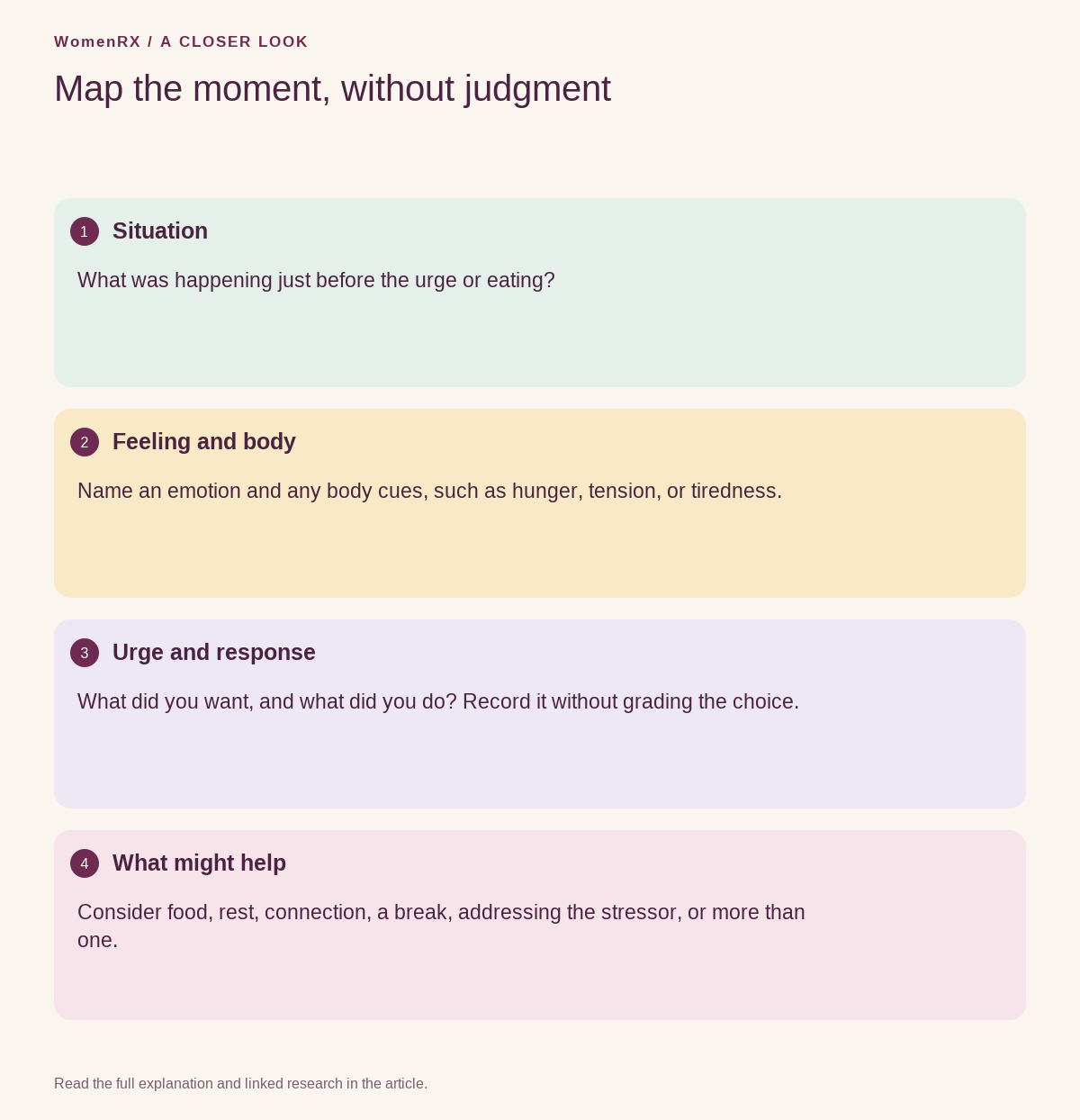
Map the moment, without judgment
Situation: What was happening just before the urge or eating?
Feeling and body: Name an emotion and any body cues, such as hunger, tension, or tiredness.
Urge and response: What did you want, and what did you do? Record it without grading the choice.
What might help: Consider food, rest, connection, a break, addressing the stressor, or more than one.
Read the figure as text
Use these prompts to connect a situation with a feeling and a response. The aim is to notice, not score or diagnose yourself.- Situation: What was happening just before the urge or eating?
- Feeling and body: Name an emotion and any body cues, such as hunger, tension, or tiredness.
- Urge and response: What did you want, and what did you do? Record it without grading the choice.
- What might help: Consider food, rest, connection, a break, addressing the stressor, or more than one.
More questions, answered
Does emotional eating automatically mean binge eating?
No. Eating in response to a feeling alone doesn’t tell you whether an episode is binge eating or whether you have an eating disorder. If eating feels hard to control, causes distress, or is affecting daily life, describe what happens to a clinician or therapist who understands eating concerns; you don’t need to diagnose yourself first.
Does mindfulness stop emotional eating?
It may help some people notice eating cues and emotional patterns. Trials have found improvements in particular groups, but results don’t show that mindfulness works for everyone or that it will stop emotional eating. 1 3
Sources you can check
- Mindfulness-based eating awareness training (MB-EAT) decreases emotional eating behavior among Hong Kong university students: a randomized controlled trial.Sanchez Vidaña DI, Ahorsu DK, McCormack L, Zeng RR, Miller T, Vinas Guasch N, Chan NJ, Lo KK, Cruz Gonzalez P, Lau BW, Lau WK. · Journal of behavioral medicine · 2026Return to first citation
- Compassion-focused group therapy improves depression, emotional eating, self-criticism and shame in people living with severe obesity: A single-centre, examiner-blind randomized controlled trial.Hynes M, Finucane FM, Collins C, O'Brien T, McAnena O, O'Shea G, Pilch M, McGuire BE. · PloS one · 2026Return to first citation
- The mind-eat program leads to greater improvements in mindful, emotional, and external eating compared to intuitive eating-oriented education in adults with overweight or obesity: a randomized controlled trial.Van Beekum M, Rodhain A, Shankland R, Chetouane S, Jullien-Durmont D, Rouzic CL, Myzia J, Guiraudou M, Kemba Y, Boegner C, Bonnet JB, Attalin V, Jalek A, Sultan A, Leys C, Péneau S... · The international journal of behavioral nutrition and physical activity · 2026Return to first citation
- Associations of Emotional Eating with Perceived Stress and Sleep Quality Among University Students: A Nationwide Cross-Sectional Study.Alexatou O, Papadopoulou SK, Angelakou EP, Migdanis A, Mentzelou M, Migdanis I, Louka A, Serdari A, Giaginis C. · Nutrients · 2026Return to first citation