Can Corn Fit Into a Weight-Management Eating Pattern?
Corn can be part of a satisfying meal; the useful choice is how to serve it and what else goes on the plate.
Yes. Whole-kernel corn can be the starchy part of a meal with beans or another main dish and other vegetables. Fresh corn on the cob works as a side; frozen or canned kernels are convenient for bowls and soups. If sodium matters to you, compare canned-food labels. 2 The studies described don’t establish that corn itself causes or prevents weight change. 3 4
Start with the meal, not a food verdict
Corn doesn’t need to be off the menu. To build a meal, decide where the kernels fit. For example, try corn with beans and other vegetables in a bowl, or serve it alongside a main dish and vegetables. If you already have a starchy food on the plate, you can decide whether corn belongs alongside it or takes its place. These are meal-building suggestions, not tested weight-loss recipes.
Fiber-containing plant foods can add bulk and help you feel full sooner. That general point about fiber doesn’t mean corn has a special effect on fullness or weight. 1
What the weight studies do, and don’t, show
A large prospective study followed women in the Nurses’ Health Study and Nurses’ Health Study II, as well as men in a separate cohort. It found that increases in a combined category of starchy vegetables, which included peas, corn, and potatoes, were associated with greater weight gain over four-year periods. The study was observational: it can identify an association, not show that corn caused weight gain. And because those foods were grouped together, it can’t tell you what happened with corn alone. Although many associations in the study were stronger among women, it doesn’t provide a corn-specific result for women. 4
A small six-week randomized trial compared barley cereal with corn cereal in 30 Korean adults with overweight, about 37% of whom were women. The results favored barley on some measures, including body weight. But this was a comparison of cereals, not corn on the cob or loose kernels, and it didn’t establish a women-specific effect. 3
Neither finding ranks fresh, frozen, and canned kernels for weight management. The practical choice is the form that helps you make the meal you want.
Fresh, frozen, or canned? Choose by the job
Fresh corn on the cob makes sense when you want corn as a side. Loose fresh kernels can also go into a salad or bowl. Frozen kernels are an option when you want to add corn to a soup, skillet meal, or bowl without starting with a cob. Canned kernels can fill that same role when you want something ready from the pantry. Those are serving ideas, not claims that one form leads to better weight outcomes.
If you’re choosing between canned products and sodium matters to you, check the sodium on their labels rather than assuming the options are identical. Food labels can show how much sodium is in prepared foods. 2
A corn snack is a different decision
A bowl with corn kernels and beans isn’t the same eating occasion as opening a packaged corn snack. If you want the snack, choose it as a snack: look at the product’s ingredients and compare its label with other snacks you might buy. If sodium is part of your decision, the label lets you compare that too. 2 You don’t have to treat every food with “corn” in its name as interchangeable with kernels.
Corn cereal is another distinct choice. The trial that favored barley tested cereal served with milk, so its result doesn’t tell you whether to buy fresh, frozen, or canned kernels for dinner. 3 For your next meal, a simpler question is: Do I want corn as a side or ingredient, or am I choosing a cereal or snack? From there, pick the form that suits the meal instead of looking for a good-food/bad-food verdict.
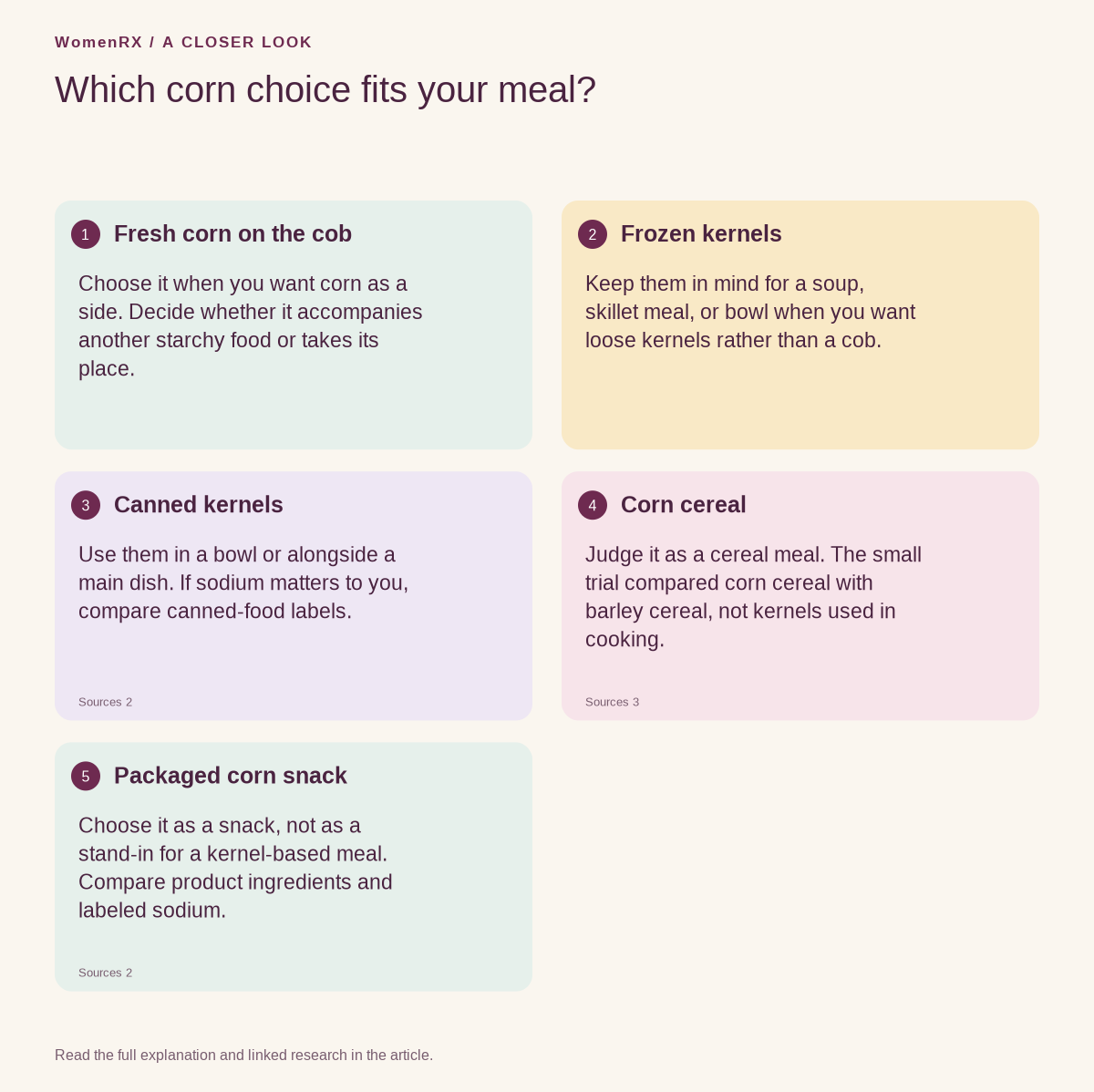
Which corn choice fits your meal?
Fresh corn on the cob: Choose it when you want corn as a side. Decide whether it accompanies another starchy food or takes its place.
Frozen kernels: Keep them in mind for a soup, skillet meal, or bowl when you want loose kernels rather than a cob.
Canned kernels: Use them in a bowl or alongside a main dish. If sodium matters to you, compare canned-food labels.2
Corn cereal: Judge it as a cereal meal. The small trial compared corn cereal with barley cereal, not kernels used in cooking.3
Packaged corn snack: Choose it as a snack, not as a stand-in for a kernel-based meal. Compare product ingredients and labeled sodium.2
Read the figure as text
These are serving and shopping ideas, not a ranking of weight-loss effects.- Fresh corn on the cob: Choose it when you want corn as a side. Decide whether it accompanies another starchy food or takes its place.
- Frozen kernels: Keep them in mind for a soup, skillet meal, or bowl when you want loose kernels rather than a cob.
- Canned kernels: Use them in a bowl or alongside a main dish. If sodium matters to you, compare canned-food labels.2
- Corn cereal: Judge it as a cereal meal. The small trial compared corn cereal with barley cereal, not kernels used in cooking.3
- Packaged corn snack: Choose it as a snack, not as a stand-in for a kernel-based meal. Compare product ingredients and labeled sodium.2
More questions, answered
Does corn affect women’s weight differently?
There’s no corn-specific difference established by these studies. The large cohort study included women but reported corn together with peas and potatoes. The small corn-cereal trial included women and men but didn’t establish a women-specific effect. 3 4
Sources you can check
- Dietary Fiber: MedlinePlusAccessed 2026-09-25Return to first citation
- Sodium: MedlinePlusAccessed 2026-09-25Return to first citation
- Barley-Based Cereals Enhance Metabolic Health and Satiety in Overweight Korean Adults: A Randomized Trial.Kang I, Jang H, Gim M, Bae SE, Lee YJ, Leem CS, Park YK. · Nutrients · 2025Return to first citation
- Association between changes in carbohydrate intake and long term weight changes: prospective cohort study.Wan Y, Tobias DK, Dennis KK, Guasch-Ferré M, Sun Q, Rimm EB, Hu FB, Ludwig DS, Devinsky O, Willett WC. · BMJ (Clinical research ed.) · 2023Return to first citation