Can Dark Chocolate Fit Into a Weight-Management Plan?
Dark chocolate can fit as a planned snack, but the weight-loss trials here don’t show that it causes weight loss or reliably suppresses appetite.
Yes, dark chocolate can be included in a weight-management plan if you account for it rather than treating it as a weight-loss aid. In trials of premenopausal women, people lost weight while following reduced-calorie plans that included chocolate snacks, but they lost similar amounts with non-chocolate snacks. Those studies don’t show that chocolate itself caused the loss or curbed hunger. 3 4
Chocolate can fit; it isn’t a weight-loss tool
If you enjoy dark chocolate, you don’t necessarily have to cut it out while managing your weight. The practical question is whether it fits the way you eat overall, not whether cocoa can cancel out the energy in a snack. Reduced calorie intake is part of the basis for long-term weight loss, according to the NIH Office of Dietary Supplements. 1
The most relevant human trials tested chocolate inside a reduced-calorie plan, not as a stand-alone strategy. That distinction matters: participants could include a sweet snack while following the plan, but the studies don’t show that adding chocolate to your usual intake leads to weight loss. 3 4
What the chocolate trials actually found
In an 18-week randomized trial, 60 overweight or obese premenopausal women followed a reduced-calorie diet with either energy-controlled dark-chocolate snacks and a sugar-free cocoa drink or non-chocolate snacks and a non-cocoa drink. Average weight loss was 4.4 kg in the chocolate group and 5.0 kg in the comparison group; the study reported equivalent weight loss between groups. Both groups also reduced energy intake. The result supports the possibility of including chocolate in that kind of plan, not a special weight-loss effect from cocoa. 4
An 18-week pilot trial assigned 26 overweight or obese premenopausal women to a reduced-calorie diet with a daily dark-chocolate snack or a non-chocolate snack. Each group lost an average of 5.1 kg. Because both groups followed the diet and the trial was small, it can’t establish that chocolate caused weight loss. 3
These studies offer a useful, limited takeaway: a plan doesn’t have to ban a particular treat to include a snack, but the chocolate wasn’t shown to work better than a non-chocolate option. The results are from premenopausal women; they don’t tell us whether the findings differ by sex, or apply specifically during perimenopause or after menopause. 3 4
Cocoa compounds aren’t the same as a chocolate bar
Cocoa-compound research is sometimes used to make claims about ordinary chocolate. But a study of cocoa ingredients or by-products is not automatically evidence that eating dark chocolate reduces body weight. For example, a proof-of-concept study tested cacao by-products alongside reduced-calorie diet counseling and an aerobic exercise plan. Participants in both groups lost weight; the abstract reports a triglyceride change in the cacao-by-product group, not a separate weight-loss effect from chocolate. 2
And weight change is different from appetite. The chocolate trials above examined outcomes during an 18-week diet plan; they don’t establish that a portion of dark chocolate reliably reduces hunger or later food intake. Treat appetite-suppression claims as unproven by this evidence, rather than as a reason to eat extra chocolate. 3 4
A simple portion-and-context check
When deciding whether to have some, try this three-part check:
- Decide what it’s doing in your day. Is it a planned snack, or an addition on top of the snacks you usually have? The trials included chocolate within a reduced-calorie plan, rather than testing extra chocolate added to usual eating. 3 4
- Choose an amount that fits your plan. Use the product’s serving information to help portion it, rather than assuming that “dark” means it doesn’t count. These trials don’t establish a weight-loss portion that works for everyone.
- Judge it by fit and preference, not a cocoa promise. If you like it and it works as a planned snack, it can be one option. If it doesn’t feel satisfying or easy to fit, a different snack is just as reasonable; the trials didn’t show greater weight loss with chocolate than with their non-chocolate comparisons. 3 4
enjoy dark chocolate if you want to, but let your overall eating pattern do the weight-management work. Cocoa or appetite claims aren’t a reason to expect the chocolate itself to produce meaningful weight loss.
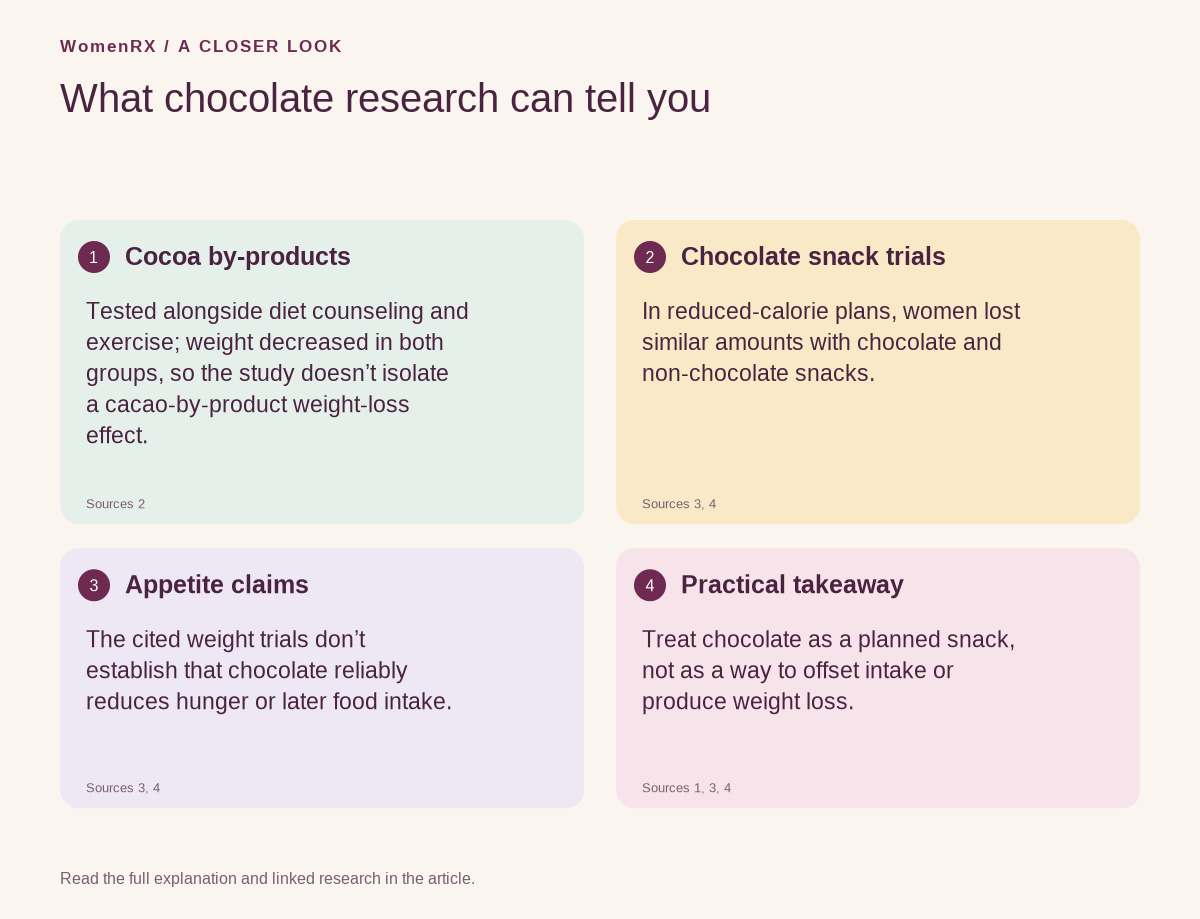
What chocolate research can tell you
Cocoa by-products: Tested alongside diet counseling and exercise; weight decreased in both groups, so the study doesn’t isolate a cacao-by-product weight-loss effect.2
Chocolate snack trials: In reduced-calorie plans, women lost similar amounts with chocolate and non-chocolate snacks.34
Appetite claims: The cited weight trials don’t establish that chocolate reliably reduces hunger or later food intake.34
Practical takeaway: Treat chocolate as a planned snack, not as a way to offset intake or produce weight loss.134
Read the figure as text
These three evidence categories separate studies of cocoa ingredients from trials of whole-chocolate snacks and show what each can support.- Cocoa by-products: Tested alongside diet counseling and exercise; weight decreased in both groups, so the study doesn’t isolate a cacao-by-product weight-loss effect.2
- Chocolate snack trials: In reduced-calorie plans, women lost similar amounts with chocolate and non-chocolate snacks.34
- Appetite claims: The cited weight trials don’t establish that chocolate reliably reduces hunger or later food intake.34
- Practical takeaway: Treat chocolate as a planned snack, not as a way to offset intake or produce weight loss.134
More questions, answered
Do the studies show dark chocolate is better than another snack?
No. In two 18-week trials in premenopausal women, weight loss was similar with chocolate and non-chocolate snacks as part of reduced-calorie plans. The studies support including a preferred snack in a plan, not choosing chocolate for a greater weight-loss effect. 3 4
Sources you can check
- Dietary Supplements for Weight Loss - Health Professional Fact SheetAccessed 2026-09-25Return to first citation
- Effects of Cacao By-Products and a Modest Weight Loss Intervention on the Concentration of Serum Triglycerides in Overweight Subjects: Proof of Concept.León-Flores P, Nájera N, Pérez E, Pardo B, Jimenez F, Diaz-Chiguer D, Villarreal F, Hidalgo I, Ceballos G, Meaney E. · Journal of medicinal food · 2020Return to first citation
- A reduced-calorie dietary pattern including a daily sweet snack promotes body weight reduction and body composition improvements in premenopausal women who are overweight and obese: a pilot study.Piehowski KE, Preston AG, Miller DL, Nickols-Richardson SM. · Journal of the American Dietetic Association · 2011Return to first citation
- Changes in body weight, blood pressure and selected metabolic biomarkers with an energy-restricted diet including twice daily sweet snacks and once daily sugar-free beverage.Nickols-Richardson SM, Piehowski KE, Metzgar CJ, Miller DL, Preston AG. · Nutrition research and practice · 2014Return to first citation