How Should You Compare Dark Chocolate Labels and Portions?
Cocoa percentage can help you compare bars, but the label’s sugar and serving details matter more for choosing what fits you.
Use cocoa percentage as a clue to a bar’s cocoa-to-other-ingredients balance, not as a measure of its flavanols or a promise of a health benefit. Compare added sugar using the same amount of chocolate, then choose a portion that suits your taste and eating habits. As a reference, one ounce (28.35 g) of 70-85% dark chocolate has about 170 calories, 2.2 g protein, and 3.1 g fiber. 3
Start with what you want from the chocolate
If you’re choosing dark chocolate because you enjoy its taste, your decision can be straightforward: compare the bars’ labels and pick a portion you’ll feel good about eating. If you’re choosing it mainly to lower blood pressure, the label can’t tell you that it will work. Studies of cocoa and chocolate have reported different results, and a bar’s cocoa percentage doesn’t tell you its measured flavanol content. 1 2
What cocoa percentage tells you
Cocoa percentage is useful for comparing the cocoa content stated on different bars. A higher figure indicates a larger share of cocoa ingredients in the product, but it doesn’t tell you the exact amount of cocoa flavanols. Cocoa products vary in their flavanol content, and chocolate formulations can include sugar and other ingredients. 1
So, a bar marked 80% isn’t automatically a better source of flavanols than one marked 70%. If a product lists a measured flavanol amount, that’s more directly relevant to flavanol content than the cocoa percentage alone. If it doesn’t, you can’t calculate the flavanol amount from the percentage.
A one-ounce nutrition reference
For a concrete portion comparison, USDA SR Legacy’s entry for dark chocolate with 70-85% cacao solids (FDC 170273) gives this estimated profile for 1 ounce, or 28.35 grams: 3
| Nutrient | Per 1 ounce (28.35 g) |
|---|---|
| Energy | 169.5 kcal |
| Protein | 2.2 g |
| Fiber | 3.1 g |
| Carbohydrate | 13.0 g |
| Fat | 12.1 g |
These are reference estimates for that food description, not lab results for a particular brand or a recommended serving. For a recipe, use the amount of chocolate that ends up in your portion as a starting point; the finished dish’s nutrition also depends on its other ingredients. This food-composition profile isn’t a women-specific recommendation or evidence of a special effect in women. 3
Compare sugar on equal terms
Check the added-sugar amount on each label, then compare the same weight of chocolate. Package serving sizes may differ, so comparing the listed numbers without checking the serving amount can make one bar appear lower in sugar simply because its serving is smaller.
For example, if one label lists sugar for a 20-gram serving and another for a 30-gram serving, compare the amounts for the same weight before deciding which is lower. You can also use the listed serving to see how the sugar would add up for the amount you actually plan to eat. The point isn’t to find a universally correct number; it’s to make a fair comparison that matches your preferences.
A higher cocoa percentage doesn’t replace checking the label. Compare what each bar actually lists rather than assuming that a darker bar has less sugar or a particular nutrition profile.
Pick a portion that works for you
There’s no portion in these studies that can be recommended as a general health target. Instead, choose an amount that feels satisfying and makes sense for how you enjoy chocolate. If you usually have a few squares, compare the label information with that amount rather than relying only on the package’s serving.
This keeps the decision grounded in what you can verify: the ingredients and nutrition information on the bar, the amount you intend to eat, and whether you like the taste. You don’t need to treat chocolate as a treatment or choose a product based on a health promise.
What blood-pressure research can, and can’t, tell you
A 2022 meta-analysis of 31 studies found that cocoa consumption for at least two weeks was associated with lower blood pressure on average. The researchers also described variation between studies and said more adequately powered research was needed to determine an effective dose. 1
A separate review concluded that dark chocolate did not reduce blood pressure, while noting evidence of improved blood-vessel function in some studies. 2 These findings aren’t a reason to assume that a higher-percentage bar will lower your blood pressure. The studies used different products and flavanol amounts, and cocoa percentage by itself doesn’t identify those amounts. 1 2
For a shopping decision, keep the practical distinction clear: use cocoa percentage to compare the stated cocoa content, use the sugar and serving information to compare products as you would eat them, and let taste and preference guide your portion. Treat any blood-pressure benefit as uncertain, not as a reason to choose or eat more chocolate.
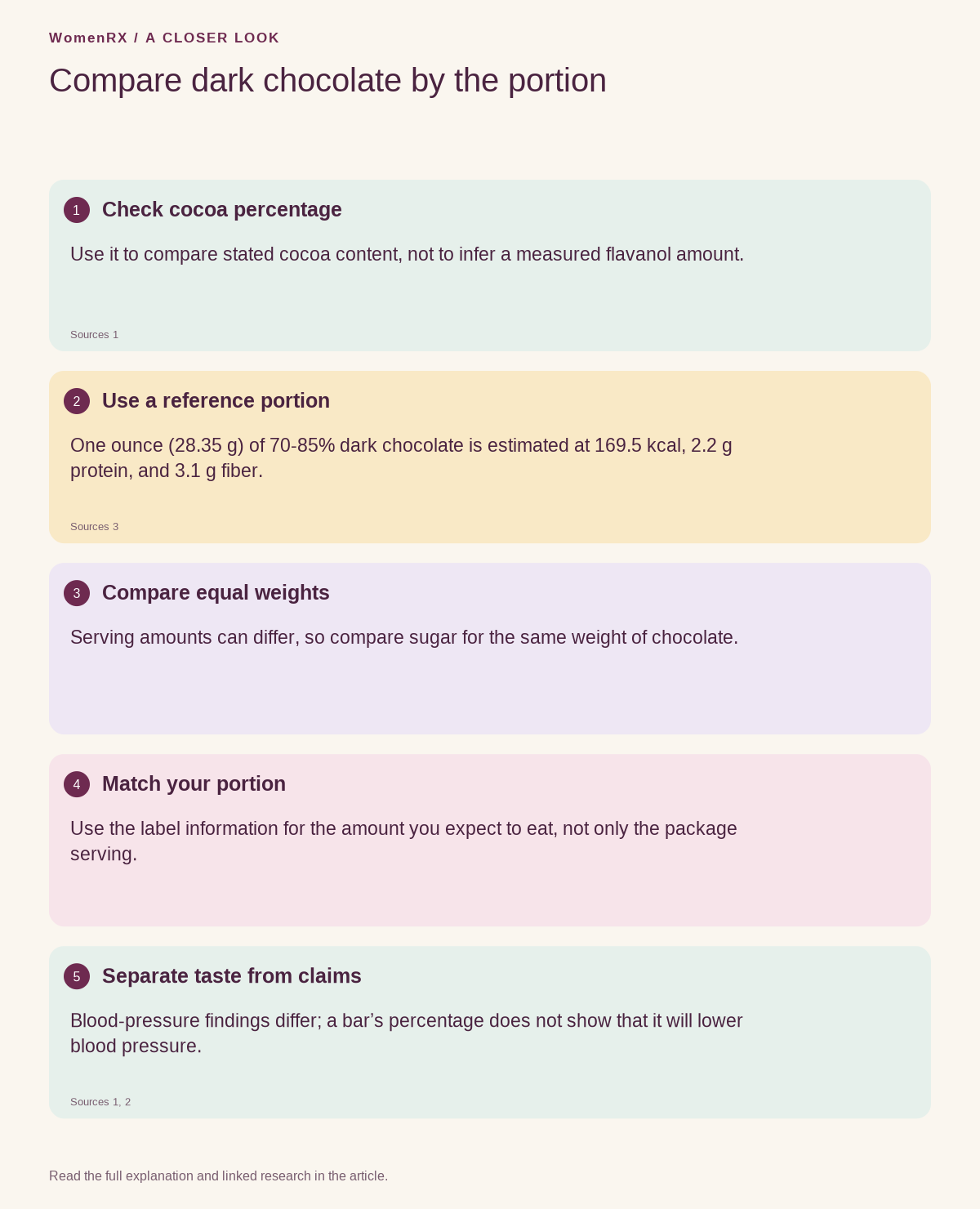
Compare dark chocolate by the portion
Check cocoa percentage: Use it to compare stated cocoa content, not to infer a measured flavanol amount.1
Use a reference portion: One ounce (28.35 g) of 70-85% dark chocolate is estimated at 169.5 kcal, 2.2 g protein, and 3.1 g fiber.3
Compare equal weights: Serving amounts can differ, so compare sugar for the same weight of chocolate.
Match your portion: Use the label information for the amount you expect to eat, not only the package serving.
Separate taste from claims: Blood-pressure findings differ; a bar’s percentage does not show that it will lower blood pressure.12
Read the figure as text
Use these checks to compare a bar’s label and put a familiar portion in context without treating cocoa percentage as a flavanol measure.- Check cocoa percentage: Use it to compare stated cocoa content, not to infer a measured flavanol amount.1
- Use a reference portion: One ounce (28.35 g) of 70-85% dark chocolate is estimated at 169.5 kcal, 2.2 g protein, and 3.1 g fiber.3
- Compare equal weights: Serving amounts can differ, so compare sugar for the same weight of chocolate.
- Match your portion: Use the label information for the amount you expect to eat, not only the package serving.
- Separate taste from claims: Blood-pressure findings differ; a bar’s percentage does not show that it will lower blood pressure.12
More questions, answered
Does a higher cocoa percentage mean more flavanols?
Not necessarily. Cocoa percentage describes the share of cocoa ingredients, but cocoa products vary in flavanol content. Without a measured flavanol amount, you can’t tell the bar’s flavanol content from its percentage alone. 1
Can dark chocolate lower blood pressure?
Research findings differ. A meta-analysis found an average reduction across cocoa studies, while another review concluded dark chocolate did not reduce blood pressure. Neither result shows that a particular bar will have that effect. 1 2
Sources you can check
- Effect of Cocoa Beverage and Dark Chocolate Consumption on Blood Pressure in Those with Normal and Elevated Blood Pressure: A Systematic Review and Meta-Analysis.Amoah I, Lim JJ, Osei EO, Arthur M, Tawiah P, Oduro IN, Aduama-Larbi MS, Lowor ST, Rush E. · Foods (Basel, Switzerland) · 2022Return to first citation
- The Impact of Cocoa Flavanols on Cardiovascular Health.Vlachojannis J, Erne P, Zimmermann B, Chrubasik-Hausmann S. · Phytotherapy research : PTR · 2016Return to first citation
- USDA SR Legacy: Chocolate, dark, 70-85% cacao solids (FDC 170273)Accessed 2026-09-25Return to first citation