Can Almonds Fit a Weight-Loss Plan?
They can be a satisfying snack or a swap for another snack, but almonds haven’t been shown to cause weight loss on their own.
Yes. Almonds can fit into a weight-loss plan, especially if they replace a snack you’d otherwise eat. But they’re energy-dense, and research doesn’t show that adding them automatically leads to weight loss. In one yearlong trial, almonds improved several diet-quality measures compared with biscuits, but body-weight change wasn’t significantly different. 1 If you have a tree-nut allergy, these almond snack suggestions don’t apply to you.
The useful question is what almonds replace
Almonds can be part of a weight-loss plan, but there’s no good reason to think they burn fat or cause weight loss by themselves. The practical tradeoff is that they’re nutrient-rich and energy-dense: eating them instead of a less nutritious snack may improve the overall snack choice, while adding them on top of what you already eat may make it harder to keep your eating pattern aligned with your goals.
If you have a tree-nut allergy, don’t treat almonds as a suitable snack swap for you. The suggestions here apply only when almonds are an appropriate food for you.
In a one-year randomized trial, 136 adults who regularly ate discretionary snacks were assigned to almonds or biscuits each day. The almond group’s diet improved in several nutrient measures, but the change in body weight wasn’t significantly different from the biscuit group. This was a comparison of one snack with another, not a test of almonds as a weight-loss treatment. 1
Portion size is a practical tool, not a magic number
Almond portions varied across studies, so there isn’t one weight-loss portion established by this research. A small appetite study tested 28 grams of almonds. The yearlong snack trial provided an amount based on participants’ estimated energy needs, with 42.5 grams as the stated equivalent for one energy level. Those are study conditions, not a prescribed serving for you. 1 2
If you want to see whether almonds work for you, try setting aside the amount you intend to eat rather than snacking straight from a large container. Then consider the whole snack: are the almonds replacing something else, or are they an extra? That distinction matters more for your plan than whether almonds have a special weight-loss effect.
Fullness may help, but almonds aren’t uniquely filling
Almonds are often discussed as a filling food. But in a small randomized study of 22 adults, including 19 women, participants reported similar hunger, desire to eat, and fullness after 28 grams of almonds or an energy- and macronutrient-matched baked snack. That result doesn’t show almonds have a unique appetite-suppressing effect compared with a similar snack. It also can’t tell us how every person will feel after eating them. 2
The weight evidence tells a similar, measured story. A scoping review of seven studies of energy-restricted diets found that all reported weight loss during energy restriction. Adding nuts was associated with greater weight loss in four of the seven studies, but results weren’t consistent, and the review included different kinds of nuts, not just almonds. 3
So, if almonds help you feel satisfied or make a snack more enjoyable, that can be useful in your own eating pattern. But that personal fit isn’t proof that almonds themselves drive weight loss.
What the research does, and doesn’t, say about women
The appetite study included mostly women, but it was small and did not establish a women-specific effect. The yearlong snack trial’s abstract doesn’t report sex-specific weight outcomes. These results can inform a general food choice, but they don’t show that almonds have a different weight effect for women. 1 2
The simplest approach is to decide what role almonds will play: a replacement you enjoy, or an extra you may not need. Their nutrition can make them a reasonable choice; it doesn’t turn them into a weight-loss strategy.
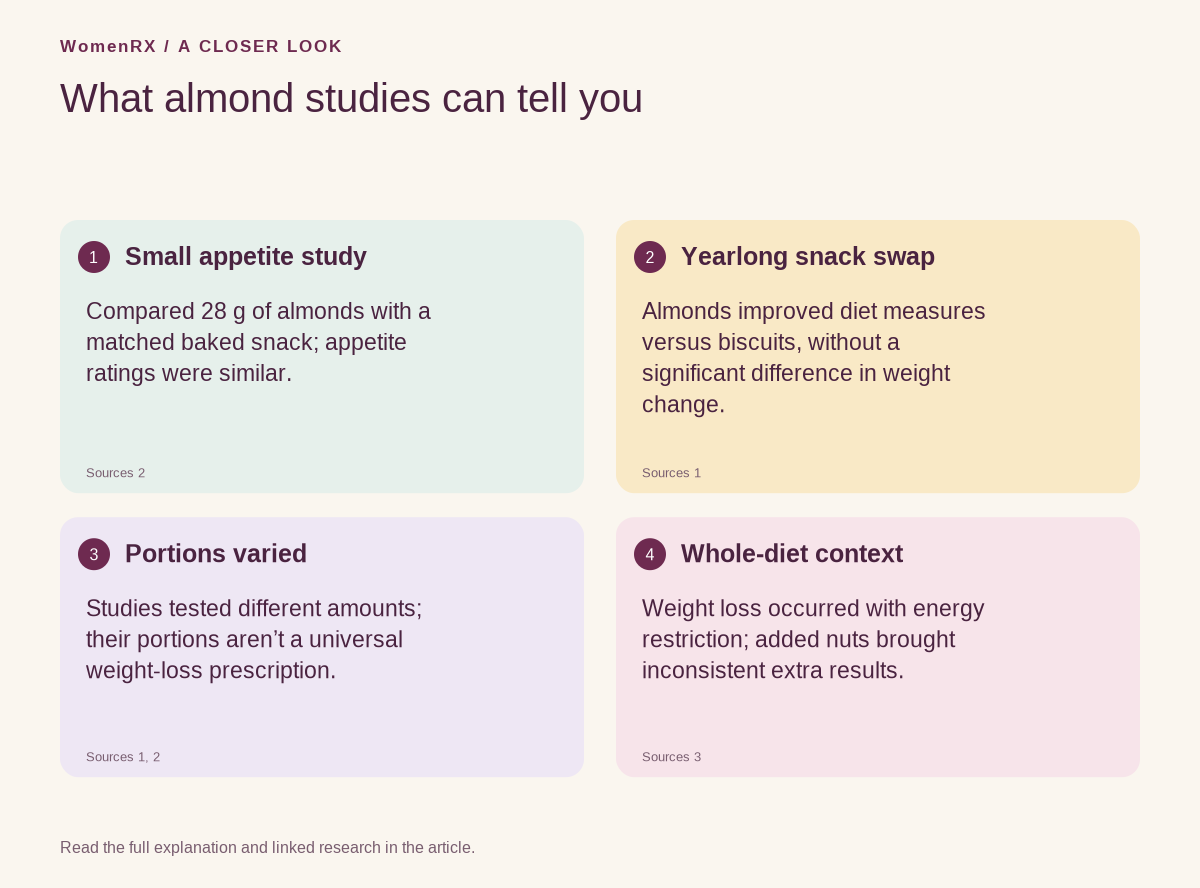
What almond studies can tell you
Small appetite study: Compared 28 g of almonds with a matched baked snack; appetite ratings were similar.2
Yearlong snack swap: Almonds improved diet measures versus biscuits, without a significant difference in weight change.1
Portions varied: Studies tested different amounts; their portions aren’t a universal weight-loss prescription.12
Whole-diet context: Weight loss occurred with energy restriction; added nuts brought inconsistent extra results.3
Read the figure as text
These comparisons separate a tested portion, a possible snack swap, and the limits of what the weight-loss evidence shows.- Small appetite study: Compared 28 g of almonds with a matched baked snack; appetite ratings were similar.2
- Yearlong snack swap: Almonds improved diet measures versus biscuits, without a significant difference in weight change.1
- Portions varied: Studies tested different amounts; their portions aren’t a universal weight-loss prescription.12
- Whole-diet context: Weight loss occurred with energy restriction; added nuts brought inconsistent extra results.3
Sources you can check
- Comparing the Effects of Consuming Almonds or Biscuits on Body Weight in Habitual Snackers: A 1-Year Randomized Controlled Trial.Brown RC, Ware L, Gray AR, Tey SL, Chisholm A. · The American journal of clinical nutrition · 2023Return to first citation
- Consuming Almonds vs. Isoenergetic Baked Food Does Not Differentially Influence Postprandial Appetite or Neural Reward Responses to Visual Food Stimuli.Sayer RD, Dhillon J, Tamer GG, Cornier MA, Chen N, Wright AJ, Campbell WW, Mattes RD. · Nutrients · 2017Return to first citation
- Effects of energy-restricted diets with or without nuts on weight, body composition and glycaemic control in adults: a scoping review.Mead LC, Hill AM, Carter S, Coates AM. · Nutrition research reviews · 2025Return to first citation