Can Peanut Butter Fit a Weight-Management Plan?
Peanut butter can fit, but its serving size and what it replaces matter more than any special weight-loss effect.
Yes. Peanut butter can be part of a weight-management plan, but these studies do not establish that peanut butter itself causes weight loss. Research on energy-restricted diets that included nuts, including peanuts, found mixed results on whether nuts added to weight loss. A small, short-term trial in women studied whole peanuts, not peanut butter, so it can’t establish a lasting weight effect. 1 2
The short answer: fit, not a fat-burning food
Peanut butter doesn’t need to be banned during weight management. The studies summarized here don’t establish whether peanut butter itself changes weight. The useful question is how it fits into the overall pattern of what you eat. A spread can add energy to a snack or meal; using it in place of something else is different from adding it on top of what you’d usually eat. That’s a practical way to think about portions, not a proven peanut-butter weight-loss strategy.
Research on energy-restricted diets that included nuts offers some context. A scoping review of seven studies found that all the diets led to weight loss, while adding nuts led to significantly greater weight loss in four of the seven studies. The studies included almonds, peanuts, pistachios, or walnuts, not just peanut butter, and the added benefit wasn’t consistent. 1
Start with the product’s serving information
Peanut butter can be easy to spread more generously than intended, so check the serving information on the jar and compare it with the amount you actually use. Products can differ; look at the calories per serving, and check the ingredient list and added-sugars information if those matter to you. There isn’t one portion that’s right for everyone, and a label comparison is more useful than assuming every peanut butter has the same composition.
Energy density is one reason the serving is worth noticing. In a small trial of women with overweight or obesity, a 35-gram serving of roasted peanuts provided 200 calories. That figure is for whole peanuts in that study, not a universal value for peanut butter. Use your own product’s label rather than transferring the trial’s number to your jar. 2
Protein and fiber don’t guarantee fullness
Peanuts provide protein and fiber, but that nutrient profile alone doesn’t prove that a peanut-based snack will keep you full or lead to weight loss. In the women’s trial, researchers compared a 200-calorie serving of peanuts with a 200-calorie serving of Greek yogurt. The yogurt group reported a significant increase in satiety 30 minutes after the snack; the peanut group had no significant changes in the measured appetite-related hormones. This was a short-term snack study after three days on a calorie-restricted diet, not a test of long-term weight change. It studied whole peanuts, not peanut butter. 2
So, if peanut butter works well for you as a snack or meal ingredient, you can include it. But don’t rely on its protein or fat to guarantee fullness, and don’t assume it will make weight loss easier. Your own response and the amount you use are more relevant than a promise based on one nutrient.
What the women’s research can, and can’t, tell you
The short-term peanut-versus-yogurt trial did enroll women: 50 participants aged 30-40 with overweight or obesity were randomized to the two snack groups. Its findings speak to one brief comparison in that population, not to women generally or to long-term weight management. 2
The broader review of nut-containing diets included adults, but its abstract doesn’t report whether results differed for women and men. And because it grouped several kinds of nuts, it can’t establish a specific effect of peanut butter. The best-supported takeaway is modest: nuts didn’t prevent weight loss in the reviewed energy-restricted diets, but an added weight-loss advantage appeared in only some studies. 1
Compare your portion and what it replaces
When choosing or using peanut butter, compare the serving on the label with what you typically spread, check product-specific nutrition information, and ask whether it’s replacing another part of the snack or meal. If you like it and it fits the way you want to eat, it can stay. If you’re choosing it mainly because you expect it to cause weight loss or reliably control hunger, these studies don’t establish that it will.
Check the jar and the meal
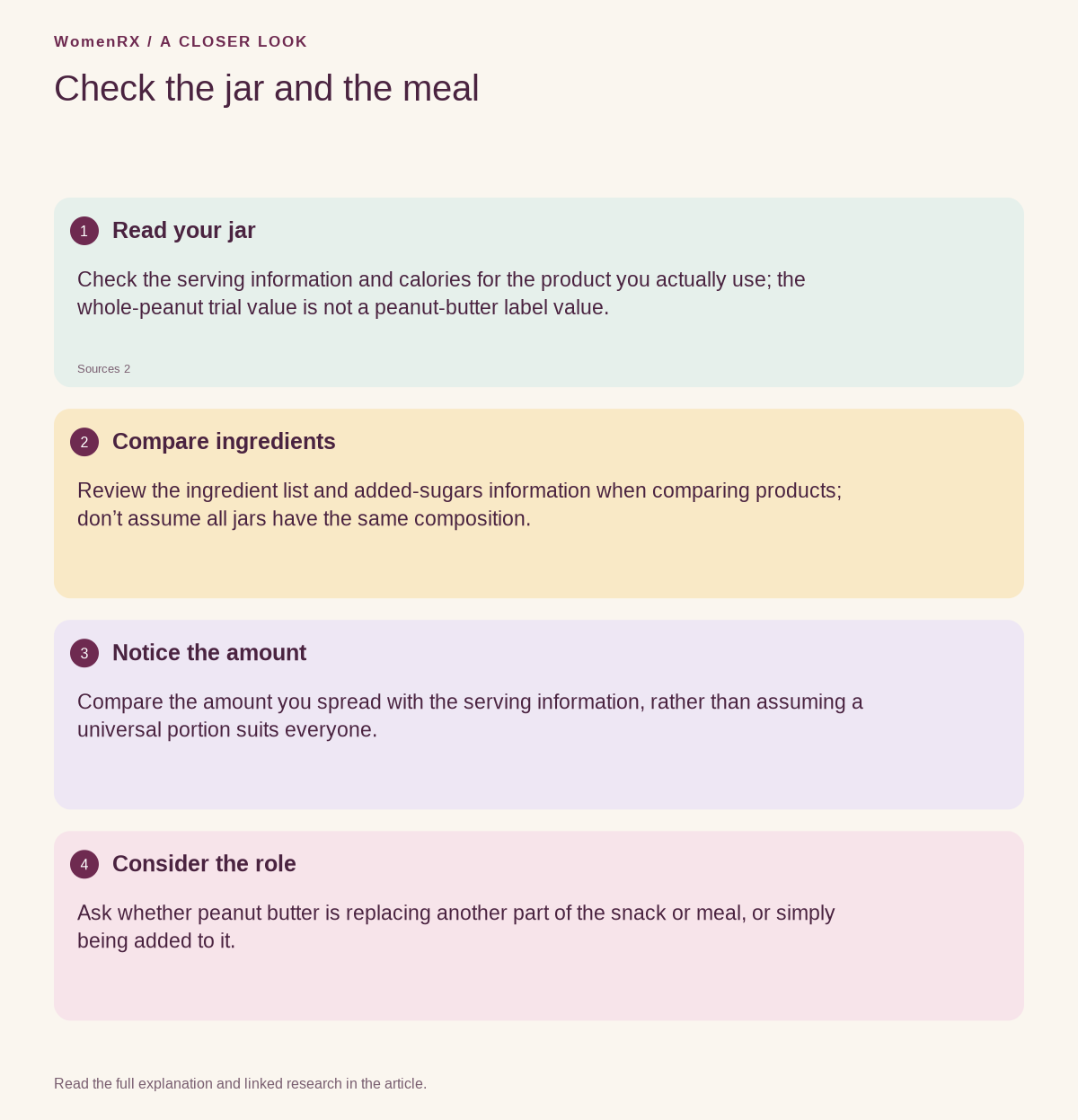
Read your jar: Check the serving information and calories for the product you actually use; the whole-peanut trial value is not a peanut-butter label value.2
Compare ingredients: Review the ingredient list and added-sugars information when comparing products; don’t assume all jars have the same composition.
Notice the amount: Compare the amount you spread with the serving information, rather than assuming a universal portion suits everyone.
Consider the role: Ask whether peanut butter is replacing another part of the snack or meal, or simply being added to it.
Read the figure as text
Use these prompts to assess a particular peanut butter and how you plan to use it, without treating one serving as right for everyone.- Read your jar: Check the serving information and calories for the product you actually use; the whole-peanut trial value is not a peanut-butter label value.2
- Compare ingredients: Review the ingredient list and added-sugars information when comparing products; don’t assume all jars have the same composition.
- Notice the amount: Compare the amount you spread with the serving information, rather than assuming a universal portion suits everyone.
- Consider the role: Ask whether peanut butter is replacing another part of the snack or meal, or simply being added to it.
More questions, answered
Does the research show a different weight effect for women?
The available women-only trial tested a single snack of whole peanuts versus Greek yogurt and measured short-term appetite responses, not lasting weight change. The broader review of nut-containing diets did not report sex-specific results in its abstract. 1 2
Sources you can check
- Effects of energy-restricted diets with or without nuts on weight, body composition and glycaemic control in adults: a scoping review.Mead LC, Hill AM, Carter S, Coates AM. · Nutrition research reviews · 2025Return to first citation
- Exploring the effects of high protein versus high fat snacks on satiety, gut hormones and insulin secretion in women with overweight and obesity: A randomized clinical trial.Al-Bayyari N, Alhameedy M, Omoush R, Ghazzawi H. · Obesity pillars · 2025Return to first citation