Pistachios as a Snack: What Weight Studies Show
Pistachios can fit into a weight-management eating pattern, but the trials show a possible satisfying snack, not a food that causes weight loss.
In a 12-week trial, healthy premenopausal women who ate pistachios daily reported less hunger and greater satiety, while their body weight stayed unchanged. That’s encouraging for pistachios as a snack, but it doesn’t show they cause weight loss. The trial abstract doesn’t report a comparison of in-shell and shelled pistachios, so it can’t tell us whether one form affects intake or weight differently. 1
Pistachios can be a reasonable snack choice if you enjoy them and account for the portion you eat. In the pistachio-specific trial discussed here, women felt more satisfied after a daily snack, but did not lose weight. A separate small trial compared pretzels with a mixture of nuts rather than pistachios alone. 1 2
What the pistachio trial found
In a 12-week randomized trial, 60 healthy premenopausal women who did not usually eat nuts were assigned either to keep their usual habits or to add 44 grams of pistachios, about 250 calories, mid-morning each day. The pistachio group reported less hunger and greater satiety after the snack. In test sessions, participants also adjusted what they ate later, mostly by eating less carbohydrate and starch. Body weight and body composition did not change in either group over the 12 weeks. 1
That makes pistachios a plausible snack for someone who finds them satisfying, not a weight-loss treatment. The study was small and involved healthy premenopausal women who were not regular nut eaters. It doesn’t establish the same response for women in other life stages, or show that everyone will naturally eat less later after having pistachios. 1
How they compare with pretzels
A separate 16-week randomized trial assigned 29 adults with overweight or obesity to eat either 42.5 grams of mixed nuts or 69 grams of pretzels each day. Both snacks provided about 253 calories. The nut mixture included several kinds of nuts, but only 5 grams were pistachios. Participants eating the mixture had lower body-fat percentage than those eating pretzels, but there was no significant difference in body weight or BMI. Because pistachios were only one small part of the mixture, this result can’t tell us whether pistachios themselves made a difference. 2
The practical comparison is less dramatic than a simple “nuts beat pretzels” message: equal-calorie portions of two different snacks did not produce a detectable body-weight difference in this small trial. A satisfying snack may suit your preferences, but these results don’t show that swapping pretzels for pistachios will make you lose weight. 2
In-shell or shelled: compare the edible portion
The pistachio trial abstract doesn’t report whether researchers compared in-shell with shelled pistachios. The findings therefore can’t tell us whether shell presentation changes how much people eat or affects weight. 1
The two forms look different when served: in-shell pistachios include shells that aren’t eaten, while shelled pistachios are already separated into kernels. When comparing portions, check whether the package’s serving information refers to edible kernels or the product as sold. Whichever form you buy, putting your intended portion in a bowl can make it easier to see what you’ve served than eating from a large container. That’s a portion-planning habit, not a proven shell effect.
A useful way to decide
Try pistachios if you like them and they make a snack feel satisfying. If you’re comparing them with another snack, look at the portions you’d actually eat and how well each fits into the rest of your day. The research supports a possible satiety benefit in one group of women, while leaving the bigger question of long-term weight change unanswered. 1
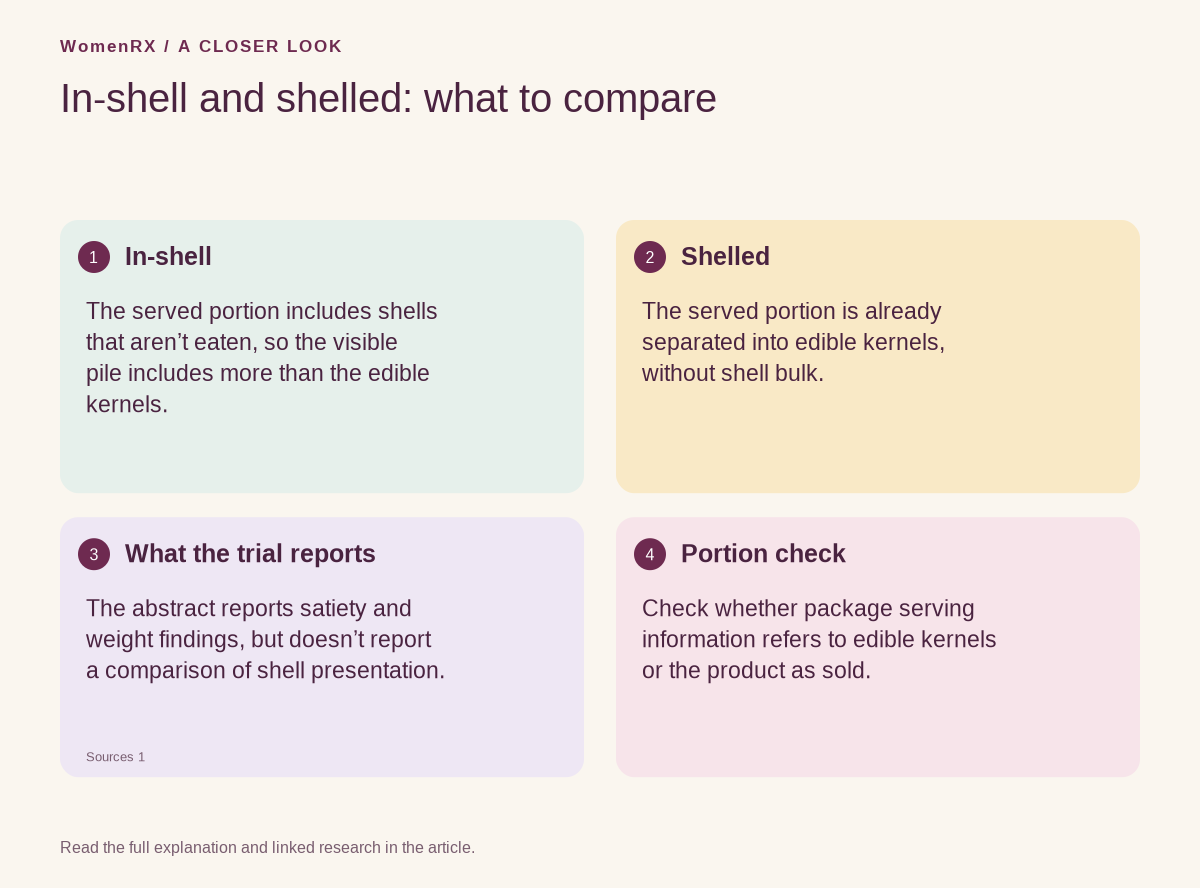
In-shell and shelled: what to compare
In-shell: The served portion includes shells that aren’t eaten, so the visible pile includes more than the edible kernels.
Shelled: The served portion is already separated into edible kernels, without shell bulk.
What the trial reports: The abstract reports satiety and weight findings, but doesn’t report a comparison of shell presentation.1
Portion check: Check whether package serving information refers to edible kernels or the product as sold.
Read the figure as text
See how the two serving forms differ visually, and what the cited pistachio trial can and cannot tell you about their effects on intake or weight.- In-shell: The served portion includes shells that aren’t eaten, so the visible pile includes more than the edible kernels.
- Shelled: The served portion is already separated into edible kernels, without shell bulk.
- What the trial reports: The abstract reports satiety and weight findings, but doesn’t report a comparison of shell presentation.1
- Portion check: Check whether package serving information refers to edible kernels or the product as sold.
Sources you can check
- Daily consumption of pistachios over 12 weeks improves dietary profile without increasing body weight in healthy women: A randomized controlled intervention.Fantino M, Bichard C, Mistretta F, Bellisle F. · Appetite · 2020Return to first citation
- Effects of mixed nut consumption on LDL cholesterol, lipoprotein(a), and other cardiometabolic risk factors in overweight and obese adults.Nora CL, Zhang L, Castro RJ, Marx A, Carman HB, Lum T, Tsimikas S, Hong MY. · Nutrition, metabolism, and cardiovascular diseases : NMCD · 2023Return to first citation