Pistachios: What a Serving Provides and How to Choose
An ounce of dry-roasted, unsalted pistachio kernels provides protein and fiber, while the sodium in salted versions is worth checking on the label.
A one-ounce portion of dry-roasted pistachio kernels without added salt provides about 162 calories, 6 grams of protein, 3 grams of fiber and 13 grams of fat. That’s an edible-kernel weight, not an ounce of nuts with shells. Roasting alone doesn’t tell you whether salt was added, so compare sodium on the package when choosing between products. 72
What an ounce actually provides
If you’re deciding whether pistachios work as an afternoon snack, start with the part you eat. The USDA’s reference portion is one ounce (28.35 grams) of dry-roasted pistachio kernels without added salt. It provides about 162 calories, 6 grams of protein, 2.9 grams of fiber, 13 grams of fat and 8 grams of carbohydrate. Its sodium estimate is about 2 milligrams. These are food-composition estimates, not a promise about every package. 7
The distinction between kernels and in-shell pistachios matters when you portion them. An ounce of nuts weighed with their shells isn’t the same as an ounce of edible kernels. If you buy them in-shell, use the package’s serving information rather than applying the USDA kernel figures to the weight of the whole snack. 7
That serving gives you both protein and fiber, but it also contributes energy. You don’t need to treat the calorie number as a reason to avoid pistachios. It’s useful context for deciding whether the portion fits what you want from a snack, rather than assuming that more will be more satisfying.
Salted, unsalted and roasted: read the two descriptions separately
“Dry-roasted” describes the pistachios in the USDA reference entry; “without salt added” is a separate part of that description. So a roasted label, by itself, isn’t the answer to whether you’re buying a lower-sodium snack. The USDA figures above apply specifically to dry-roasted kernels without added salt, not to every roasted or salted product. 7
For a practical comparison, look at the sodium listed for the same serving size on the packages you’re considering. If you’re watching sodium, that number is more useful than the front-of-package wording alone. Most people in the US get more sodium than they need, and MedlinePlus recommends using food labels to compare it. 2
For example, if you like the flavor of salted pistachios, compare their label with an unsalted option you’d also enjoy. You can make the choice based on the actual difference between those products instead of assuming that all roasted pistachios have similar sodium.
What the snack studies can and can’t tell you
There is some direct evidence in women, though it studied a larger snack than the one-ounce reference portion. In a 12-week randomized trial, 30 healthy premenopausal women who didn’t usually eat nuts added 44 grams of pistachios, reported as 250 calories, as a mid-morning snack. Another 30 women continued their usual eating habits. The pistachio group reported less hunger and greater satiety after the snack, and their later food intake adjusted. Body weight and body composition were unchanged in both groups over the 12 weeks. That supports pistachios as a potentially satisfying snack in this setting, not as a weight-loss method. 3
A broader review of adult studies found that people sometimes ate less later after eating nuts, but the degree of compensation varied with the nut’s form and how it was eaten. The review included several types of nuts, not just pistachios, and found no clear evidence that increased resting energy expenditure explained the weight findings. In everyday terms, a filling snack may change what you eat next, but you can’t count on it canceling out its calories. 4
Pistachios have also been studied for blood pressure, blood sugar and blood-lipid measures. A review of 11 randomized trials involving 506 participants found improvements in some of those risk markers with pistachio-enriched diets compared with controls. Results varied substantially across trials for several measures, and the review did not establish that eating pistachios prevents heart disease. It also did not report a women-specific result. 5 A larger review of tree-nut trials found changes in some cholesterol measures but was not evidence that pistachios have a unique effect for women. 6
The useful takeaway is modest: pistachios can be a protein- and fiber-containing snack, and one trial found greater fullness after a daily pistachio snack in healthy premenopausal women. Neither finding makes them a treatment for weight or heart risk, and these studies don’t establish hormone or reproductive benefits. 735
If you’re allergic to pistachios, avoid them and check ingredient labels. If you have an allergy to another nut, follow the guidance for your own allergy rather than assuming all nut allergies are identical. 1
Choosing a pistachio snack
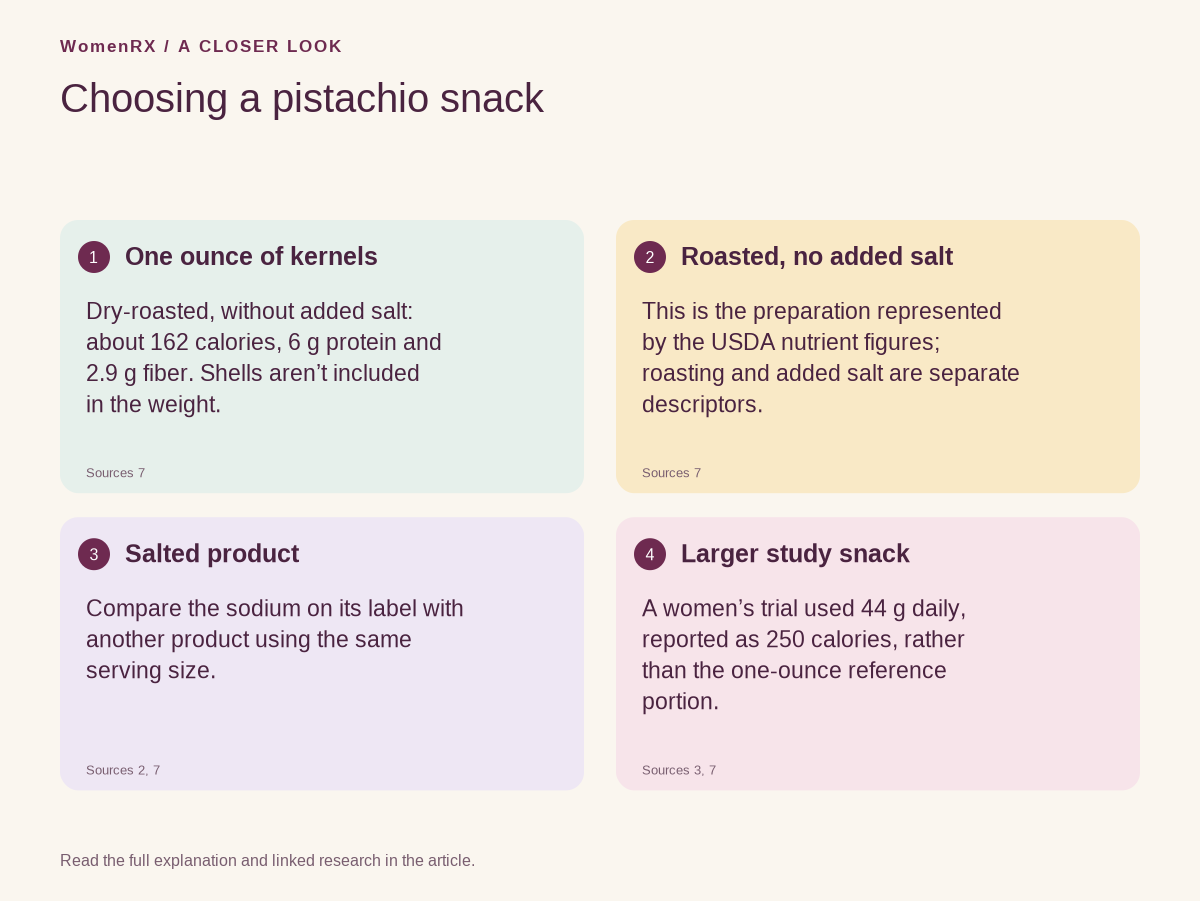
One ounce of kernels: Dry-roasted, without added salt: about 162 calories, 6 g protein and 2.9 g fiber. Shells aren’t included in the weight.7
Roasted, no added salt: This is the preparation represented by the USDA nutrient figures; roasting and added salt are separate descriptors.7
Salted product: Compare the sodium on its label with another product using the same serving size.27
Larger study snack: A women’s trial used 44 g daily, reported as 250 calories, rather than the one-ounce reference portion.37
Read the figure as text
Keep the edible portion, preparation and study portion distinct when comparing your options.- One ounce of kernels: Dry-roasted, without added salt: about 162 calories, 6 g protein and 2.9 g fiber. Shells aren’t included in the weight.7
- Roasted, no added salt: This is the preparation represented by the USDA nutrient figures; roasting and added salt are separate descriptors.7
- Salted product: Compare the sodium on its label with another product using the same serving size.27
- Larger study snack: A women’s trial used 44 g daily, reported as 250 calories, rather than the one-ounce reference portion.37
Sources you can check
- Food allergy - NHSAccessed 2026-09-25Return to first citation
- Sodium: MedlinePlusAccessed 2026-09-25Return to first citation
- Daily consumption of pistachios over 12 weeks improves dietary profile without increasing body weight in healthy women: A randomized controlled intervention.Fantino M, Bichard C, Mistretta F, Bellisle F. · Appetite · 2020Return to first citation
- The Effects of Tree Nut and Peanut Consumption on Energy Compensation and Energy Expenditure: A Systematic Review and Meta-Analysis.Nikodijevic CJ, Probst YC, Tan SY, Neale EP. · Advances in nutrition (Bethesda, Md.) · 2023Return to first citation
- Pistachios and cardiometabolic risk factors: A systematic review and meta-analysis of randomized controlled clinical trials.Ghanavati M, Rahmani J, Clark CCT, Hosseinabadi SM, Rahimlou M. · Complementary therapies in medicine · 2020Return to first citation
- Effects of tree nuts on blood lipids, apolipoproteins, and blood pressure: systematic review, meta-analysis, and dose-response of 61 controlled intervention trials.Del Gobbo LC, Falk MC, Feldman R, Lewis K, Mozaffarian D. · The American journal of clinical nutrition · 2015Return to first citation
- USDA SR Legacy: Nuts, pistachio nuts, dry roasted, without salt added (FDC 170185)Accessed 2026-09-25Return to first citation