How Much Protein Is in a Serving of Edamame?
A half-cup of prepared edamame offers protein and fiber, making it an easy snack or a useful start to a meal.
A half-cup of prepared frozen edamame provides about 9 grams of protein and 4 grams of fiber, based on USDA food-composition data. A full cup provides roughly twice that amount. For a snack, the half-cup may be enough on its own; for a meal, use it alongside other foods rather than treating it as the whole plate. 73
Count the beans you eat, not the pods
If you’re scooping edamame from a bowl of pods, the portion that matters nutritionally is the beans you eat. The USDA reference for ½ cup of prepared frozen edamame is about 9.2 grams of protein and 4.0 grams of fiber. That’s approximately 94 calories. A full cup of the same prepared beans would provide about 18.4 grams of protein and 8.0 grams of fiber. These are food-composition estimates, not measurements of every bag or restaurant serving. 7
That protein-and-fiber combination is what makes edamame useful as a snack. Protein helps your body maintain muscle and other tissues, while fiber adds bulk and can help you feel full. Neither number tells you exactly how long a snack will satisfy you, but looking at both gives you a better picture than judging it by protein alone. 21
Snack or meal? Let the portion do the talking
A half-cup of beans can stand alone when you want something between meals. If you’re building lunch or dinner, it makes more sense as a component: for example, add edamame to a grain-and-vegetable bowl, or serve it with a salad and another food you enjoy. A full cup contributes more protein and fiber, but a meal also needs to fit your appetite and provide a variety of nutrients. 73
Edamame isn’t a weight-loss treatment. In a review of randomized trials involving postmenopausal women, phytoestrogen supplements showed no overall association with body weight or several measures of body composition. That result doesn’t test whether choosing edamame instead of a different snack changes anyone’s weight. The practical reason to choose it is simpler: you like it, and it contributes protein and fiber to what you’re eating. 67
Fresh, frozen, and ready-to-eat: what changes?
Fresh and frozen edamame are different shopping options, but this USDA nutrient estimate is specifically for frozen, prepared edamame. It doesn’t establish a reliable protein or fiber difference between fresh and frozen beans. Compare the amount of edible beans you’ll actually serve rather than assuming one form is more nutritious. 7
For a seasoned or ready-to-eat product, check its Nutrition Facts label for the listed serving size, protein, fiber, and sodium. The USDA reference lists only about 5 milligrams of sodium per half-cup of prepared edamame; that figure shouldn’t be carried over to a salted or sauced product. Likewise, an edamame beverage isn’t nutritionally interchangeable with whole beans: its ingredients and processing determine what ends up in the glass. 74
If beans tend to leave you bloated, start with a portion that feels comfortable. Increasing fiber quickly can cause gas, bloating, or cramps. 1
What about soy and women’s health?
Edamame is a soy food, not a concentrated soy supplement. That distinction matters when you hear claims about hormones. A 2025 review pooled randomized trials of soy isoflavones from foods or supplements in postmenopausal women. Across four measured outcomes, including estradiol and endometrial thickness, it found no statistically significant effect compared with non-isoflavone controls. It did not test whether a serving of edamame changes hormones in cycling women, during pregnancy, or after childbirth. 85
Research on soy products and menopausal hot flashes suggests any benefit from soy protein or isoflavone supplements may be small, and findings haven’t been consistent. That’s not a reason to eat edamame expecting it to treat hot flashes. Nor does its soy content establish that it prevents breast cancer: findings about soy and breast health vary by product and population. 8
During pregnancy or breastfeeding, ordinary soy foods and concentrated or unusually large amounts of soy aren’t the same question. NCCIH notes uncertainty about amounts greater than those commonly found in foods, particularly while breastfeeding. And if you have a soy allergy, edamame is soy; packaged foods in the US must identify soy on the label. 8
For an everyday decision, keep the focus on the food in front of you: measure the edible beans, use the package label for prepared versions, and decide whether that portion fits better as your snack or as part of a fuller meal.
Edamame portions and product labels
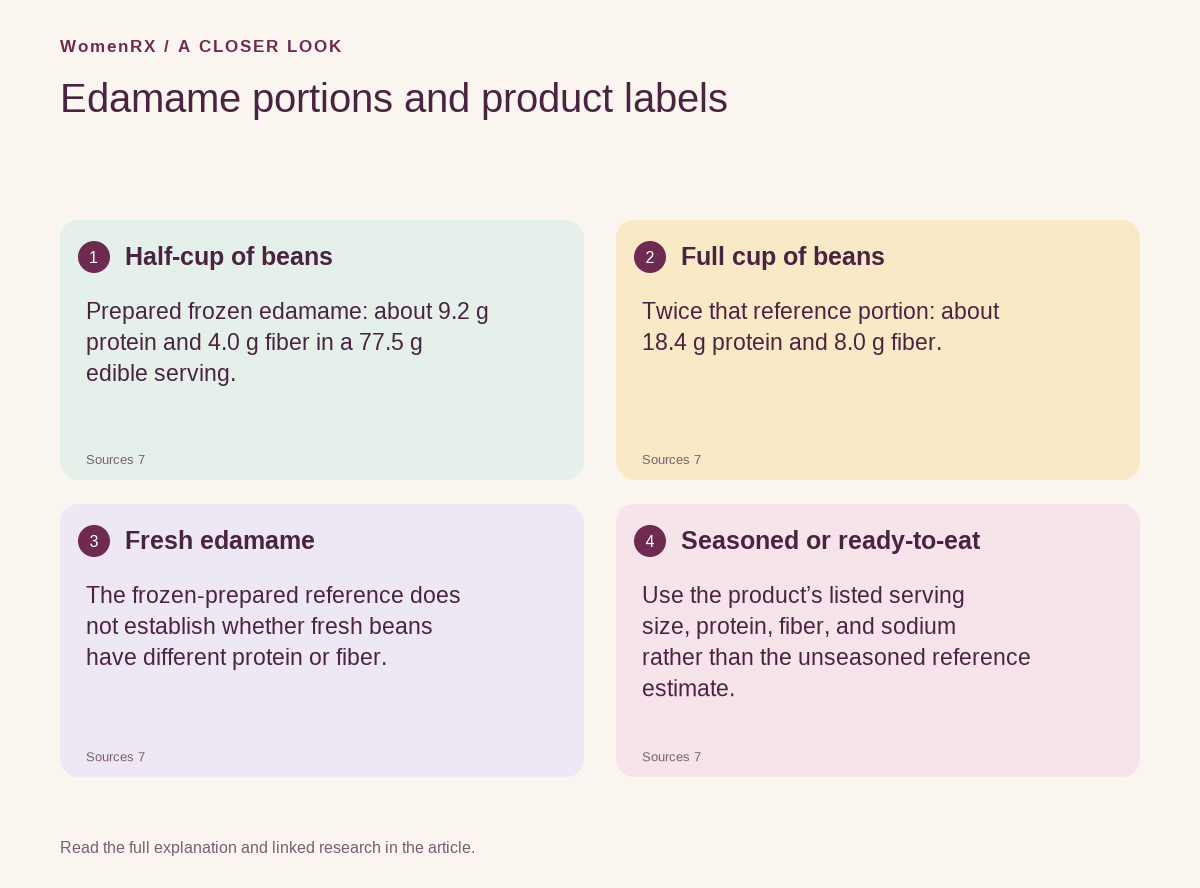
Half-cup of beans: Prepared frozen edamame: about 9.2 g protein and 4.0 g fiber in a 77.5 g edible serving.7
Full cup of beans: Twice that reference portion: about 18.4 g protein and 8.0 g fiber.7
Fresh edamame: The frozen-prepared reference does not establish whether fresh beans have different protein or fiber.7
Seasoned or ready-to-eat: Use the product’s listed serving size, protein, fiber, and sodium rather than the unseasoned reference estimate.7
Read the figure as text
A serving estimate is useful only when it matches the beans and product you’re eating.- Half-cup of beans: Prepared frozen edamame: about 9.2 g protein and 4.0 g fiber in a 77.5 g edible serving.7
- Full cup of beans: Twice that reference portion: about 18.4 g protein and 8.0 g fiber.7
- Fresh edamame: The frozen-prepared reference does not establish whether fresh beans have different protein or fiber.7
- Seasoned or ready-to-eat: Use the product’s listed serving size, protein, fiber, and sodium rather than the unseasoned reference estimate.7
Sources you can check
- Dietary Fiber: MedlinePlusAccessed 2026-09-25Return to first citation
- Dietary Proteins: MedlinePlusAccessed 2026-09-25Return to first citation
- Nutrition: MedlinePlusAccessed 2026-09-25Return to first citation
- Co-Formulation of Edamame-Based Beverage with Coconut Derivatives Enhances Nutritional Quality, Antioxidant Capacity, Flavor Profile, and Physical Stability.Klinmalai P, Promhuad K, Srisa A, Sathawarintu A, Harnkarnsujarit N. · Foods (Basel, Switzerland) · 2025Return to first citation
- Effect of Soy Isoflavones on Measures of Estrogenicity: A Systematic Review and Meta-Analysis of Randomized Controlled Trials.Viscardi G, Back S, Ahmed A, Yang S, Mejia SB, Zurbau A, Khan TA, Selk A, Messina M, Kendall CW, Jenkins DJ, Sievenpiper JL, Chiavaroli L. · Advances in nutrition (Bethesda, Md.) · 2025Return to first citation
- Phytoestrogen supplementation and body composition in postmenopausal women: A systematic review and meta-analysis of randomized controlled trials.Glisic M, Kastrati N, Musa J, Milic J, Asllanaj E, Portilla Fernandez E, Nano J, Ochoa Rosales C, Amiri M, Kraja B, Bano A, Bramer WM, Roks AJM, Danser AHJ, Franco OH, Muka T. · Maturitas · 2018Return to first citation
- USDA SR Legacy: Edamame, frozen, prepared (FDC 168411)Accessed 2026-09-25Return to first citation
- Soy: Usefulness and Safety | NCCIHAccessed 2026-09-25Return to first citation