What to Eat After a Workout for Recovery
For most workouts, a meal with protein, carbohydrate, and something to drink is more useful than a specialized recovery product.
After training, eat a meal or snack with protein to support muscle repair and carbohydrate to help replace the fuel you used. Drink enough to replace fluids, especially after a long or hot session. You don’t need to race a clock or buy a recovery shake after every workout. How much attention recovery food needs depends on how hard and how often you train. 2
Match the meal to the workout
A walk, a strength session, and a long run don’t create identical demands. Protein supplies the amino acids your body uses to maintain and repair muscle. Carbohydrate helps replace muscle glycogen, a stored fuel used during exercise. Fluids matter too. For a shorter, less demanding workout, your next ordinary meal may cover all three jobs. If you’ve trained for a long time, exercised in heat, or have another demanding session ahead, food and fluids deserve more deliberate attention. 12
For example, after lifting before lunch, you might have a bean-and-rice bowl, or a sandwich with eggs and fruit. After an evening workout, dinner could be fish or tofu with potatoes and vegetables, plus a drink. Those are meal ideas, not foods proven to eliminate soreness. Meat, seafood, eggs, dairy, beans, and nuts are among the everyday sources of protein described by the NIH Office of Dietary Supplements. 2
Protein helps adaptation, but the clock has some give
Exercise stimulates muscle-protein synthesis, the process of building muscle protein, and dietary protein provides the amino acids that process needs. Sports-nutrition guidance summarized by the NIH recommends protein soon after exercise for athletes seeking to maximize training adaptations. Yet a meta-analysis discussed in that same reference did not find that taking protein within an hour before or after exercise significantly improved muscle strength or size. The opportunity to support muscle remodeling extends well beyond a brief post-workout window. 2
The practical takeaway: if you’re hungry after training, eat. If you had a protein-containing meal before your workout and dinner is coming later, you don’t need to interrupt your day for an emergency shake. Look at whether you’re getting enough protein across your meals, rather than treating one snack as the deciding factor. Protein needs vary with age, health, and activity level. 12
A supplement can be convenient when a meal isn’t practical or an athlete has trouble meeting higher protein needs with food. It isn’t automatically better than food. In a randomized trial of 27 healthy adults eating a controlled diet, additional whey or another protein supplement after damaging leg exercise did not significantly improve measured muscle-protein synthesis, strength recovery, or soreness compared with an isocaloric carbohydrate supplement over three days. That specific trial doesn’t mean extra protein never helps; it does show why a shake shouldn’t be treated as a guaranteed recovery fix. 25
Think about carbohydrate and fluids when training is demanding
Carbohydrate matters most to your immediate plan when you’ve used substantial fuel or need to perform again soon. Athletes need enough carbohydrate across the day to maintain blood glucose and replace muscle glycogen. A meal containing grains, potatoes, fruit, or beans alongside a protein food can address both fuel and muscle-repair needs without a dedicated recovery product. 2
For a routine workout, drink with your meal and pay attention to how much you drank and sweated during training. Longer endurance activity or exercise in hot conditions can call for more attention to replacing fluids, electrolytes, and carbohydrate. That’s a different situation from assuming every gym visit requires a sports drink. 2
Soreness is a different question
Feeling less sore, regaining strength, and increasing muscle-protein synthesis are different outcomes. A food or supplement can affect one without clearly improving the others. In the 27-person protein trial, soreness and strength declined or rose after the strenuous exercise as expected, but extra protein did not significantly change either recovery measure compared with carbohydrate. Another randomized trial in 33 recreationally active adults found only a modest recovery signal from supplemental protein: jump height favored one protein group at a later measurement, while the other measured outcomes showed no significant differences between groups. 56
Tart cherry products are often promoted specifically for soreness. A 2026 review of trials in healthy adults found that 7 of 14 studies reported improved post-exercise strength recovery, while 6 of 22 reported reduced delayed-onset soreness. The trials varied and were often small. Enjoy cherries if you like them, but the evidence doesn’t make tart cherry juice a necessary part of your routine or a reliable way to avoid next-day aches. 4
What changes for women and with age?
The food-first principles apply to women, but don’t mistake a general sports-nutrition recommendation for a result tested equally across women’s life stages. The NIH notes that much exercise-supplement research involves young adults, more often men than women. The two protein recovery trials above included healthy or recreationally active adults, but their reported results don’t establish separate effects for women, older adults, or people in perimenopause or postmenopause. 256
In older adulthood, maintaining muscle strength has a practical purpose: it can help with everyday tasks such as getting out of a chair. Strength-building activity remains worthwhile, and eating enough protein remains part of supporting muscle maintenance. Neither point means an older woman needs a special post-workout product or that either short trial identifies her ideal recovery meal. 123
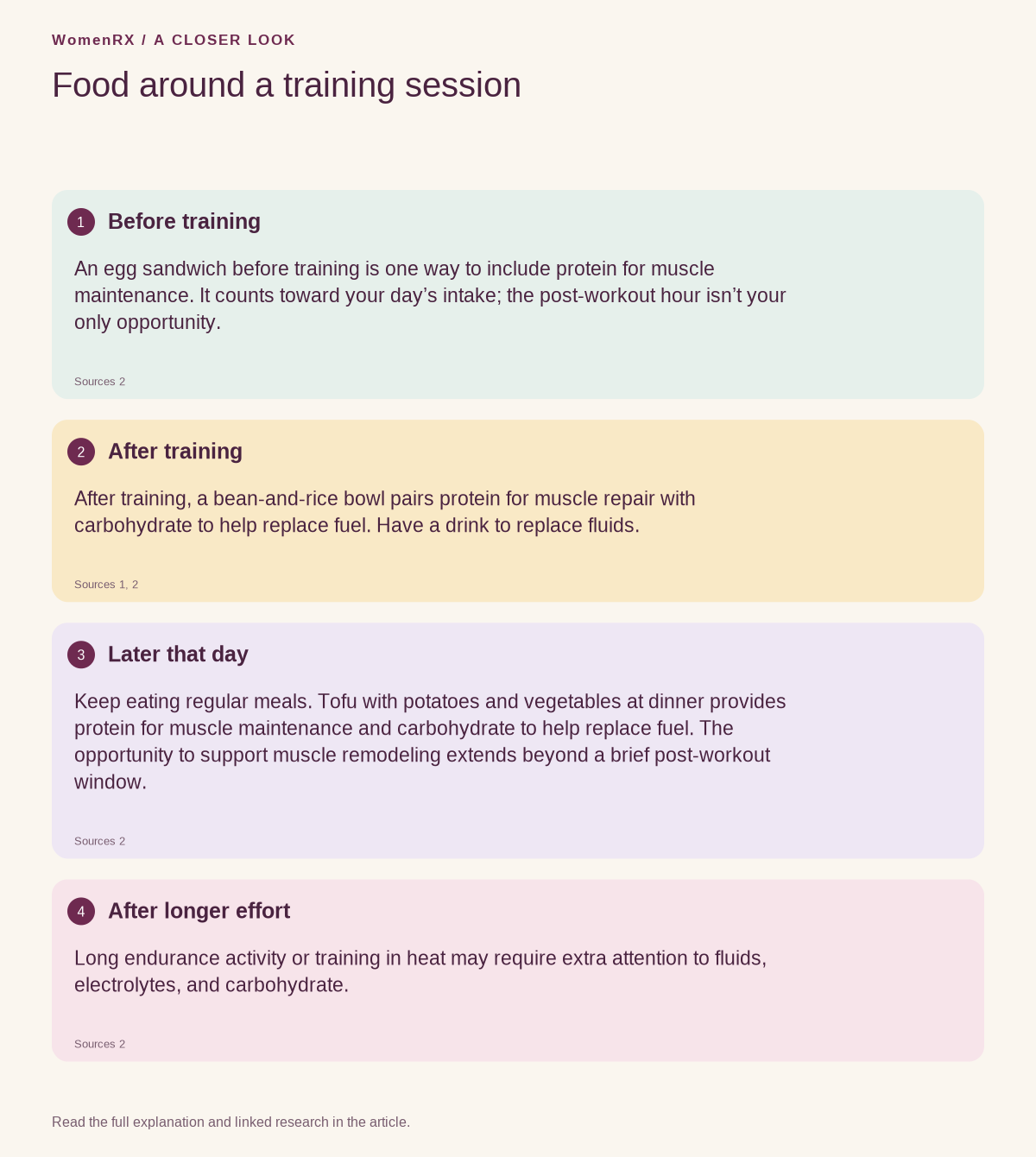
Food around a training session
Before training: An egg sandwich before training is one way to include protein for muscle maintenance. It counts toward your day’s intake; the post-workout hour isn’t your only opportunity.2
After training: After training, a bean-and-rice bowl pairs protein for muscle repair with carbohydrate to help replace fuel. Have a drink to replace fluids.12
Later that day: Keep eating regular meals. Tofu with potatoes and vegetables at dinner provides protein for muscle maintenance and carbohydrate to help replace fuel. The opportunity to support muscle remodeling extends beyond a brief post-workout window.2
After longer effort: Long endurance activity or training in heat may require extra attention to fluids, electrolytes, and carbohydrate.2
Read the figure as text
Use the sequence to plan an ordinary meal, not as a deadline for buying or taking a product.- Before training: An egg sandwich before training is one way to include protein for muscle maintenance. It counts toward your day’s intake; the post-workout hour isn’t your only opportunity.2
- After training: After training, a bean-and-rice bowl pairs protein for muscle repair with carbohydrate to help replace fuel. Have a drink to replace fluids.12
- Later that day: Keep eating regular meals. Tofu with potatoes and vegetables at dinner provides protein for muscle maintenance and carbohydrate to help replace fuel. The opportunity to support muscle remodeling extends beyond a brief post-workout window.2
- After longer effort: Long endurance activity or training in heat may require extra attention to fluids, electrolytes, and carbohydrate.2
More questions, answered
Do I need a protein shake after every strength workout?
No. Protein-containing foods can supply the amino acids used in muscle repair, and a supplement is mainly a convenience when meeting your needs through meals is difficult. Taking protein immediately after a workout has not consistently improved longer-term strength or size compared with other timing. 12
Sources you can check
- Dietary Proteins: MedlinePlusAccessed 2026-09-25Return to first citation
- Dietary Supplements for Exercise and Athletic Performance - Health Professional Fact SheetAccessed 2026-09-25Return to first citation
- Benefits of Exercise: MedlinePlusAccessed 2026-09-25Return to first citation
- The effect of Montmorency tart cherry consumption on athletic performance and post-exercise recovery in healthy adults: a scoping review.Zhu Y, Smith J, Cohn A. · Frontiers in nutrition · 2026Return to first citation
- Muscle Recovery and Myofibrillar Protein Synthesis after Damaging Exercise with Recombinant Bovine β-Lactoglobulin, Dairy-Derived Whey or Carbohydrate Supplementation in Young Healthy Adults.Rogers LM, Korzepa M, Belfield AE, Quinlan JI, Wallis GA, Breen L. · The Journal of nutrition · 2026Return to first citation
- Investigating the Effects of a Novel Salmon-Derived Protein Peptide on Markers of Recovery From Exercise-Induced Muscle Damage.Haigney E, Waddell A, Korzepa M, Belfield AE, Liaset B, Breen L. · International journal of sport nutrition and exercise metabolism · 2026Return to first citation