Can Diet Help With Brain Fog? What to Check
Food can support health, but the diet research doesn’t show that a particular meal or supplement clears a spell of brain fog.
A balanced eating pattern may support cognitive health over time, but that’s different from proving that food treats today’s concentration problems. Check when the trouble began and what changed alongside it, including heavy periods, usual eating and drinking, sleep, and medicines. Iron deficiency can affect concentration; heavy bleeding is one reason to discuss iron status, rather than starting a supplement on guesswork. 2 3
Diet research is not a brain-fog treatment test
“Brain fog” can describe losing your train of thought, struggling to focus, or feeling slower than usual. Studies of diet and cognition often measure test performance or longer-term outcomes. Those aren’t the same as testing whether a food clears a current spell of brain fog.
For example, a cross-sectional study of 102 middle-aged women with a family history of Alzheimer’s disease found that higher diet-quality scores were associated with better executive-function scores among women without an APOE-ε4 variant. It can’t establish that diet caused the difference, and the result doesn’t show that changing what you eat will relieve current concentration problems. 5
A much larger prospective study followed women and men and found associations between higher Mediterranean- and MIND-style diet scores and lower dementia risk, as well as other cognitive outcomes. These findings concern longer-term outcomes, not a quick fix for brain fog; the abstract reports combined results rather than a women-specific effect. 6
So, it’s reasonable to aim for a varied diet, but there’s no “brain-fog food” established by these findings. The women’s study assessed overall diet quality and included foods such as vegetables, fruit, whole grains, and lean proteins in its description of a high-quality pattern. It didn’t test any one food as a treatment. 5
Check for a nutrient issue, not a magic ingredient
Iron is one practical question to raise if concentration problems come with fatigue or weakness, or if you have heavy periods. Iron-deficiency anemia can involve difficulty concentrating, and heavy periods are a known reason to be more likely to have low iron. 2 3
Iron comes from animal foods such as meat and seafood, and from plant foods and fortified grains, including beans, nuts, and vegetables. That makes your usual eating pattern relevant, but food choices alone can’t establish whether you’re iron deficient. Iron status can require more than one blood measure to assess. 2
If you have heavy bleeding, describe what it’s like. Needing to change a pad or tampon every one to two hours is one sign NHS guidance gives for heavy periods. A symptom diary can also help show whether concerns follow a cycle pattern. 1
Vitamin B12 supports nervous-system function and is naturally present in some foods or added to others. If your diet is restricted, your usual sources may be useful context to mention. This research doesn’t establish B12 supplements as a general treatment for brain fog. 4
Don’t take iron just because you feel foggy. Too much can be harmful, and assessment can help determine whether low iron is actually part of the picture. 2 3
Look at timing and what changed around it
Try to make the problem specific: Did it begin suddenly or gradually? Is it brief, recurring, or there most days? Does it seem to cluster around your cycle, or did it start around the same time as a change in medicines, sleep, eating, or drinking? These observations don’t identify a cause, but they can make a conversation about next steps more useful.
If the pattern seems linked to your cycle, noting when symptoms occur may help you describe it. Pregnancy, postpartum changes, menopause symptoms, and heavy bleeding can also be relevant context to share, but they shouldn’t automatically be treated as the explanation for new concentration problems. NHS guidance suggests keeping a symptom diary for period problems. 1
Sleep and hydration are worth reviewing as part of what changed, too. The diet studies discussed above don’t test whether drinking more water or changing sleep clears subjective brain fog, so treat these as context to review, not proven fixes.
When food isn’t the next step
If concentration problems are new, persist, keep returning, or interfere with daily life, arrange a medical assessment rather than waiting to see whether a diet change solves them. Bring the timeline and mention heavy bleeding, dietary restrictions, relevant life-stage changes, and medication changes. A clinician can decide whether checking iron or B12 status makes sense for you; iron assessment may involve more than one measure. 2 4
The useful goal isn’t to find a perfect menu before seeking help. It’s to separate broad, long-term diet-and-cognition findings from a current problem that may need a closer look.
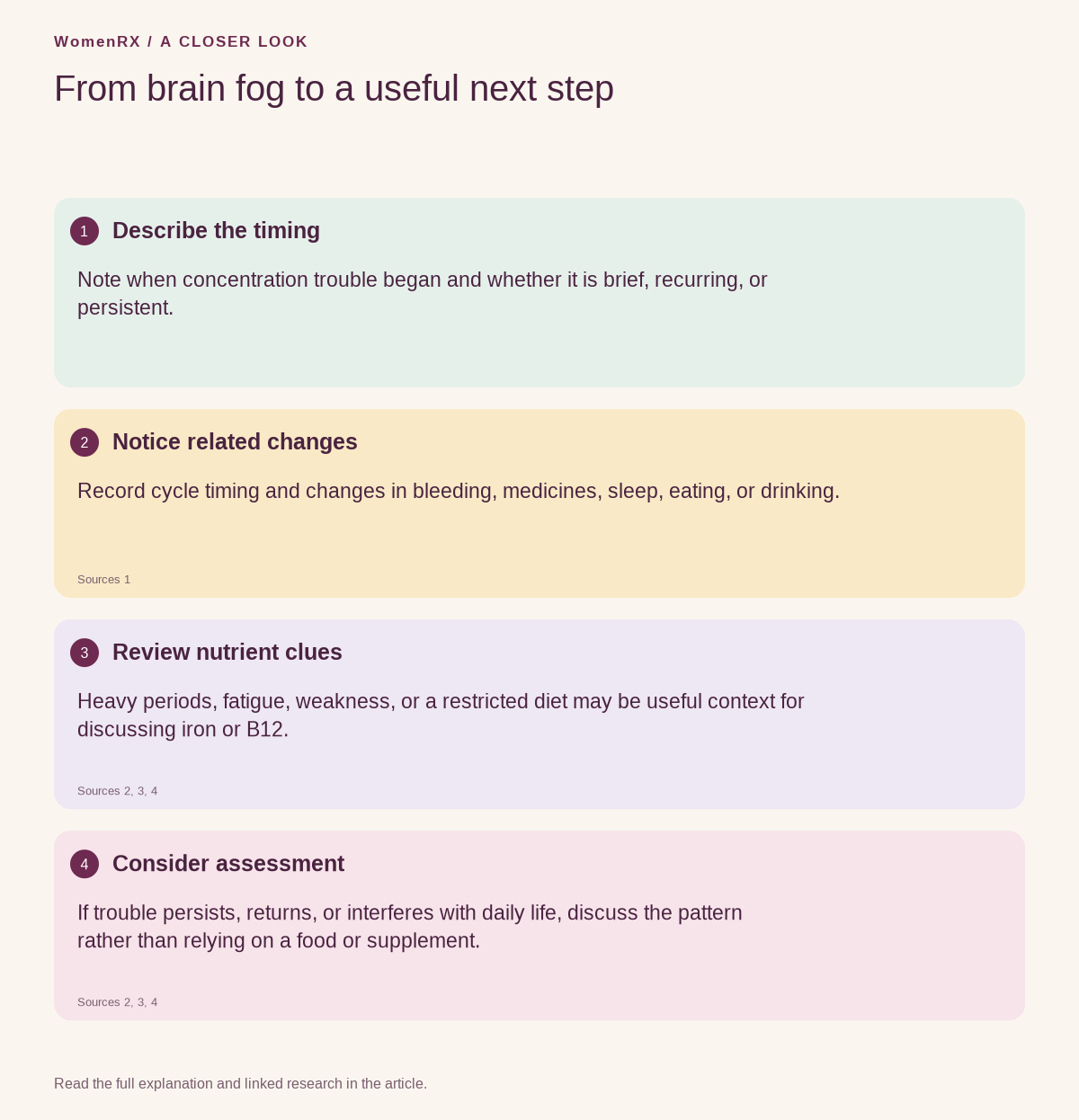
From brain fog to a useful next step
Describe the timing: Note when concentration trouble began and whether it is brief, recurring, or persistent.
Notice related changes: Record cycle timing and changes in bleeding, medicines, sleep, eating, or drinking.1
Review nutrient clues: Heavy periods, fatigue, weakness, or a restricted diet may be useful context for discussing iron or B12.234
Consider assessment: If trouble persists, returns, or interferes with daily life, discuss the pattern rather than relying on a food or supplement.234
Read the figure as text
This flow organizes timing and practical nutrition questions without treating them as a diagnosis.- Describe the timing: Note when concentration trouble began and whether it is brief, recurring, or persistent.
- Notice related changes: Record cycle timing and changes in bleeding, medicines, sleep, eating, or drinking.1
- Review nutrient clues: Heavy periods, fatigue, weakness, or a restricted diet may be useful context for discussing iron or B12.234
- Consider assessment: If trouble persists, returns, or interferes with daily life, discuss the pattern rather than relying on a food or supplement.234
More questions, answered
Should I take iron for brain fog?
Not just because you feel foggy. Low iron can be associated with difficulty concentrating, but excess iron can be harmful. Heavy periods or fatigue are useful details to discuss when deciding whether iron status should be assessed. 2 3
Sources you can check
- Period problems - NHSAccessed 2026-09-25Return to first citation
- Iron - Health Professional Fact SheetAccessed 2026-09-25Return to first citation
- Iron: MedlinePlusAccessed 2026-09-25Return to first citation
- Vitamin B12 - Health Professional Fact SheetAccessed 2026-09-25Return to first citation
- APOE-ε4 moderates the association between diet quality and executive function in middle-aged women at increased risk for Alzheimer's disease.Wessinger CM, Park KS, DuBois SL, Wideman L, Armstrong BD, Vance JC, Kibildis SW, Som-Pimpong H, Etnier JL. · Journal of nutritional science · 2026Return to first citation
- Long-term adherence and changes in the Mediterranean and MIND diets in relation to dementia risk and cognitive function.Liu Y, Li Y, Li Y, Zhang Y, Wang Y, Gu X, Yue Y, Kang JH, Eliassen AH, Rimm EB, Wang M, Willett WC, Hu FB, Stampfer MJ, Wang DD. · Alzheimer's & dementia : the journal of the Alzheimer's Association · 2026Return to first citation