Menopause Brain Fog: What Can Supplements Actually Do?
A few supplements have shown tentative results in menopause studies, but a reported improvement in brain fog isn’t the same as better performance on a memory test.
No supplement has convincing evidence that it reliably clears menopause-related brain fog. Reviews of trials in menopausal women report possible cognitive benefits for soy-related products and ginkgo, but the evidence has substantial weaknesses. One review found a reduction in reported cognitive symptoms in a single red-clover trial. Omega-3, creatine, and extra B12 aren’t established fixes for this concern. 4 5 3
If you’ve lost your train of thought halfway through a sentence, you may want something that helps you feel sharper. The first question to ask of a supplement claim is simple: did people feel less foggy, or did they perform differently on a cognitive task? Those are useful but different answers.
Feeling foggy and testing memory are different questions
“Brain fog” can mean difficulty concentrating, feeling mentally slow, or noticing everyday lapses. A cognitive test, by contrast, asks someone to complete a defined task. An improvement in reported symptoms tells you about that person’s experience; it doesn’t automatically establish improved test performance.
That distinction matters when reading menopause research. One review examined supplements and cognition in postmenopausal women. Another examined trials during the menopausal transition and early postmenopause that measured hot flashes alongside other symptoms, including cognitive symptoms. Their conclusions shouldn’t be treated as a single, interchangeable measure of brain fog. 4 5
Where the menopause supplement findings stand
A systematic review of 12 randomized trials in postmenopausal women found that five suggested possible cognitive benefits from isoflavones, soy, or ginkgo. Most of the trials had serious methodological flaws, however, and the reviewers concluded that the evidence for a cognitive benefit wasn’t compelling. The finding is tentative, not a reason to expect a particular product to improve your concentration. 4
A separate review looked at trials during the menopausal transition and early postmenopause. Only one trial in that review found a significant reduction in cognitive symptoms, with a red-clover isoflavone preparation. The reviewers called for larger studies and better measurement of outcomes. That symptom finding doesn’t establish that red clover improves performance on memory tests. 5
What about the other supplements you may see advertised for brain health?
- Omega-3 fatty acids: Fish oil and other products contain different omega-3s, and their formulations vary. That makes “omega-3” a broad label, not one uniform product. The menopause-focused findings described above don’t establish that an omega-3 supplement clears brain fog. 1 4 5
- Creatine: Its popularity for other purposes doesn’t establish a menopause-specific cognitive benefit. The findings in these menopause-focused reviews don’t provide a basis for recommending it for brain fog. 4 5
- Vitamin B12: B12 is needed for normal nervous-system function. That biological role is a reason to take possible inadequacy seriously, not evidence that taking extra B12 will sharpen thinking when your B12 status is adequate. 3
Don’t let the timing settle the cause
Concentration changes may show up around the same time as other changes in your life. Menopause trials have studied cognitive symptoms alongside sleep and mood symptoms, but that doesn’t tell us whether one caused another in an individual woman. If your sleep or mood has changed too, that context is worth considering rather than assuming a supplement targets the underlying problem. 5
Medicines and health conditions can matter as well. MedlinePlus lists reactions to certain medicines and thyroid, kidney, or liver problems among possible contributors to memory difficulties. If your forgetfulness worries you, is getting worse, or is disrupting familiar tasks, arrange a medical assessment rather than treating it as menopause by default. Forgetting how to use a familiar phone or how to find your way home is especially concerning. 2
A useful way to judge a supplement claim is to ask three questions: Who was studied? What changed: a reported symptom or a measured task? How confident were the reviewers in the result? For menopause brain fog, those answers are more informative than the words “brain health” on a bottle. 4 5
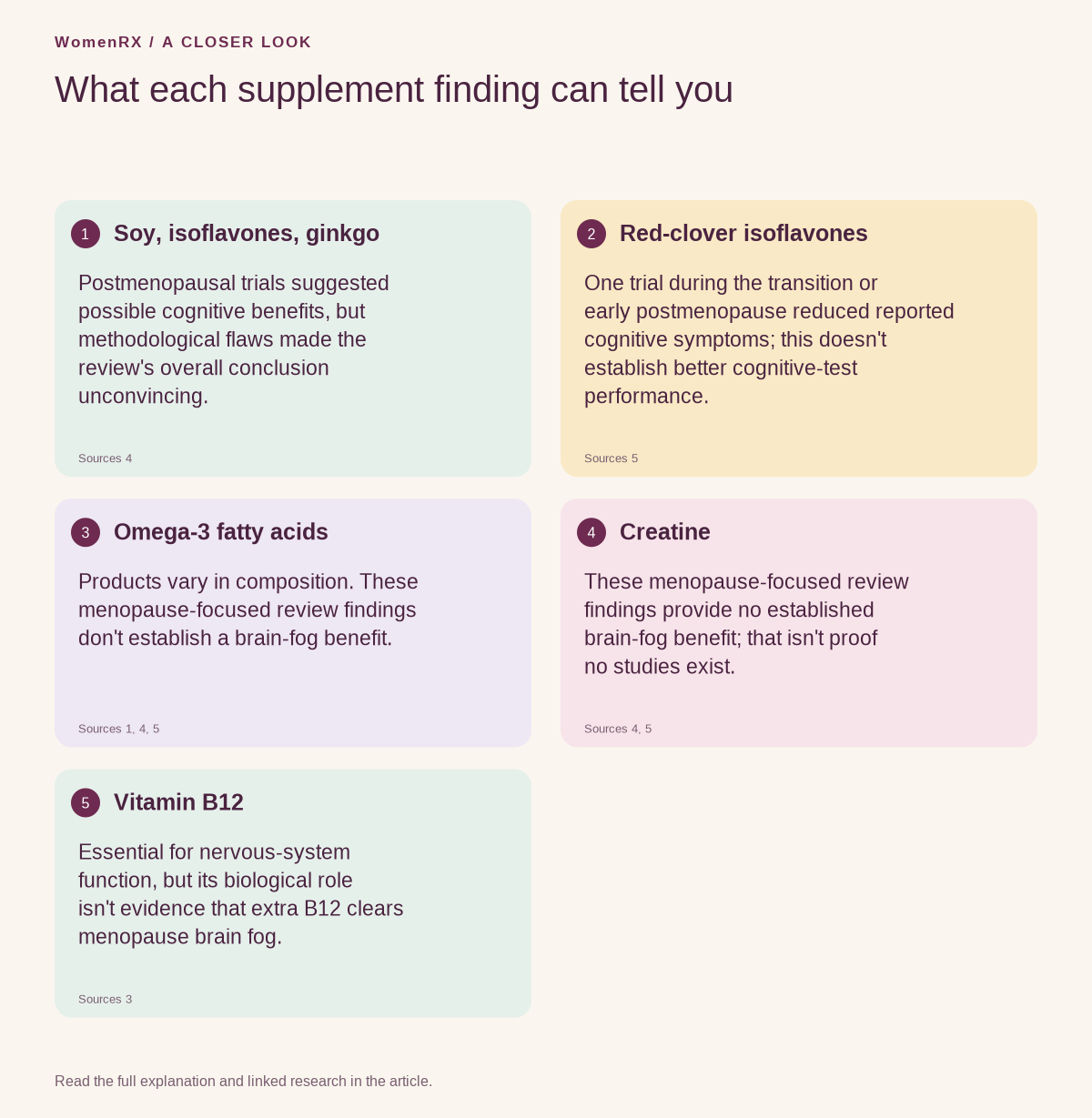
What each supplement finding can tell you
Soy, isoflavones, ginkgo: Postmenopausal trials suggested possible cognitive benefits, but methodological flaws made the review's overall conclusion unconvincing.4
Red-clover isoflavones: One trial during the transition or early postmenopause reduced reported cognitive symptoms; this doesn't establish better cognitive-test performance.5
Omega-3 fatty acids: Products vary in composition. These menopause-focused review findings don't establish a brain-fog benefit.145
Creatine: These menopause-focused review findings provide no established brain-fog benefit; that isn't proof no studies exist.45
Vitamin B12: Essential for nervous-system function, but its biological role isn't evidence that extra B12 clears menopause brain fog.3
Read the figure as text
The outcome and the people studied matter as much as the supplement name. These findings do not all answer the same brain-fog question.- Soy, isoflavones, ginkgo: Postmenopausal trials suggested possible cognitive benefits, but methodological flaws made the review's overall conclusion unconvincing.4
- Red-clover isoflavones: One trial during the transition or early postmenopause reduced reported cognitive symptoms; this doesn't establish better cognitive-test performance.5
- Omega-3 fatty acids: Products vary in composition. These menopause-focused review findings don't establish a brain-fog benefit.145
- Creatine: These menopause-focused review findings provide no established brain-fog benefit; that isn't proof no studies exist.45
- Vitamin B12: Essential for nervous-system function, but its biological role isn't evidence that extra B12 clears menopause brain fog.3
Sources you can check
- Omega-3 Fatty Acids - Health Professional Fact SheetAccessed 2026-09-25Return to first citation
- Memory | MedlinePlusAccessed 2026-09-25Return to first citation
- Vitamin B12 - Health Professional Fact SheetAccessed 2026-09-25Return to first citation
- Effects of herbal and dietary supplements on cognition in menopause: a systematic review.Clement YN, Onakpoya I, Hung SK, Ernst E. · Maturitas · 2011Return to first citation
- Effects of isoflavones and amino acid therapies for hot flashes and co-occurring symptoms during the menopausal transition and early postmenopause: a systematic review.Thomas AJ, Ismail R, Taylor-Swanson L, Cray L, Schnall JG, Mitchell ES, Woods NF. · Maturitas · 2014Return to first citation