Brain Fog Around Perimenopause: Can Supplements Help?
Soy isoflavones have been studied for menopause-related memory changes, but the findings don’t show a dependable supplement fix.
There isn’t compelling evidence that supplements reliably improve menopause-related memory or concentration. Reviews of herbal and dietary supplements find the results inconclusive, and a small trial in healthy postmenopausal women found no improvement on the cognitive tasks it measured. That doesn’t establish what causes your symptoms, so consider other health factors as well as menopause before choosing a supplement. 2 3 4
What the research says about supplements
Soy isoflavones are among the supplements studied for cognition around menopause. The overall picture is uncertain: a systematic review of 12 randomized trials found that five suggested possible cognitive benefits from isoflavones, soy, or ginkgo, but most of the trials had serious methodological flaws. A later systematic review found no conclusive cognitive benefit from isoflavones. 2 3
A randomized, placebo-controlled trial helps show what that uncertainty looks like in practice. It included 79 healthy postmenopausal women ages 48 to 65. Over 16 weeks, neither soy milk nor an isoflavone supplement improved the attention and memory tasks researchers measured. This was a relatively small study of postmenopausal women, not a test of every supplement or of people in perimenopause. It doesn’t prove that no one could benefit, but it doesn’t support treating soy isoflavones as a proven fix for brain fog. 4
The outcome matters, too. A result on a specific test of attention or memory is not the same as showing that a supplement helps you keep track of conversations, focus at work, or manage everyday tasks. Reviews of menopause-related diet research describe evidence for dietary patterns and cognition as largely observational, which can show an association but can’t establish that a diet or supplement caused an improvement. 5
Keep the cause open
“Brain fog” describes a frustrating experience; it isn’t a diagnosis. Menopause may be one part of the picture, but it shouldn’t be assumed to explain every concentration or memory change. MedlinePlus lists thyroid, kidney, and liver problems among possible causes of more serious memory difficulties. 1
A useful next step is to describe what has changed and ask about more than supplements. For example, you might bring these questions to a clinician:
- Could this change be related to perimenopause, or should we consider other health factors?
- Could my sleep, mood, or a change in my medicines be relevant in my situation?
- What would help us decide whether a supplement is worth considering, and what specific outcome should I expect it to affect?
These questions don’t assume that sleep, mood, medicines, or hormones are the cause. They help keep the conversation focused on your experience rather than on a product’s broad promise to support “brain health.”
Make the supplement claim specific
If you’re considering a product, ask what outcome it has actually been studied for, and in whom. Evidence from postmenopausal women may not answer the same question for someone in perimenopause. And evidence about one menopause symptom doesn’t automatically show a benefit for memory or concentration. The isoflavone reviews, for example, discuss cognitive outcomes separately from other symptoms and do not find a conclusive cognition benefit. 3
Bring the product name or label if you want to discuss it. A claim about general focus or brain health is not the same as evidence that the product improves a particular memory or attention measure. Given the mixed findings for isoflavones, it’s reasonable to pause before spending money on a supplement based on a promise to reverse menopause-related cognitive changes. 2 3 4
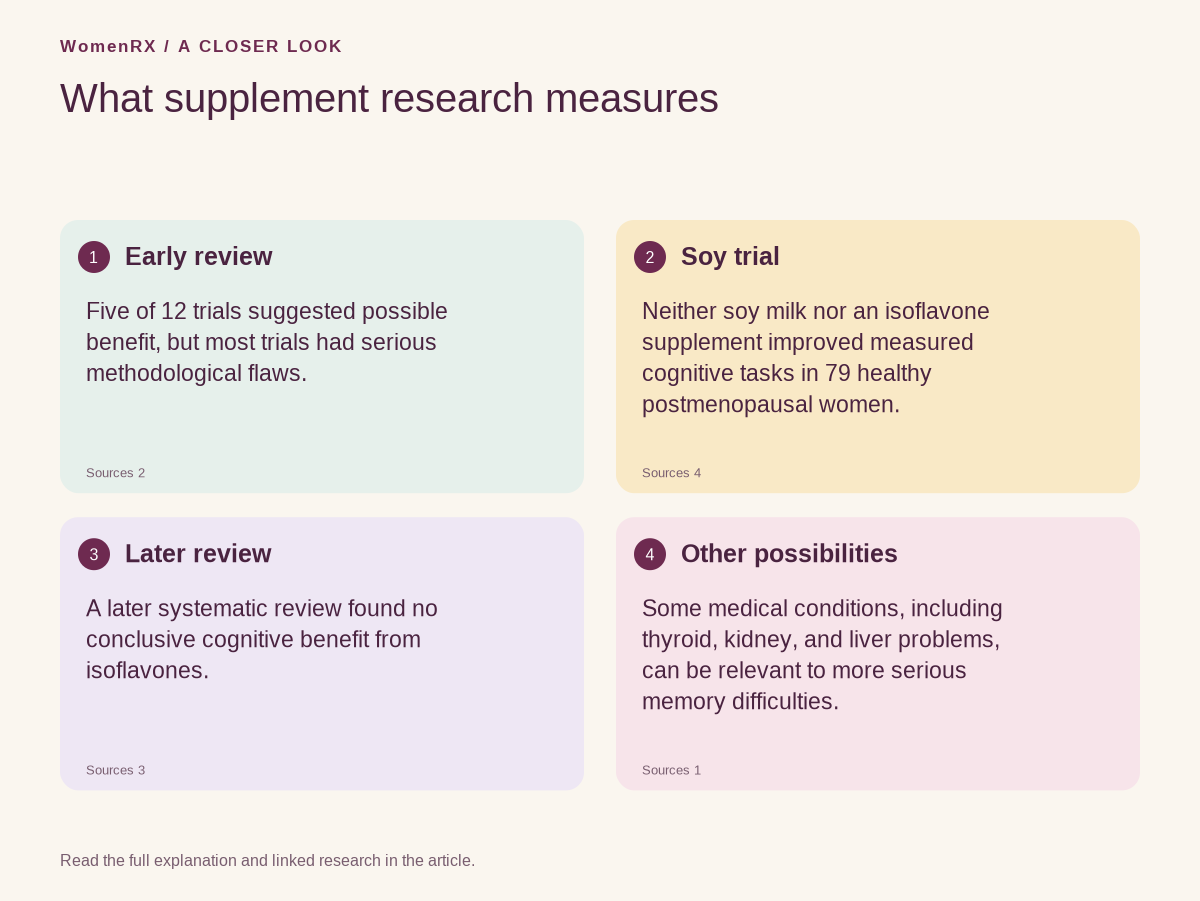
What supplement research measures
Early review: Five of 12 trials suggested possible benefit, but most trials had serious methodological flaws.2
Soy trial: Neither soy milk nor an isoflavone supplement improved measured cognitive tasks in 79 healthy postmenopausal women.4
Later review: A later systematic review found no conclusive cognitive benefit from isoflavones.3
Other possibilities: Some medical conditions, including thyroid, kidney, and liver problems, can be relevant to more serious memory difficulties.1
Read the figure as text
These findings distinguish possible signals in early trials from the limits of a specific soy trial and the uncertainty that remains.- Early review: Five of 12 trials suggested possible benefit, but most trials had serious methodological flaws.2
- Soy trial: Neither soy milk nor an isoflavone supplement improved measured cognitive tasks in 79 healthy postmenopausal women.4
- Later review: A later systematic review found no conclusive cognitive benefit from isoflavones.3
- Other possibilities: Some medical conditions, including thyroid, kidney, and liver problems, can be relevant to more serious memory difficulties.1
More questions, answered
Does research in postmenopausal women answer the question for perimenopause?
Not directly. The soy trial enrolled healthy postmenopausal women, so it cannot establish whether soy or isoflavone supplements help during perimenopause. 4
If soy isoflavones may help hot flashes, does that mean they help memory?
No. A finding about one symptom does not establish a benefit for another. The review found no conclusive benefit of isoflavones for cognition. 3
Sources you can check
- Memory | MedlinePlusAccessed 2026-09-25Return to first citation
- Effects of herbal and dietary supplements on cognition in menopause: a systematic review.Clement YN, Onakpoya I, Hung SK, Ernst E. · Maturitas · 2011Return to first citation
- Isoflavone Supplements for Menopausal Women: A Systematic Review.Chen LR, Ko NY, Chen KH. · Nutrients · 2019Return to first citation
- The effects of soy milk and isoflavone supplements on cognitive performance in healthy, postmenopausal women.Fournier LR, Ryan Borchers TA, Robison LM, Wiediger M, Park JS, Chew BP, McGuire MK, Sclar DA, Skaer TL, Beerman KA. · The journal of nutrition, health & aging · 2007Return to first citation
- The role of diet in managing menopausal symptoms: A narrative review.Yelland S, Steenson S, Creedon A, Stanner S. · Nutrition bulletin · 2023Return to first citation