Choline Deficiency: What Your Diet Can and Can’t Tell You
Low choline intake is common in pregnancy, but an intake estimate below the recommended reference isn’t a diagnosis of deficiency.
A symptom or an estimated choline intake, by itself, doesn’t establish that you have choline deficiency. Deficiency can cause liver and muscle damage, but many people consume less than the Adequate Intake (AI), and frank deficiency is rare in healthy men and nonpregnant women. If you’re pregnant or breastfeeding, review your usual foods and prenatal label. The AI is 450 mg a day during pregnancy and 550 mg during lactation. 1 2
Low intake is not the same as deficiency
Choline helps form cell membranes and supports the developing nervous system. Your body makes some choline, and you get more from food. During pregnancy, that dietary contribution deserves attention: most pregnant women in the United States consume less than the choline Adequate Intake (AI). 1 2
The AI is a reference for planning and assessing intake, not a line between healthy and deficient. Researchers haven’t established an Estimated Average Requirement for choline, so an intake estimate below the AI cannot, by itself, tell you whether your body is deficient. In healthy men and nonpregnant women, clinically recognized choline deficiency is rare despite many people eating less than the AI. When deficiency does occur, it can cause liver and muscle damage. But a symptom or an intake estimate, by itself, doesn’t establish that someone has choline deficiency. 1
Blood choline measurements have been used in pregnancy research, but researchers have described blood biomarkers, like self-reported dietary intake, as imprecise ways to measure choline exposure. That’s another reason not to treat one number as a complete answer to a personal intake question. 3
What changes during pregnancy and breastfeeding
For women ages 19 and older, the choline AI is 425 mg a day when not pregnant or lactating, 450 mg during pregnancy, and 550 mg during lactation. The pregnancy and lactation AIs are also 450 mg and 550 mg a day, respectively, for ages 14 to 18. These are intake references, not diagnostic cutoffs. 1
Population figures show why an intake review can be worthwhile without telling any one woman she has a deficiency. In an analysis of U.S. pregnant women ages 20 to 40 using 2001-2014 survey data, average choline intake from food was 321 mg a day, and 7.7% had intake above the AI. That measures reported intake, not the prevalence of clinical deficiency. 2
Start with the foods you eat regularly
Think about your usual meals rather than a single day. Eggs, meat, poultry, fish, and dairy are common choline sources. Soybeans, other beans, cruciferous vegetables such as broccoli and Brussels sprouts, nuts, seeds, and whole grains contribute too. 1 2
The amounts vary enough that it helps to look at actual foods. One large hard-boiled egg provides about 147 mg of choline; half a cup of roasted soybeans provides about 107 mg. Half a cup of canned kidney beans provides about 45 mg, while half a cup of boiled broccoli provides about 31 mg. These are examples of contributions to a day’s intake, not a required menu. 1
If you avoid eggs or follow a vegan diet, pay particular attention to which plant sources appear regularly in your meals. Choline-containing supplements may be useful when food alone doesn’t meet a need, including for some people who avoid eggs or animal foods, but your diet and any supplement should be considered together. 1 2
Your prenatal may not fill the gap
Check the choline amount per serving on your prenatal label rather than assuming it’s included. In an evaluation of 188 prenatal supplements on the U.S. market, 40% contained choline. Among those that did, the median amount was 25 mg per serving. 2
A missing choline line on a food label means something different: choline generally doesn’t have to be listed unless it has been added to the food. Use food-source information to review your meals, and use the supplement label to see what that product actually provides. 1
If you’re planning pregnancy, pregnant, or breastfeeding and regularly eat few choline-containing foods, bring your usual meal pattern and supplement label to your prenatal care team or a registered dietitian. That makes the question specific: how much choline is likely coming from food, how much from the supplement, and whether your eating pattern needs a change. If you have symptoms or concerns about liver or muscle health, those need a broader medical assessment rather than a conclusion drawn from a choline estimate. High choline intakes can also cause adverse effects, so an uncertain intake isn’t a reason to start a high-dose supplement on your own. 1 2
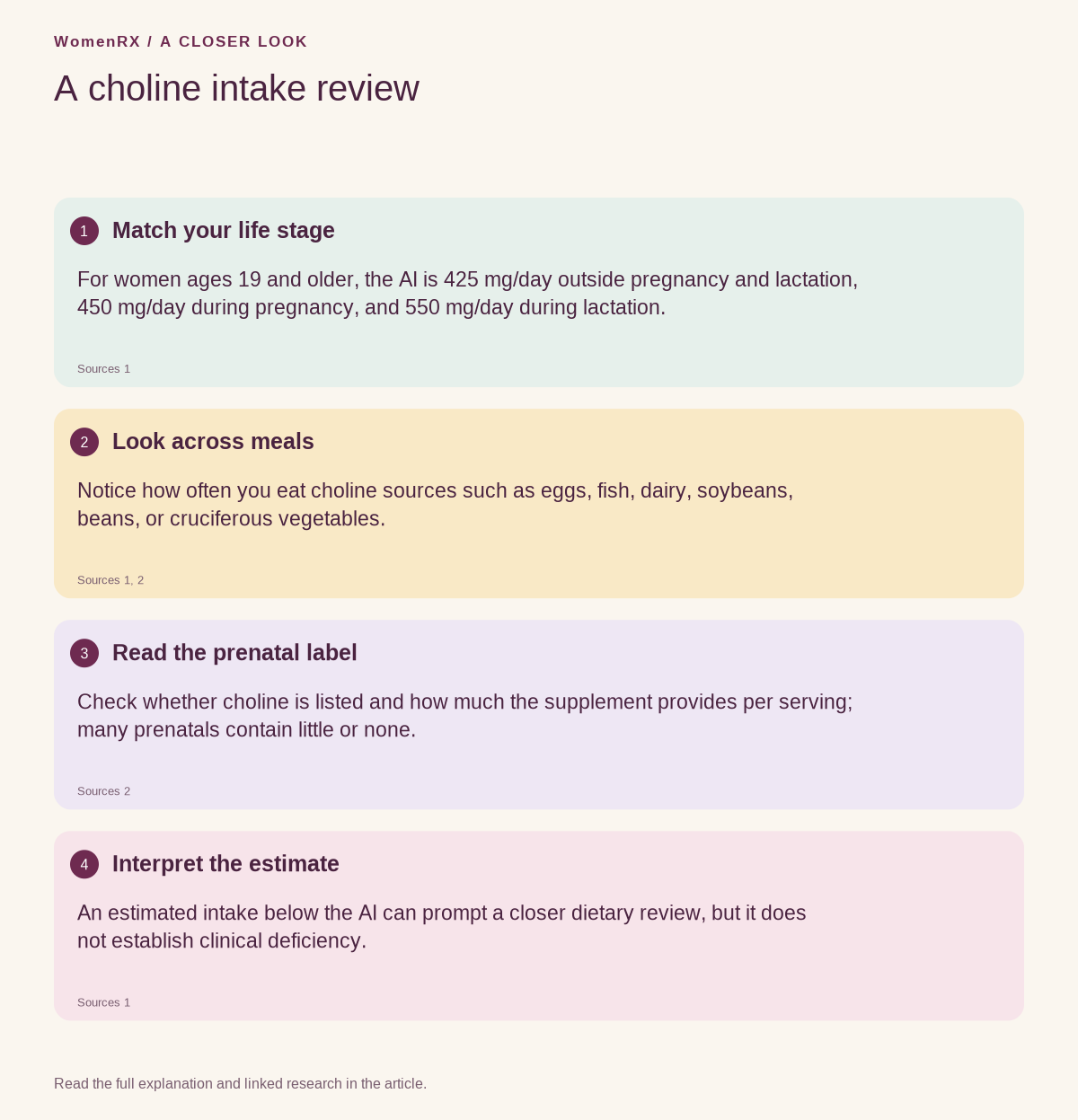
A choline intake review
Match your life stage: For women ages 19 and older, the AI is 425 mg/day outside pregnancy and lactation, 450 mg/day during pregnancy, and 550 mg/day during lactation.1
Look across meals: Notice how often you eat choline sources such as eggs, fish, dairy, soybeans, beans, or cruciferous vegetables.12
Read the prenatal label: Check whether choline is listed and how much the supplement provides per serving; many prenatals contain little or none.2
Interpret the estimate: An estimated intake below the AI can prompt a closer dietary review, but it does not establish clinical deficiency.1
Read the figure as text
These prompts help you review intake without treating any one symptom or intake estimate as a diagnosis. They are not a diagnostic score.- Match your life stage: For women ages 19 and older, the AI is 425 mg/day outside pregnancy and lactation, 450 mg/day during pregnancy, and 550 mg/day during lactation.1
- Look across meals: Notice how often you eat choline sources such as eggs, fish, dairy, soybeans, beans, or cruciferous vegetables.12
- Read the prenatal label: Check whether choline is listed and how much the supplement provides per serving; many prenatals contain little or none.2
- Interpret the estimate: An estimated intake below the AI can prompt a closer dietary review, but it does not establish clinical deficiency.1
More questions, answered
Does eating less than the AI mean I’m choline-deficient?
No. The AI is an intake reference established because there isn’t enough evidence to set an Estimated Average Requirement for choline. An estimate below it is a reason to look more closely at your diet, not proof of clinical deficiency. 1
Sources you can check
- Choline - Health Professional Fact SheetAccessed 2026-09-25Return to first citation
- Dietary Supplements and Life Stages: Pregnancy - Health Professional Fact SheetAccessed 2026-09-25Return to first citation
- The Effect of Maternal Choline Intake on Offspring Cognition in Adolescence: Protocol for a 14-year Follow-Up of a Randomized Controlled Feeding Trial.Roth SA, Lam AE, Strupp BJ, Canfield RL, Larson EA. · JMIR research protocols · 2025Return to first citation