Choline Intake: What to Check Before You Worry
A low-looking intake estimate isn’t a diagnosis, but food patterns and life stage can help you decide what to review.
Choline is found in foods such as eggs, soybeans, meat, fish, dairy, beans, and cruciferous vegetables. The U.S. Adequate Intake is 425 mg daily for adult women, 450 mg during pregnancy, and 550 mg while breastfeeding. Falling below these figures doesn’t prove deficiency: there’s no routine status test for healthy people, and symptoms alone can’t identify low intake. 12
Why symptoms don’t give a clear answer
Choline helps the body make cell-membrane components and acetylcholine, a chemical involved in nerve signaling. The liver can make some choline, but not enough to meet the body’s needs on its own. 1
A serious shortage can cause liver or muscle damage, but that doesn’t make fatigue, memory changes, or other everyday symptoms a reliable choline checklist. In healthy people, choline status isn’t routinely measured, and blood levels don’t work well as a measure of whether someone’s intake is adequate. 12
The usual intake figures are Adequate Intakes (AIs), not Recommended Dietary Allowances. An AI is used when there isn’t enough evidence to set an Estimated Average Requirement, the value used to assess how many people in a group may not be getting enough. So an intake below the AI is a reason to look at the overall diet, not proof that you’re deficient. 1
Check your life stage and eating pattern
For women ages 19 and older, the AI is 425 mg a day. It is 450 mg a day during pregnancy and 550 mg a day while breastfeeding. For ages 14-18, the figures are 400 mg for nonpregnant teens, 450 mg during pregnancy, and 550 mg while breastfeeding. 12
Pregnancy deserves a closer look because the AI rises and many pregnant women consume less than that amount. In a U.S. analysis of pregnant women ages 20-40 using data from 2001-2014, average choline intake from food was 321 mg a day, and 7.7% had an intake above the AI. That’s a population estimate, not a prediction of any one person’s status. 2
Your food pattern can also help identify where a gap might arise. In the U.S., common choline sources include eggs, meat, poultry, fish, and dairy. Soybeans, beans, nuts, seeds, whole grains, broccoli, and Brussels sprouts contribute too. For example, one large hard-boiled egg contains 147 mg, half a cup of roasted soybeans 107 mg, and half a cup of cooked broccoli 31 mg. These are examples, not a required menu. 12
Eating vegan or avoiding eggs doesn’t establish that you’re low, but it can make it useful to review your usual sources. Certain genetic variations may affect how much choline a person needs. 12
A useful assessment is about the whole pattern
Rather than trying to diagnose yourself from symptoms or a single day of meals, review what you typically eat across different days. Note whether your regular meals include choline sources, whether you’re pregnant or breastfeeding, and what your prenatal or other supplements actually contain. Choline may not appear on a food label unless it has been added, so a label that doesn’t list it doesn’t mean the food contains none. 1
Prenatal vitamins aren’t a guarantee of a meaningful amount. In an evaluation of 188 prenatal supplements on the U.S. market in 2022, 40% included choline, and the median amount among those products was 25 mg per serving. Check your own product label rather than assuming it covers your intake. 2
A clinician or registered dietitian can help review your food pattern and supplement label, especially during pregnancy or breastfeeding, or if your diet excludes several common sources. If you receive long-term total parenteral nutrition, raise choline with your care team: choline is not routinely included in commercial parenteral nutrition solutions, and long-term use can be associated with low blood choline and liver abnormalities. 1
Food first, supplement decisions second
A varied diet can contribute choline from more than one kind of food. If you’re pregnant and follow a vegetarian or vegan diet, U.S. guidance recommends discussing with a health care provider whether a choline supplement is needed; it does not recommend that every pregnant woman take one. The pregnancy AI is a planning reference, not a personal prescription. 2
If you’re considering a supplement, review the amount alongside food and other supplements rather than adding one automatically. High choline intakes can cause adverse effects, and the adult upper intake level is 3,500 mg a day, including food and supplements. 12
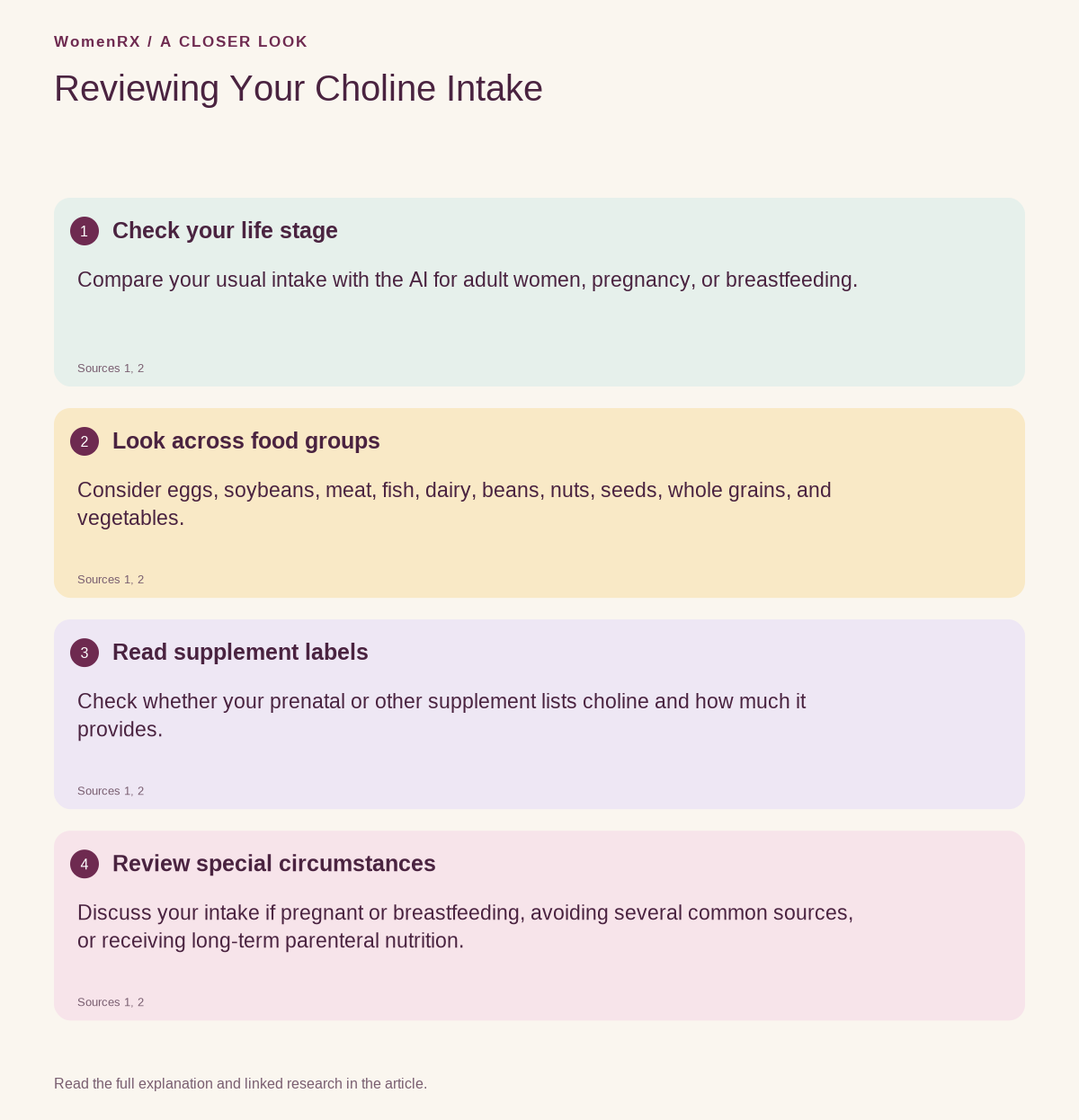
Reviewing Your Choline Intake
Check your life stage: Compare your usual intake with the AI for adult women, pregnancy, or breastfeeding.12
Look across food groups: Consider eggs, soybeans, meat, fish, dairy, beans, nuts, seeds, whole grains, and vegetables.12
Read supplement labels: Check whether your prenatal or other supplement lists choline and how much it provides.12
Review special circumstances: Discuss your intake if pregnant or breastfeeding, avoiding several common sources, or receiving long-term parenteral nutrition.12
Read the figure as text
Use these prompts to organize a food-pattern and life-stage review; they do not diagnose deficiency.- Check your life stage: Compare your usual intake with the AI for adult women, pregnancy, or breastfeeding.12
- Look across food groups: Consider eggs, soybeans, meat, fish, dairy, beans, nuts, seeds, whole grains, and vegetables.12
- Read supplement labels: Check whether your prenatal or other supplement lists choline and how much it provides.12
- Review special circumstances: Discuss your intake if pregnant or breastfeeding, avoiding several common sources, or receiving long-term parenteral nutrition.12
More questions, answered
Can a blood test tell me whether I get enough choline?
Choline status is not routinely measured in healthy people, and plasma or serum choline concentrations are not good indicators of status. A review of your usual food intake and supplements is a more useful starting point. 12
Does being below the Adequate Intake mean I’m deficient?
No. The AI is a planning benchmark used because there isn’t enough evidence to set an Estimated Average Requirement for choline. An intake below it does not diagnose deficiency in an individual. 1