Choline in Pregnancy: Intake, Supplements, and What to Expect
The pregnancy Adequate Intake for choline is 450 mg a day, but that reference isn’t a supplement dose or a promise of a noticeable effect.
During pregnancy, the Adequate Intake for choline is 450 mg a day; it’s a population reference, not a personal test or a supplement dose. Food can contribute substantially, and prenatal products vary in whether they contain choline and how much. A supplement can add to your intake. An observational pregnancy study cannot tell whether supplementation changes child outcomes or when an effect might be noticed. 1 2 3
Start with intake, not a timeline
Choline is an essential nutrient used to build cell membranes and make acetylcholine, a chemical involved in nervous-system functions. It also plays a role in early brain development. Choline status isn’t routinely measured in healthy people. 1 2
The pregnancy Adequate Intake (AI) is 450 mg a day. The AI is a reference for planning and assessing intake in healthy people, set because there wasn’t enough evidence to establish a Recommended Dietary Allowance for choline. It isn’t a blood-test target, a personalized diagnosis, or an instruction to take 450 mg as a supplement. The AI is 400 mg for females ages 14-18 who aren’t pregnant and 425 mg for females 19 and older who aren’t pregnant. 1 2
For someone planning pregnancy, it can be useful to look at usual food intake and the prenatal label before pregnancy as well as during it. That’s a practical review of a nutrient that matters in pregnancy, not a promise that starting a supplement at a particular time changes an outcome. 2
Add up foods before judging the label
Choline is found in a mix of animal and plant foods. For a sense of scale, NIH lists about 147 mg in one large hard-boiled egg, 107 mg in half a cup of roasted soybeans, 72 mg in 3 ounces of roasted chicken breast, and 31 mg in half a cup of cooked broccoli. These are examples, not a prescribed menu; portions and the rest of your day matter. Meat, fish, dairy, beans, nuts, seeds, and whole grains can also contribute. 1
Food records can be an imperfect guide: choline is not required on food labels unless it has been added. So an absent number on a package doesn’t mean the food contains none. A varied day of eating may contribute choline across several meals rather than relying on one “high-choline” food. 1
Intake is often below the AI: an analysis of U.S. data from 2001-2014 found that pregnant women ages 20-40 consumed an average of 321 mg a day from food, and 7.7% had food intake above the AI. This describes a population, not your individual intake or whether you have a deficiency. 2
Check what a prenatal actually adds
Don’t assume a prenatal contains much choline. In an evaluation of 188 prenatal supplements on the U.S. market in 2022, 40% contained choline; among those that contained it, the median amount was 25 mg per serving. That amount may add to food intake, but it is not the same as meeting the 450 mg AI by itself. Check the serving size and the amount of choline per serving, and count any choline in other supplements you take. 2
Look for the amount of choline, not just a form name such as choline bitartrate, phosphatidylcholine, or lecithin. NIH lists these forms in supplements and notes that studies haven’t compared their relative bioavailability. The label can tell you what the product provides; it can’t show that one form produces a better pregnancy outcome. 1
A practical label review is to ask: Is choline listed? How many milligrams are in the serving I’d take? Is choline also included in another product? What amount do my usual foods contribute? If you avoid eggs or follow a vegan diet, mention that when discussing your overall intake, since a supplement may be one way to add choline if food alone isn’t enough. 2
What pregnancy research can and can’t say
Choline has roles in fetal growth and central nervous system development. Some evidence has suggested a link between low maternal choline and neural tube defects, but research findings on maternal blood choline and neural tube defects have not been consistent. An association or biological role does not establish that a supplement prevents a birth defect. 1 2
A human pregnancy cohort followed 309 women and assessed children at ages 3-5. Maternal choline intake in the second trimester was not associated with most measured outcomes, including intelligence, language, memory, or motor outcomes. This was an observational study, so it cannot determine what a supplement would cause; it also doesn’t settle every possible pregnancy or child outcome. 3
A supplement can increase the amount of choline you take in, but added intake alone doesn’t tell you whether a pregnancy outcome will change. The cohort was not a supplement trial, so it can’t establish whether taking a supplement changes an outcome or when someone might notice a difference. 2 3
If you’re pregnant, planning pregnancy, or considering an additional product, bring the label and a rough picture of your usual foods to your prenatal care discussion. Ask whether the product’s amount fits with your overall intake and other supplements. The adult pregnancy upper limit is 3,500 mg a day for ages 19 and older, and 3,000 mg for ages 14-18; these are upper limits, not goals. 1 2
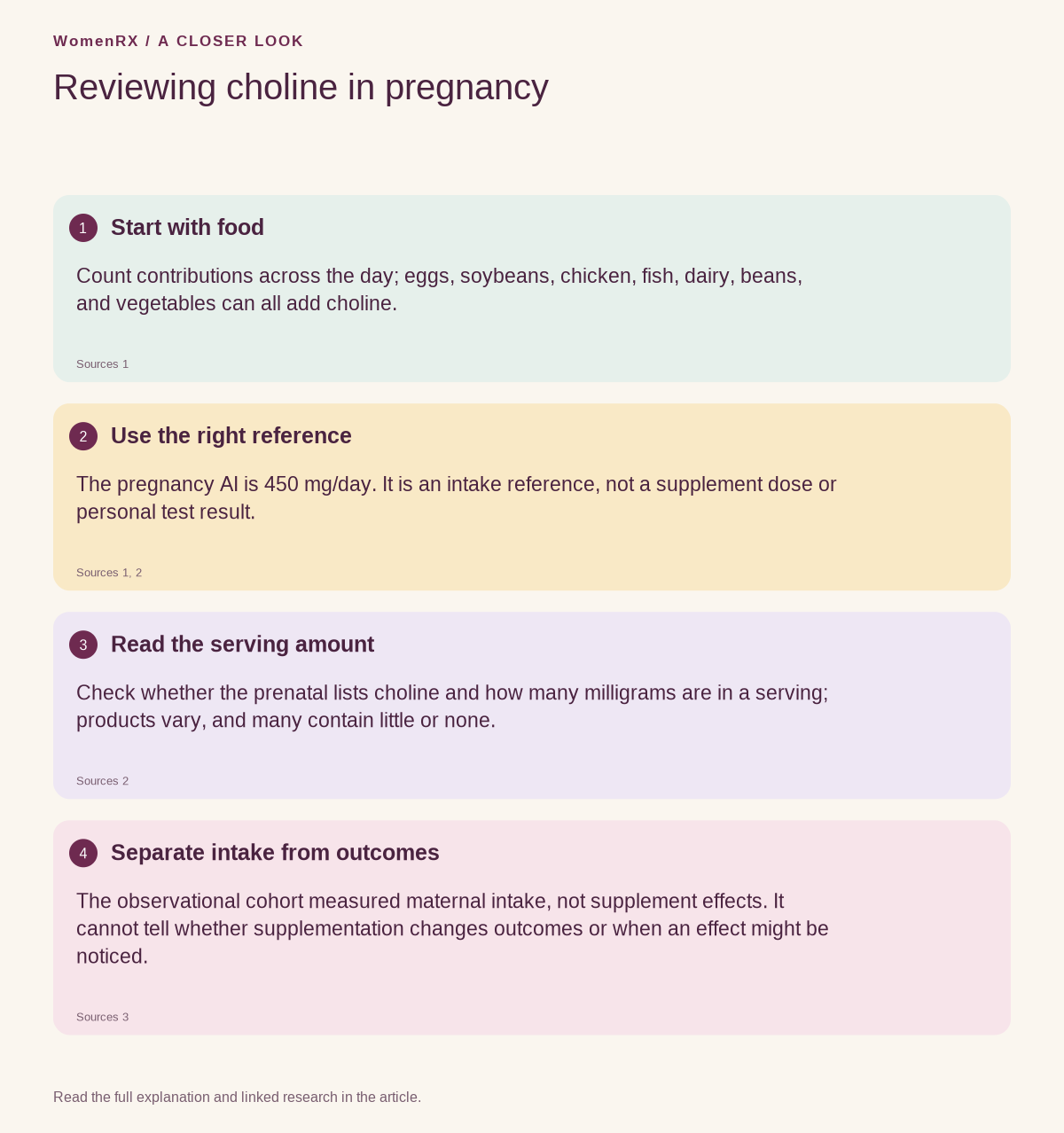
Reviewing choline in pregnancy
Start with food: Count contributions across the day; eggs, soybeans, chicken, fish, dairy, beans, and vegetables can all add choline.1
Use the right reference: The pregnancy AI is 450 mg/day. It is an intake reference, not a supplement dose or personal test result.12
Read the serving amount: Check whether the prenatal lists choline and how many milligrams are in a serving; products vary, and many contain little or none.2
Separate intake from outcomes: The observational cohort measured maternal intake, not supplement effects. It cannot tell whether supplementation changes outcomes or when an effect might be noticed.3
Read the figure as text
Use these prompts to separate everyday food intake from what a prenatal product adds and what an observational study can establish.- Start with food: Count contributions across the day; eggs, soybeans, chicken, fish, dairy, beans, and vegetables can all add choline.1
- Use the right reference: The pregnancy AI is 450 mg/day. It is an intake reference, not a supplement dose or personal test result.12
- Read the serving amount: Check whether the prenatal lists choline and how many milligrams are in a serving; products vary, and many contain little or none.2
- Separate intake from outcomes: The observational cohort measured maternal intake, not supplement effects. It cannot tell whether supplementation changes outcomes or when an effect might be noticed.3
More questions, answered
Can a blood test tell me if I’m getting enough choline?
Choline status isn’t routinely measured in healthy people. NIH reports that plasma choline did not fall below 50% of normal in people who had gone without food for more than a week. That fasting finding doesn’t establish that a blood test reliably reflects your usual choline intake. 1
Does the Daily Value on a label equal the pregnancy target?
No. The FDA Daily Value for choline is 550 mg, while the pregnancy Adequate Intake is 450 mg a day. They are different reference values with different purposes; use the milligrams listed on the product to see what it adds. 1 2
Sources you can check
- Choline - Health Professional Fact SheetAccessed 2026-09-25Return to first citation
- Dietary Supplements and Life Stages: Pregnancy - Health Professional Fact SheetAccessed 2026-09-25Return to first citation
- Associations between maternal folate status and choline intake during pregnancy and neurodevelopment at 3-4 years of age in the Alberta Pregnancy Outcomes and Nutrition (APrON) study.Irvine N, England-Mason G, Field CJ, Letourneau N, Bell RC, Giesbrecht GF, Kinniburgh DW, MacDonald AM, Martin JW, Dewey D, APrON Study Team. · Journal of developmental origins of health and disease · 2023Return to first citation