Kefir and Weight Management: What the Evidence Shows
Kefir can be part of your eating routine, but one small trial found no weight-loss advantage over milk.
Kefir hasn’t been shown to cause weight loss on its own. In an 8-week trial of premenopausal women with overweight or obesity, both a kefir group and a milk group had greater reductions in weight, BMI, and waist circumference than a control group, but kefir did not outperform milk. A separate NIH summary finds inconsistent weight results in probiotic dietary-supplement trials, not kefir trials. 2 1
Kefir may suit you as a drink or meal ingredient, but it isn’t a proven weight-loss aid. The most directly relevant human trial compared kefir with milk, and it found no weight advantage for kefir. That distinction matters: a food can fit into your routine without having a special effect on the scale.
What the kefir trial actually tested
The randomized trial included 75 women aged 25 to 45 with overweight or obesity. For eight weeks, one group followed a weight-maintenance diet with two additional servings of low-fat milk each day, another had two additional servings of commercial kefir, and a control group followed a maintenance-level diet with two servings of low-fat dairy. The study reported results using an intention-to-treat analysis of all 75 participants, though 58 completed the trial. 2
At eight weeks, the kefir and milk groups each had greater reductions in weight, BMI, and waist circumference than the control group. But the researchers found no significant difference between kefir and milk. The trial therefore doesn’t show a kefir-specific advantage. It also tested added dairy servings within a particular dietary plan, not kefir as a stand-alone treatment or as a replacement for another food. 2
The participants were premenopausal women, which makes the trial directly relevant to that group. It doesn’t establish the same result for women in perimenopause or after menopause, and it doesn’t show that kefir works through a hormone-related effect. 2
Why probiotic claims don’t settle the question
Kefir-specific findings and findings from probiotic dietary-supplement trials aren’t interchangeable. In its fact sheet on weight-loss supplements, the NIH Office of Dietary Supplements describes probiotic trial results as inconsistent for body weight, body fat, and waist and hip measurements. That summary isn’t a review of kefir or fermented foods, and it doesn’t establish a women-specific benefit. 1
A change in a gut or metabolic measure would not, by itself, mean a person lost weight. For this decision, focus on the outcome you care about: the kefir-versus-milk trial measured weight, BMI, and waist circumference, and kefir did not outperform milk on those measures. 2
A practical way to decide whether to drink it
Choose kefir if you enjoy it and it works for the way you eat. Treat it as a food choice, not as a weight-loss product. If you’re comparing kefir with milk, the available trial gives no reason to expect kefir to produce more weight loss. If you’re comparing it with a different drink or ingredient, this trial doesn’t answer that comparison.
Be cautious with claims that a kefir product or probiotic will “boost” weight loss. The NIH summary of probiotic dietary-supplement trials can’t be applied automatically to a particular kefir drink, and it describes weight findings in those trials as inconsistent. 1
The useful takeaway is simple: kefir can be one option in your routine, but the trial doesn’t make it a better weight-management choice than milk. The trial doesn’t tell us whether a different kefir, a different amount, or a longer timeframe would change the result.
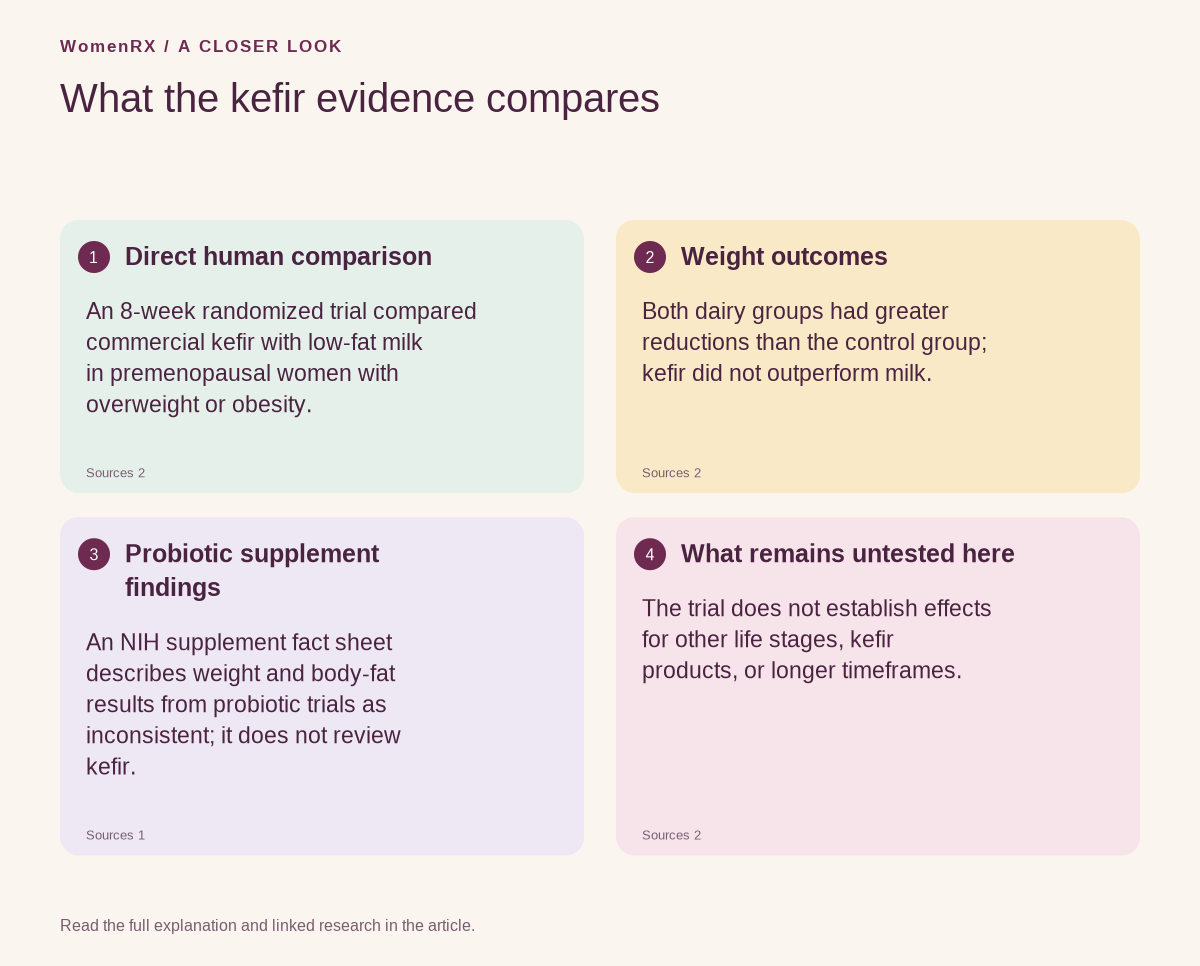
What the kefir evidence compares
Direct human comparison: An 8-week randomized trial compared commercial kefir with low-fat milk in premenopausal women with overweight or obesity.2
Weight outcomes: Both dairy groups had greater reductions than the control group; kefir did not outperform milk.2
Probiotic supplement findings: An NIH supplement fact sheet describes weight and body-fat results from probiotic trials as inconsistent; it does not review kefir.1
What remains untested here: The trial does not establish effects for other life stages, kefir products, or longer timeframes.2
Read the figure as text
Separate the direct kefir trial from probiotic dietary-supplement findings, and keep the outcomes and study population in view.- Direct human comparison: An 8-week randomized trial compared commercial kefir with low-fat milk in premenopausal women with overweight or obesity.2
- Weight outcomes: Both dairy groups had greater reductions than the control group; kefir did not outperform milk.2
- Probiotic supplement findings: An NIH supplement fact sheet describes weight and body-fat results from probiotic trials as inconsistent; it does not review kefir.1
- What remains untested here: The trial does not establish effects for other life stages, kefir products, or longer timeframes.2
More questions, answered
Does kefir have a proven weight-loss benefit for women?
One randomized trial studied premenopausal women with overweight or obesity. Kefir did not lead to greater weight, BMI, or waist reductions than milk. The study doesn’t establish a benefit for other life stages. 2
Does probiotic research prove kefir helps with weight loss?
No. An NIH summary describes weight and body-fat findings from probiotic dietary-supplement trials as inconsistent. That supplement evidence isn’t evidence that kefir specifically causes weight loss. 1
Sources you can check
- Dietary Supplements for Weight Loss - Health Professional Fact SheetAccessed 2026-09-25Return to first citation
- Kefir drink leads to a similar weight loss, compared with milk, in a dairy-rich non-energy-restricted diet in overweight or obese premenopausal women: a randomized controlled trial.Fathi Y, Faghih S, Zibaeenezhad MJ, Tabatabaei SH. · European journal of nutrition · 2016Return to first citation