Kimchi and Weight: What the Evidence Can Tell You
Kimchi may fit comfortably into meals, but current human evidence links it with weight patterns rather than proving it causes weight loss.
A large observational study of middle-aged and older Koreans found associations between kimchi intake and body-weight patterns, but it cannot show that kimchi caused weight loss. Women were included, though the findings don’t establish a different effect for women. You can enjoy kimchi as a flavorful side; keep its sodium and the overall meal in mind. 3
What the kimchi study actually found
The most directly relevant human study followed participants in a Korean community cohort. Researchers used a food-frequency questionnaire to estimate intake of several kinds of kimchi. In analyses of 58,290 participants, they reported an association between higher kimchi intake and BMI change. A separate prospective analysis included 20,066 people whose BMI was at least 25 at the start. The authors concluded that moderate intake was associated with weight loss, especially in men. 3
That’s an association, not a test of kimchi as a weight-loss treatment. People weren’t randomly assigned to eat kimchi or avoid it, so the study can’t show that kimchi itself caused the observed weight patterns. Eating habits, other lifestyle factors, and how accurately people recalled their intake could also matter. And BMI change is not the same as a direct measure of fat loss.
Women were part of the study, and the authors reported an association involving BMI change for women as well as men. But the study doesn’t establish that kimchi has a weight-loss effect specific to women, or that women and men respond differently. 3
Don’t mix up body weight and other outcomes
Research on a particular kimchi food, a specific bacterial strain, or a microbiome marker isn’t interchangeable with evidence that eating kimchi reduces body weight in people. For example, studies of kimchi or bacteria isolated from it have examined liver fat in cells and mice, inflammation in mice, or cancer-related weight loss in mice. Those findings may help researchers explore biological questions, but they don’t demonstrate weight loss in women or men who eat kimchi. 4 5 7 8
The cohort study measured body-weight patterns; it doesn’t establish that a microbiome change explains them. That distinction matters because an interesting mechanism or a change in a different health outcome isn’t proof of a change in body fat or weight. 3
Use it as food, not a weight-loss strategy
If you like kimchi, it can be one flavorful part of a meal. Whether it helps your eating pattern depends on the whole meal and what it accompanies, not on a proven fat-burning effect. A small side portion alongside a meal is one practical way to enjoy it without treating it as an unlimited add-on.
Kimchi cabbage is typically brined as part of preparation, and brining affects salt content. The amount in a serving can vary by product and recipe, so check the package’s sodium information when it’s available. 6 2 If you’re watching sodium, consider the rest of the meal too: kimchi may add to sodium from sauces, soups, or other packaged foods. Most U.S. adults are advised to consume less than 2.3 grams of sodium a day; people with certain health conditions may need less. 2
The practical takeaway is simple: choose kimchi because you enjoy it, account for its sodium, and judge the meal as a whole. The available cohort finding is a reason for further study, not a reason to expect kimchi to produce weight loss. For weight management, a healthy eating pattern and other sustainable lifestyle changes remain the foundation. 1
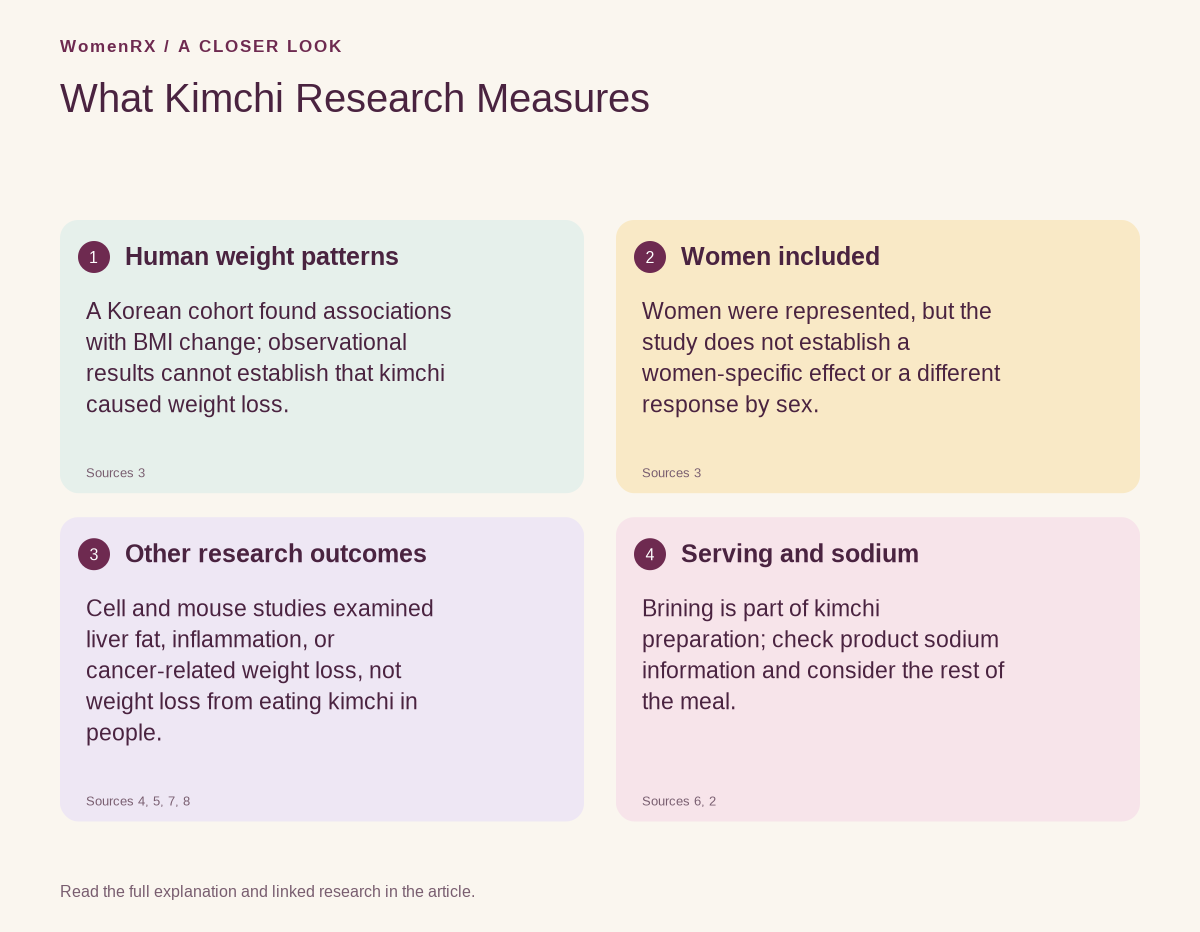
What Kimchi Research Measures
Human weight patterns: A Korean cohort found associations with BMI change; observational results cannot establish that kimchi caused weight loss.3
Women included: Women were represented, but the study does not establish a women-specific effect or a different response by sex.3
Other research outcomes: Cell and mouse studies examined liver fat, inflammation, or cancer-related weight loss, not weight loss from eating kimchi in people.4578
Serving and sodium: Brining is part of kimchi preparation; check product sodium information and consider the rest of the meal.62
Read the figure as text
Separate the human weight findings from other outcomes, then put sodium and meal context into the food choice.- Human weight patterns: A Korean cohort found associations with BMI change; observational results cannot establish that kimchi caused weight loss.3
- Women included: Women were represented, but the study does not establish a women-specific effect or a different response by sex.3
- Other research outcomes: Cell and mouse studies examined liver fat, inflammation, or cancer-related weight loss, not weight loss from eating kimchi in people.4578
- Serving and sodium: Brining is part of kimchi preparation; check product sodium information and consider the rest of the meal.62
More questions, answered
Did the kimchi study include women?
Yes. Women were included, and the study reported an association involving BMI change for women as well as men. It did not establish a women-specific weight-loss effect or a different response by sex. 3
Should I avoid kimchi if I’m limiting sodium?
Not necessarily, but kimchi is made with brined vegetables and can contribute sodium. Check the product label when available, and consider how it fits with sodium from the rest of your meal. 6 2
Sources you can check
- Dietary Supplements for Weight Loss - Health Professional Fact SheetAccessed 2026-09-25Return to first citation
- Sodium: MedlinePlusAccessed 2026-09-25Return to first citation
- Effect of kimchi intake on body weight of general community dwellers: a prospective cohort study.Tan LJ, Yun YR, Hong SW, Shin S. · Food & function · 2023Return to first citation
- Kimchi attenuates endoplasmic reticulum stress-induced hepatic steatosis in HepG2 cells and C57BL/6N mice.Yun YR, Lee JE. · Nutrition research (New York, N.Y.) · 2024Return to first citation
- Development of Anti-inflammatory Probiotic Limosilactobacillus reuteri EFEL6901 as Kimchi Starter: in vitro and In vivo Evidence.Seo H, Seong H, Kim GY, Jo YM, Cheon SW, Song Y, Ryu BH, Kang H, Han NS. · Frontiers in microbiology · 2021Return to first citation
- Application of Response Surface Methodology Based on a Box-Behnken Design to Determine Optimal Parameters to Produce Brined Cabbage Used in Kimchi.Song H, Moon EW, Ha JH. · Foods (Basel, Switzerland) · 2021Return to first citation
- Latilactobacillus curvatus BYB3 Isolated from Kimchi Alleviates Dextran Sulfate Sodium (DSS)-Induced Colitis in Mice by Inhibiting IL-6 and TNF-R1 Production.Wang X, Li D, Meng Z, Kim K, Oh S. · Journal of microbiology and biotechnology · 2022Return to first citation
- Dietary intake of probiotic kimchi ameliorated IL-6-driven cancer cachexia.An JM, Kang EA, Han YM, Oh JY, Lee DY, Choi SH, Kim DH, Hahm KB. · Journal of clinical biochemistry and nutrition · 2019Return to first citation