Escitalopram and Weight Gain: What the Evidence Can Tell You
A large U.S. study found a small difference in six-month weight change versus sertraline, but it can’t predict what will happen to you.
Escitalopram doesn’t inevitably cause weight gain. In a large observational study, people starting escitalopram had an estimated average weight change 0.41 kg higher at six months than people starting sertraline; that’s a comparison between groups, not the amount each person gained. The study doesn’t establish when a change begins or report a women-only result. 3
If your weight changed after starting escitalopram (Lexapro), the timing is worth noticing, but it doesn’t prove the medicine caused the change. The most useful escitalopram-specific evidence gives a six-month comparison with another antidepressant. It can inform a conversation with your prescriber, but it can’t tell you your personal odds or whether a different treatment would be right for you.
What the six-month comparison found
A U.S. observational study followed 183,118 people who started one of eight common antidepressants. Compared with people starting sertraline, people starting escitalopram had an estimated mean weight change that was 0.41 kg higher at six months. The study also reported a 10% to 15% higher risk of gaining at least 5% of baseline weight for escitalopram, paroxetine, and duloxetine than for sertraline. That is a relative comparison, not your absolute chance of gaining that amount. 3
The 0.41 kg figure is a difference between groups. It does not mean that everyone taking escitalopram gained 0.41 kg, or that this was the total amount gained while taking it. The study was observational, so it can show an association but cannot establish that escitalopram alone caused the difference. It also found only small average differences among the antidepressants studied. 3
What timing can, and can’t, tell you
The study estimated weight change at six months after treatment began. It doesn’t tell us exactly when a change starts, how it develops for an individual, or what happens to every person over longer use. If you noticed a change soon after starting or changing escitalopram, that date is useful context, not proof of cause.
A practical way to look at timing is to compare your weight before starting, when you first noticed a change, and the pattern since then. A single scale reading can’t tell you whether the difference is body fat: body weight includes water, muscle, bone, and fat. 1 An unexpected, sudden change is worth discussing with your prescriber rather than assuming it is a medication effect. 1
The result isn’t specific to women
The large comparison included patients across U.S. health systems, but its reported escitalopram result isn’t a women-only estimate. It doesn’t tell us whether the effect differs by sex. The study adjusted for baseline factors, but the summary does not provide a sex-specific escitalopram result. So there’s no basis here for saying the weight effect is unique to women or for giving women a separate likelihood. 3
Another analysis combined several antidepressant regimens, including escitalopram alone and escitalopram combined with bupropion. Its reported antidepressant-group figure cannot be read as an escitalopram-specific likelihood. That’s one reason to prefer the direct comparison above while keeping its limits in view. 2
What you can review with your prescriber
The decision isn’t only about the scale. You can weigh the change against how well escitalopram is helping the reason you take it, how noticeable or concerning the change is to you, and whether other changes happened around the same time. For example, you might bring up a change in another medicine, eating or activity routines, or a shift in mood or symptoms. These are points to review, not proof that any one factor caused your weight change.
A focused discussion can cover:
- The timeline: when you started escitalopram, when the change became noticeable, and whether it has continued.
- The size and pattern: whether the change is gradual, sudden, or based on one reading.
- The treatment tradeoff: how much benefit you’re getting and how the weight concern affects your priorities.
- Possible next steps: whether to keep the current plan, look at other contributors, or discuss another treatment option. The study found small average differences between medicines; it doesn’t choose the best one for your circumstances. 3
Don’t make a medication change based on a group average alone. If you’re considering a change, discuss a plan with the prescriber who knows your treatment history.
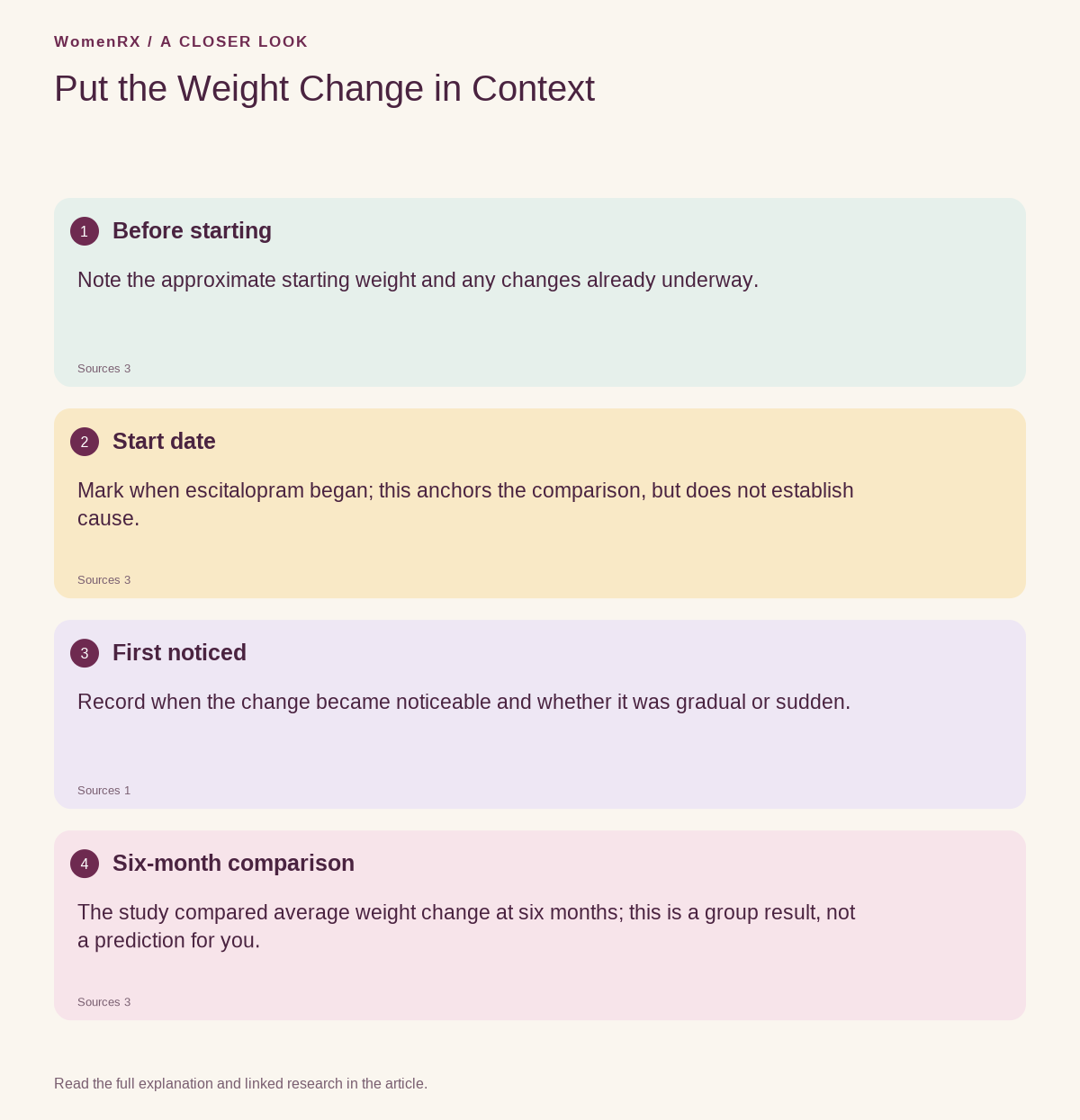
Put the Weight Change in Context
Before starting: Note the approximate starting weight and any changes already underway.3
Start date: Mark when escitalopram began; this anchors the comparison, but does not establish cause.3
First noticed: Record when the change became noticeable and whether it was gradual or sudden.1
Six-month comparison: The study compared average weight change at six months; this is a group result, not a prediction for you.3
Read the figure as text
A personal timeline can help organize what happened without treating sequence as proof that escitalopram caused the change.- Before starting: Note the approximate starting weight and any changes already underway.3
- Start date: Mark when escitalopram began; this anchors the comparison, but does not establish cause.3
- First noticed: Record when the change became noticeable and whether it was gradual or sudden.1
- Six-month comparison: The study compared average weight change at six months; this is a group result, not a prediction for you.3
More questions, answered
Does the study give my personal chance of gaining weight?
No. It reports comparisons between groups, including a relative difference in risk versus sertraline, not an absolute chance for an individual taking escitalopram. Your own experience may differ from the group average. 3
Does the evidence show that weight gain is more likely in women?
The reported escitalopram result doesn’t include a women-only estimate or show whether the effect differs by sex. It can’t establish a different likelihood for women. 3
Sources you can check
- Body Weight: MedlinePlusAccessed 2026-09-25Return to first citation
- Transdiagnostic medication-associated weight gain across five effectiveness trials: a harmonized longitudinal cohort analysis of antipsychotics, antidepressants, and mood stabilizers.Serretti A. · Progress in neuro-psychopharmacology & biological psychiatry · 2026Return to first citation
- Medication-Induced Weight Change Across Common Antidepressant Treatments : A Target Trial Emulation Study.Petimar J, Young JG, Yu H, Rifas-Shiman SL, Daley MF, Heerman WJ, Janicke DM, Jones WS, Lewis KH, Lin PD, Prentice C, Merriman JW, Toh S, Block JP. · Annals of internal medicine · 2024Return to first citation