Antidepressants and Weight: What the Comparisons Can Tell You
Weight change is possible with antidepressants, but the evidence doesn’t predict what will happen to you or support a simple ranking of every medicine.
Reviews associate bupropion more often with weight loss than gain, but their summaries don’t establish a women-specific outcome. One analysis found that 16% of antidepressant-treated participants with a follow-up weight gained at least 7% over their study follow-up. That result combined several regimens, not a prediction for you or any one drug. Don’t stop suddenly: review the timing and options with your prescriber. 5 6 7 3
First, look at the timeline
A change that began after starting a medicine is worth discussing, but timing alone doesn’t prove the medicine caused it. Bring a simple timeline: when you started or changed the antidepressant, when you first noticed a change, and whether your mood or day-to-day routines changed around the same time. If you have earlier weights, they can help show the pattern. Ask whether other medicines, changes in appetite or activity, or a life-stage change might also be part of the picture. These are useful possibilities to review, not proof of a particular cause.
The underlying mental-health condition matters too. A recent review notes that people with depression already have elevated risk of metabolic problems and weight gain, which antidepressant treatment may add to. So the relevant question is not just “Did I gain weight on this medicine?” but “What changed, when, and what is the treatment helping with?” 8
What the medicine comparisons do, and don’t, show
Bupropion has the clearest weight-related signal in these reviews. A systematic review and meta-analysis says it is more likely to be associated with weight loss than weight gain. A separate review of cohort studies also reported weight loss among people treated with bupropion. That cohort review included children and adults; the summaries of these reviews don’t report a separate weight outcome for women. Neither finding guarantees weight loss for an individual, and weight is only one part of whether a treatment fits your needs. 5 6
Fluoxetine is mentioned as a possible option when metabolic risk is a concern, but that isn’t a head-to-head ranking. A 2025 review identifies fluoxetine and bupropion among medicines that have shown efficacy while reducing metabolic risks in people with increased susceptibility. The summary doesn’t give a comparable weight-change estimate for fluoxetine versus the other named medicines, so it can’t tell you how your weight would respond. 8
For sertraline, escitalopram, paroxetine, and mirtazapine, these findings don’t support a reliable individual ranking. A broad review lists a 7% weight-gain figure for sertraline, but its table doesn’t establish a matched population, timeframe, or comparison with the other medicines named here. For escitalopram and paroxetine, the table lists metabolic or digestive findings rather than comparable weight-change figures. 4 In a separate harmonized analysis, the antidepressant group included escitalopram alone, bupropion plus escitalopram, and venlafaxine plus mirtazapine. Its reported group result doesn’t isolate the weight effect of mirtazapine or provide a ranking of those individual medicines. 7
That same analysis offers a useful sense of how weight change can show up over time, with important limits. Among antidepressant-treated participants who had at least one post-baseline weight, 16% had cumulative weight gain of at least 7% during the study follow-up. This combined three regimens from CO-MED, a single trial for major depression. Differences in follow-up length and weight-measurement frequency concerned comparisons across drug-class trials, not reported differences among these antidepressant regimens. It isn’t an estimate for any one drug, a six-month prediction, or a result specifically for adult women. 7
Women aren’t one study group
The harmonized analysis adjusted for sex where applicable and reported that male sex predicted faster early gain. But its summary doesn’t give separate weight estimates for women or results by menstrual stage, perimenopause, postmenopause, pregnancy, or postpartum. The bupropion reviews likewise don’t report separate weight outcomes for women in their summaries. That leaves a real gap: the findings can inform a medication conversation, but they don’t say whether weight effects differ across women’s life stages. 5 6 7
If you’re pregnant, breastfeeding, or recently postpartum, include that in the discussion because the treatment decision involves more than weight. Guidance for fluoxetine and sertraline describes weighing treatment benefits and potential risks during pregnancy and breastfeeding. Don’t make a medication change on the basis of a weight comparison alone. 1 2
A focused medication review
You can take these questions to the prescriber who manages your treatment:
- What was happening with my weight before I started, and how does that compare with the timing of this change?
- How much is this medicine helping the symptoms it was chosen to treat?
- Could another medicine, a change in health or routine, or a life-stage change also be contributing?
- Given my symptoms and health history, are there treatment alternatives worth weighing, including their likely benefits and drawbacks?
- If we decide to change treatment, what’s a safe plan and how will we follow both my mood and weight?
There may be options to discuss, including a different antidepressant or support for weight-related concerns, but the right tradeoff depends on your mental-health needs and medical history. A recent review describes these as possible clinical approaches; it doesn’t establish one best option for everyone. 8
Don’t stop an antidepressant abruptly to test whether it’s affecting your weight. Stopping suddenly can cause withdrawal symptoms; if you and your prescriber decide to stop or switch, make a gradual plan together. 1 2 3
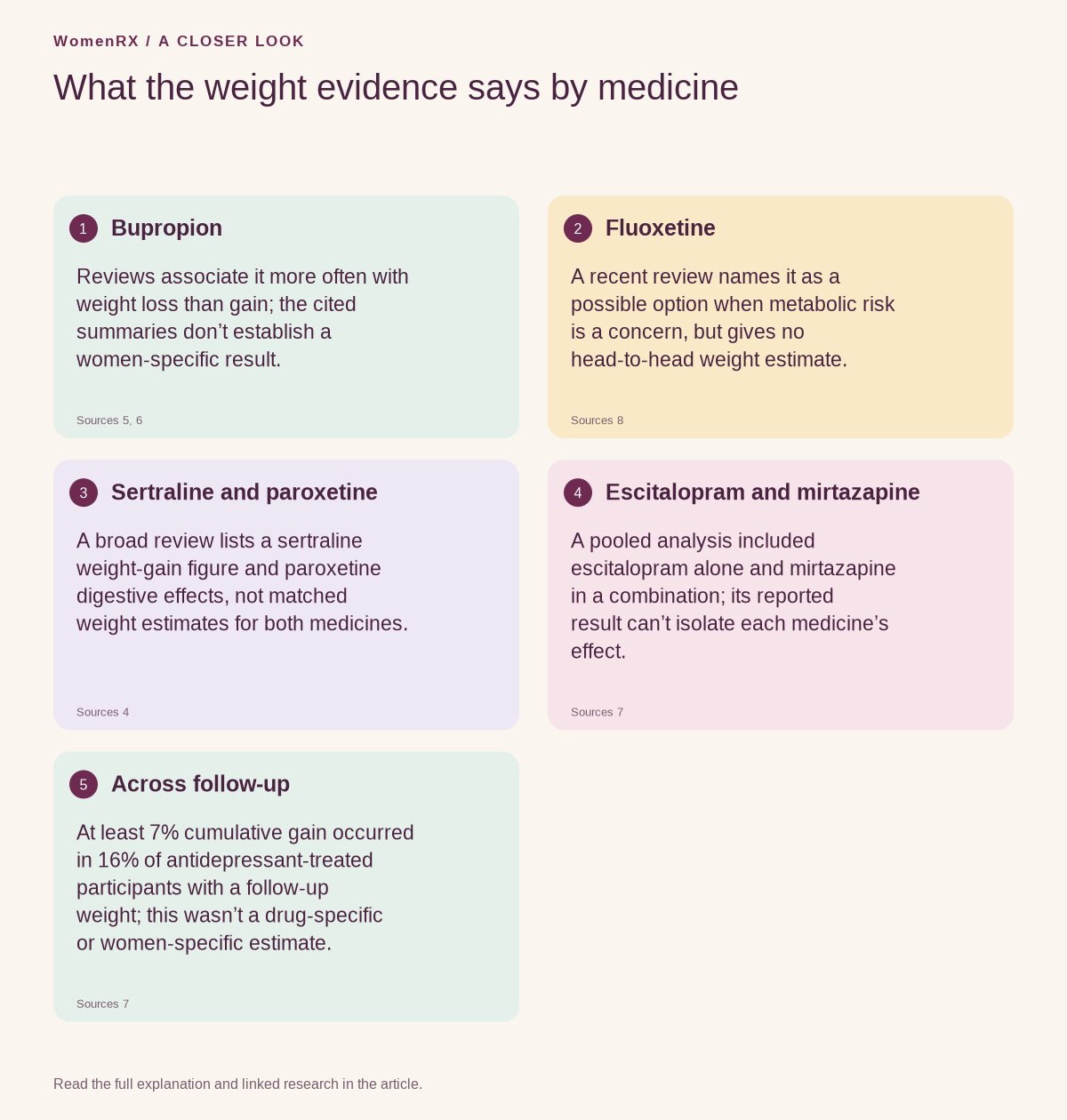
What the weight evidence says by medicine
Bupropion: Reviews associate it more often with weight loss than gain; the cited summaries don’t establish a women-specific result.56
Fluoxetine: A recent review names it as a possible option when metabolic risk is a concern, but gives no head-to-head weight estimate.8
Sertraline and paroxetine: A broad review lists a sertraline weight-gain figure and paroxetine digestive effects, not matched weight estimates for both medicines.4
Escitalopram and mirtazapine: A pooled analysis included escitalopram alone and mirtazapine in a combination; its reported result can’t isolate each medicine’s effect.7
Across follow-up: At least 7% cumulative gain occurred in 16% of antidepressant-treated participants with a follow-up weight; this wasn’t a drug-specific or women-specific estimate.7
Read the figure as text
The evidence is stronger for some broad patterns than for head-to-head comparisons. These distinctions can help frame a medication review without treating study results as a personal forecast.- Bupropion: Reviews associate it more often with weight loss than gain; the cited summaries don’t establish a women-specific result.56
- Fluoxetine: A recent review names it as a possible option when metabolic risk is a concern, but gives no head-to-head weight estimate.8
- Sertraline and paroxetine: A broad review lists a sertraline weight-gain figure and paroxetine digestive effects, not matched weight estimates for both medicines.4
- Escitalopram and mirtazapine: A pooled analysis included escitalopram alone and mirtazapine in a combination; its reported result can’t isolate each medicine’s effect.7
- Across follow-up: At least 7% cumulative gain occurred in 16% of antidepressant-treated participants with a follow-up weight; this wasn’t a drug-specific or women-specific estimate.7
More questions, answered
Does weight gain mean my antidepressant isn’t working?
Bring both concerns into a medication review rather than assuming what the weight change says about treatment. Tell your prescriber how your weight has changed and whether the symptoms being treated have improved before deciding what to do next. 3
Should I switch to bupropion if I’m worried about weight?
Bupropion is more likely to be associated with weight loss than gain in reviews, but that doesn’t make it right for everyone or guarantee a particular result. The cited summaries don’t establish a women-specific weight outcome. Ask whether it’s suitable for your symptoms, health history, and other medicines. 5 6
Sources you can check
- Fluoxetine: an antidepressant medicine - NHSAccessed 2026-09-25Return to first citation
- Sertraline: an antidepressant medicine - NHSAccessed 2026-09-25Return to first citation
- Antidepressants - NHSAccessed 2026-09-25Return to first citation
- Metabolic Adverse Effects of Psychotropic Drug Therapy: A Systematic Review.Sepúlveda-Lizcano L, Arenas-Villamizar VV, Jaimes-Duarte EB, García-Pacheco H, Paredes CS, Bermúdez V, Rivera-Porras D. · European journal of investigation in health, psychology and education · 2023Return to first citation
- Effects of antidepressant and antipsychotic use on weight gain: A systematic review.Alonso-Pedrero L, Bes-Rastrollo M, Marti A. · Obesity reviews : an official journal of the International Association for the Study of Obesity · 2019Return to first citation
- Bupropion: a systematic review and meta-analysis of effectiveness as an antidepressant.Patel K, Allen S, Haque MN, Angelescu I, Baumeister D, Tracy DK. · Therapeutic advances in psychopharmacology · 2016Return to first citation
- Transdiagnostic medication-associated weight gain across five effectiveness trials: a harmonized longitudinal cohort analysis of antipsychotics, antidepressants, and mood stabilizers.Serretti A. · Progress in neuro-psychopharmacology & biological psychiatry · 2026Return to first citation
- Antidepressants and Weight Gain: An Update on the Evidence and Clinical Implications.Moss L, Laudenslager M, Steffen KJ, Sockalingam S, Coughlin JW. · Current obesity reports · 2025Return to first citation