Antidepressants for PMDD: Choosing a Schedule Together
SSRIs can reduce premenstrual symptoms, but the best treatment plan depends on your symptom pattern and what matters most to you.
For diagnosed PMDD, selective serotonin reuptake inhibitors (SSRIs) can reduce premenstrual symptoms. They may be prescribed every day or during the premenstrual part of the cycle. A review found greater average symptom improvement with daily use, though it included women with both PMS and PMDD. Your symptom pattern, side effects, other medicines, and pregnancy plans can shape the discussion. 5237
Start with the pattern, not the prescription
PMDD is more than having difficult days before a period. Symptoms typically begin in the week or two before bleeding, improve after the period starts, and can disrupt work, social life, or relationships. The timing matters: symptoms that persist throughout the month may need a different assessment from symptoms that reliably rise and then ease with each cycle. 17
A daily record of symptoms, bleeding, and their effect on your usual activities can help you and your prescriber see that pattern across cycles. If your periods are irregular, or distress makes tracking difficult, say so. Those details are useful for understanding the pattern and considering whether a cycle-timed treatment would be practical. 7
Daily and cycle-timed SSRIs: the real tradeoff
Continuous treatment means taking an SSRI every day. Luteal-phase treatment means taking it during the premenstrual part of the cycle. A 2024 Cochrane review of 34 randomized trials found that SSRIs probably reduced overall self-rated premenstrual symptoms compared with placebo. Its schedule analyses found greater average symptom improvement with continuous than with luteal-phase use. The trials included women with PMS as well as PMDD, so that comparison is not a PMDD-only estimate or a rule for which schedule will work best for you. 5
There’s a third approach to ask about: symptom-onset treatment, which begins when symptoms appear rather than at a planned point in the cycle. In one randomized trial, 252 women with PMDD were assigned to sertraline or placebo from symptom onset through the first few days of menstruation over six cycles. Some measures favored sertraline, but the primary symptom-scale comparison did not show a clear difference. That mixed result shouldn’t be treated as evidence that symptom-onset and luteal-phase schedules work equally well. 6
Consider what each approach would mean in your life. If symptoms are closely confined to a predictable premenstrual window, a cycle-timed approach may be worth discussing. If your cycles are unpredictable or symptoms also occur at other times, ask how those details affect the choice. These are questions for planning a prescription together, not instructions to change an existing schedule yourself. 57
The medicine matters as well as the timing
The review included trials of fluoxetine, sertraline, escitalopram, paroxetine, and citalopram. It does not establish one SSRI as the best choice for everyone with PMDD. Prior experiences with antidepressants, other health conditions, and medicines you already take are relevant to choosing one; medicine references caution that some drugs and supplements may not mix well with fluoxetine or sertraline. 523
Side effects deserve a place in the decision, too. Across the review’s PMS and PMDD trials, SSRIs were associated with increased odds of nausea, insomnia, sexual dysfunction or decreased libido, and fatigue or sedation compared with placebo. Ask which effects are relevant to the medicine you’re considering and how you’ll assess both symptom improvement and side effects. 5
If you’re planning a pregnancy, pregnant, or breastfeeding, bring that up before choosing or changing treatment. Guidance for fluoxetine and sertraline calls for weighing the benefits and risks in those situations; it does not provide a PMDD-specific comparison between the two medicines. 23
A planned intermittent prescription is not the same thing as abruptly stopping a continuous one. The symptom-onset sertraline trial found no difference between groups on its withdrawal-symptom scale, but that finding does not settle what happens with every medicine or schedule. Abruptly stopping an antidepressant taken continuously can cause withdrawal symptoms, so discuss any change to an existing prescription with your prescriber. 6234
Bring these questions to the decision
- Do my symptoms and their timing fit PMDD, or might another condition also be contributing?
- How would daily treatment compare with a cycle-timed approach for my pattern and cycle predictability?
- Which medicine fits my health history, other medicines, and pregnancy or breastfeeding plans?
- What changes in mood and daily functioning would tell us treatment is helping? Which side effects should I raise?
- If the first plan isn’t helping or is hard to live with, what would we reconsider?
If you develop new suicidal thoughts or an urge to self-harm after starting an antidepressant, contact your prescriber promptly. If you’re in immediate danger or can’t keep yourself safe, seek emergency help. 4
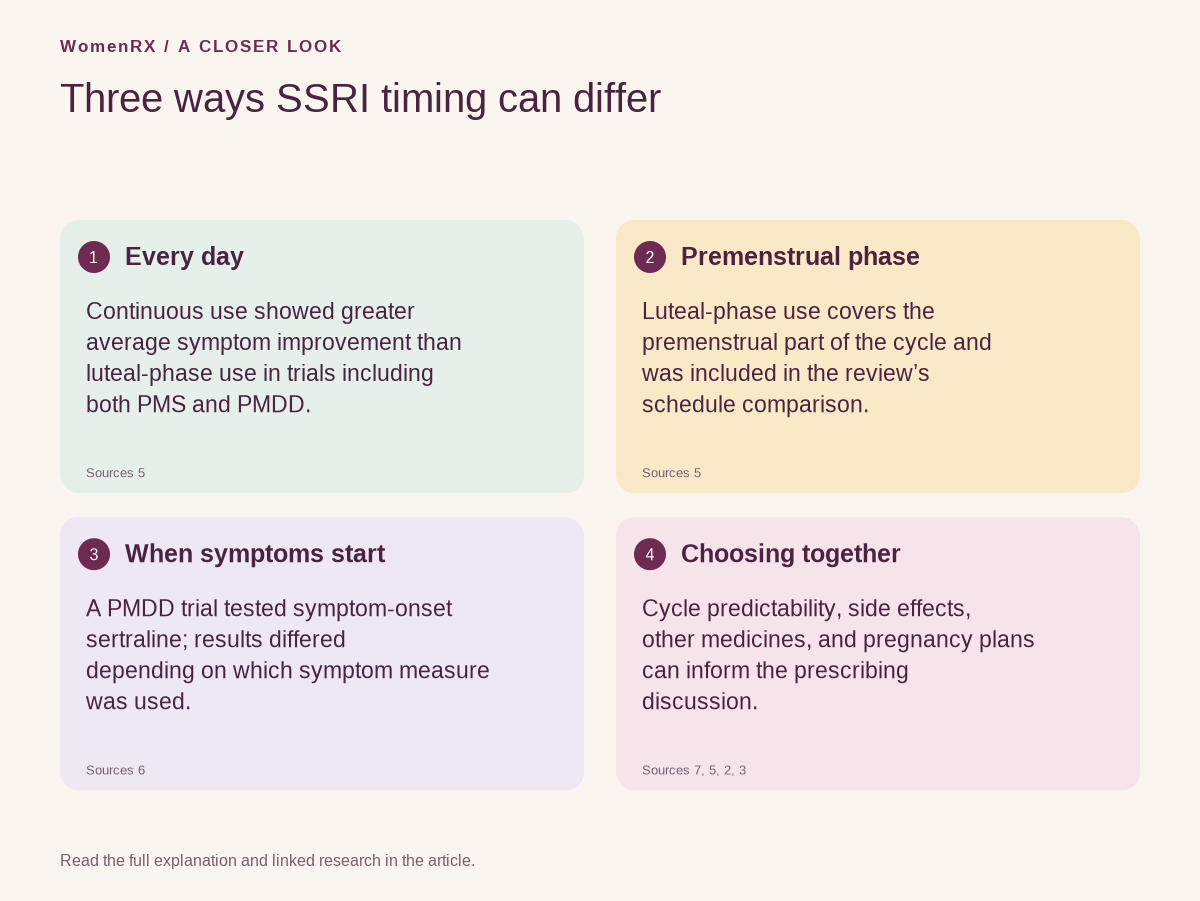
Three ways SSRI timing can differ
Every day: Continuous use showed greater average symptom improvement than luteal-phase use in trials including both PMS and PMDD.5
Premenstrual phase: Luteal-phase use covers the premenstrual part of the cycle and was included in the review’s schedule comparison.5
When symptoms start: A PMDD trial tested symptom-onset sertraline; results differed depending on which symptom measure was used.6
Choosing together: Cycle predictability, side effects, other medicines, and pregnancy plans can inform the prescribing discussion.7523
Read the figure as text
The schedules differ in when treatment is taken and what the research can tell us about each approach.- Every day: Continuous use showed greater average symptom improvement than luteal-phase use in trials including both PMS and PMDD.5
- Premenstrual phase: Luteal-phase use covers the premenstrual part of the cycle and was included in the review’s schedule comparison.5
- When symptoms start: A PMDD trial tested symptom-onset sertraline; results differed depending on which symptom measure was used.6
- Choosing together: Cycle predictability, side effects, other medicines, and pregnancy plans can inform the prescribing discussion.7523
More questions, answered
Is symptom-onset treatment the same as luteal-phase treatment?
No. Luteal-phase treatment covers the premenstrual part of the cycle, while symptom-onset treatment begins when symptoms appear. The sertraline symptom-onset trial had differing results across measures, so it does not establish that the two approaches are interchangeable. 56
Sources you can check
- PMDD (premenstrual dysphoric disorder) - NHSAccessed 2026-09-25Return to first citation
- Fluoxetine: an antidepressant medicine - NHSAccessed 2026-09-25Return to first citation
- Sertraline: an antidepressant medicine - NHSAccessed 2026-09-25Return to first citation
- Antidepressants - NHSAccessed 2026-09-25Return to first citation
- Selective serotonin reuptake inhibitors for premenstrual syndrome and premenstrual dysphoric disorder.Jespersen C, Lauritsen MP, Frokjaer VG, Schroll JB. · The Cochrane database of systematic reviews · 2024Return to first citation
- Symptom-Onset Dosing of Sertraline for the Treatment of Premenstrual Dysphoric Disorder: A Randomized Clinical Trial.Yonkers KA, Kornstein SG, Gueorguieva R, Merry B, Van Steenburgh K, Altemus M. · JAMA psychiatry · 2015Return to first citation
- Premenstrual dysphoric disorder in online peer support communities: a Reddit case study.Evkoski B, Letina S, Kralj Novak P, Riddell J. · Scientific reports · 2025Return to first citation