PMDD: Recognizing the Pattern and Comparing Treatments
Severe symptoms that repeatedly rise before a period and ease afterward deserve assessment, especially when they disrupt your life.
PMDD is assessed by looking at both timing and impact: symptoms recur before a period, ease afterward, and cause significant distress or disruption. Daily notes across at least two cycles can help confirm that pattern. Treatment options include selective serotonin reuptake inhibitors (SSRIs), oral contraceptive pills, and cognitive behavioral therapy. The best discussion starts with what your symptoms affect and what you want from treatment. 134
Look for a pattern, not just a bad week
PMDD can bring severe emotional and physical symptoms in the week or two before a period. They usually improve a few days after bleeding starts. What distinguishes PMDD from less disruptive premenstrual symptoms is the effect on your life: the symptoms cause significant distress or interfere with work, school, social activities, or relationships. 14
That timing matters. For example, feeling markedly worse before each period and noticeably better afterward points toward a different pattern than feeling unwell at much the same level all month. Symptoms that persist throughout the month may call for reassessment for another or an additional cause, even if they get worse before a period. 4
There isn’t one established cause that explains every case. Increased sensitivity to natural hormonal changes during the menstrual cycle is one possible explanation. It doesn’t mean that everyone with PMDD has abnormal hormone levels. 1
Why daily notes help with diagnosis
A clinician will ask what happens, when it happens, and how it affects you. Because one cycle may differ from another, recording symptoms as they occur for at least two cycles helps show whether the pattern repeats. The Daily Record of Severity of Problems is one structured option. A diary contributes to assessment; it isn’t a diagnosis by itself. 14
Make the notes useful rather than elaborate: record your symptoms, bleeding dates, and whether you could do the things you needed or wanted to do. Include the better days. Seeing when symptoms ease is just as helpful as seeing when they peak. 4
If your cycles are irregular, record actual bleeding dates rather than trying to fit symptoms into an expected calendar week. If you use hormonal contraception, include that in your notes and tell the clinician assessing you. These details give context to the timing you’re describing; you don’t need to settle what the pattern means on your own.
What to weigh when choosing treatment
SSRIs are a first-line treatment option for PMDD. Improvement can be relatively rapid, but side effects may limit their use. A useful question is which changes you’re hoping to see in your hardest premenstrual days, and which potential side effects would matter most to you. 4
Oral contraceptive pills are another option used to manage PMDD. If you’re considering one, bring both your symptom goals and your contraception preferences into the conversation. A pill that fits someone else’s priorities may not fit yours. 3
Cognitive behavioral therapy (CBT) and exercise may also help with symptoms. They offer different ways to approach the problem and needn’t be treated as substitutes for discussing medication when symptoms are severely disruptive. A clinical review also mentions acupuncture, acupressure, and Vitex agnus castus as possible approaches, without establishing that any one of them is the right choice for everyone. 4
You can keep the treatment discussion focused with a few questions: Which symptom or disruption are we trying to change first? What drawbacks might affect my choice? How will we judge whether the approach is helping? If symptoms remain uncontrolled, should we reconsider the treatment, the diagnosis, or both? Reassessment is particularly relevant when symptoms continue throughout the month. 4
If your safety is at risk
A systematic review found that PMDD and related premenstrual disorders were associated with suicidal thoughts and behaviors, although the studies varied and many had methodological concerns. That finding cannot predict any one person’s risk. If you’re having thoughts of suicide or feel at risk of acting on them, seek urgent mental-health help now rather than waiting to complete a symptom diary. 12
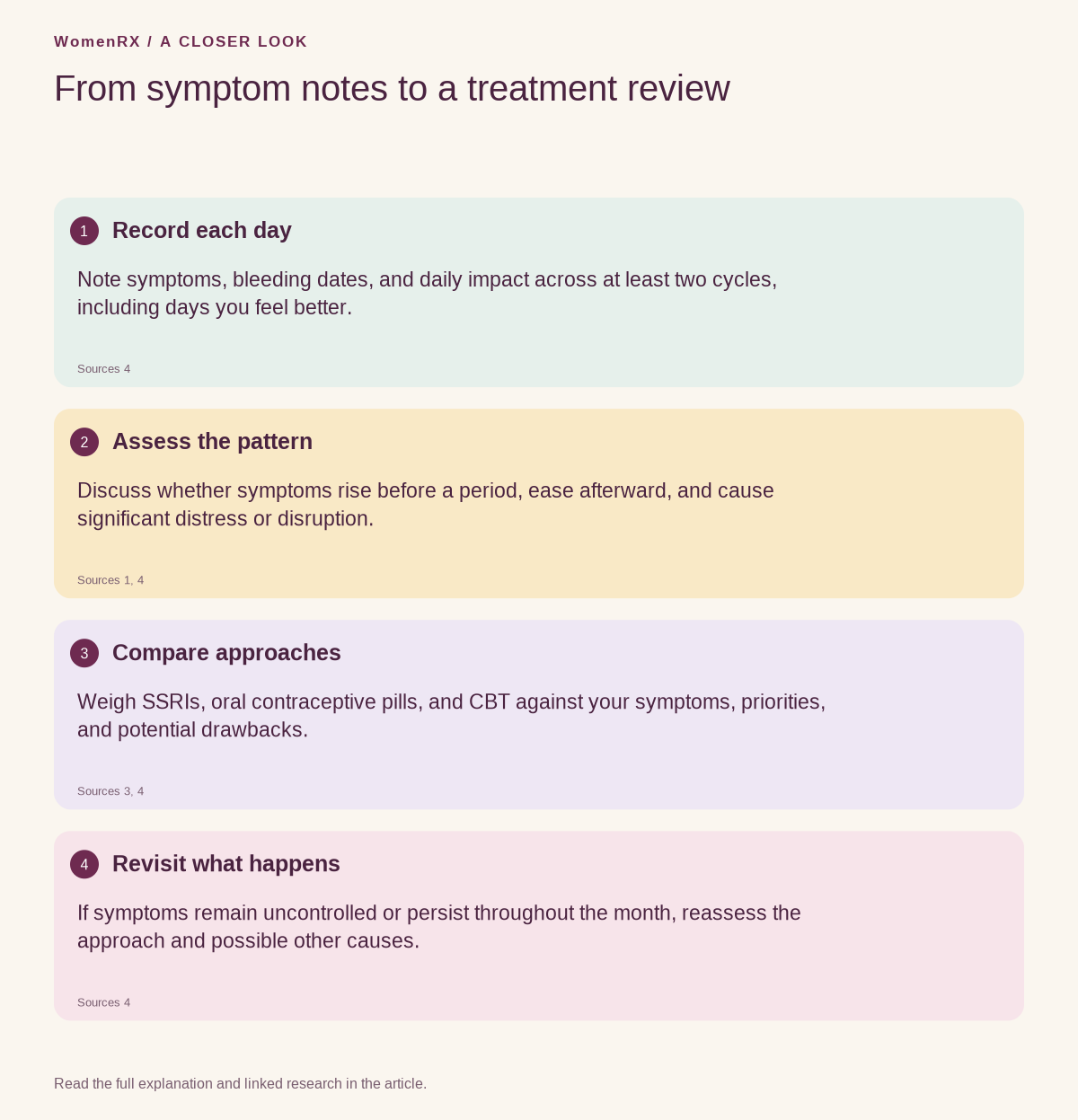
From symptom notes to a treatment review
Record each day: Note symptoms, bleeding dates, and daily impact across at least two cycles, including days you feel better.4
Assess the pattern: Discuss whether symptoms rise before a period, ease afterward, and cause significant distress or disruption.14
Compare approaches: Weigh SSRIs, oral contraceptive pills, and CBT against your symptoms, priorities, and potential drawbacks.34
Revisit what happens: If symptoms remain uncontrolled or persist throughout the month, reassess the approach and possible other causes.4
Read the figure as text
Use this route to connect what happens across your cycle with an assessment and a discussion of care options.- Record each day: Note symptoms, bleeding dates, and daily impact across at least two cycles, including days you feel better.4
- Assess the pattern: Discuss whether symptoms rise before a period, ease afterward, and cause significant distress or disruption.14
- Compare approaches: Weigh SSRIs, oral contraceptive pills, and CBT against your symptoms, priorities, and potential drawbacks.34
- Revisit what happens: If symptoms remain uncontrolled or persist throughout the month, reassess the approach and possible other causes.4
More questions, answered
Can I have PMDD if symptoms change from cycle to cycle?
Symptoms can vary, which is one reason daily recording across at least two cycles is recommended. The assessment looks for a recurring relationship to your cycle and significant distress or disruption, not identical days every month. 4
Sources you can check
- PMDD (premenstrual dysphoric disorder) - NHSAccessed 2026-09-25Return to first citation
- Prevalence, Risk Factors, and Treatments for Suicidality in People Living with Premenstrual Dysphoric Disorder (PMDD): A Systematic Review.Zhitnik E, Britt T, Bertone-Johnson E, Mackie TI, Hartmann-Boyce J. · Administration and policy in mental health · 2026Return to first citation
- Evaluation and management of premenstrual dysphoric disorder.Nagle SA, Murray PJ, Allen EB. · Current opinion in pediatrics · 2026Return to first citation
- Premenstrual Syndrome and Premenstrual Dysphoric Disorder: Common Questions and Answers.Biggs WS, Romeu JM, Gaudard T. · American family physician · 2025Return to first citation