PMDD or Perimenopause? Make Sense of the Pattern
Daily notes can show whether severe mood symptoms lift after your period or continue through the month as your cycles change.
PMDD is suggested by symptoms that reliably build before a period, interfere with daily life, and ease after bleeding begins. Mood symptoms that persist through the month, or worsen before bleeding without clearing afterward, may point to another mood condition or premenstrual worsening of one. Because irregular cycles make timing harder to read, record symptoms and bleeding every day across cycles and review the pattern with a clinician. 1
The timing matters more than the label
Severe irritability, sadness, anxiety, or feeling overwhelmed before a period can fit PMDD, but the symptom list alone can’t settle the question. The key is the pattern: symptoms become prominent before bleeding, ease after it starts, and cause meaningful distress or disruption. A 2002 clinical review describes PMDD as requiring at least five specified symptoms, but emphasizes that their timing and impact are central to assessment. 1
If symptoms are present throughout the month and simply intensify before bleeding, a clinician may consider premenstrual exacerbation of another condition, such as depression. If low mood or anxiety is happening at other times too, that broader pattern matters. Perimenopause can also be part of the picture, but the transition itself doesn’t prove what is causing a particular mood change. A 2025 review describes possible links between reproductive hormone changes and mood while noting that these relationships still need further investigation. 12
There can be overlap. In a clinic study of 141 women ages 45 to 55, a history of PMDD was associated with depressive symptoms during perimenopause. That finding is an association in a particular group, not proof that PMDD causes later depression or that every woman with PMDD will develop it. 3
Keep a daily record, even when cycles are irregular
Retrospective impressions can miss the timing. In the clinical review, fewer than half of women who reported PMS had daily records that confirmed those reports. The review recommends prospective daily ratings over two to three cycles when assessing a possible premenstrual disorder. It also notes that irregular cycling complicates the usual assessment and warrants consideration of other conditions. 1
Use a calendar, notes app, or paper chart, whichever you’ll actually keep up with. Each day, note:
- Mood symptoms and how intense they felt.
- Whether they affected work, relationships, sleep, or ordinary tasks.
- Bleeding, including when it starts and stops.
- Relevant context, such as hot flashes or a major change in sleep.
Record days when you feel well, too. Those days help show whether symptoms truly ease after bleeding begins or remain present between periods. Don’t wait for an app to predict a “usual” cycle day; mark what happens, when it happens. The goal isn’t to diagnose yourself or produce a perfect chart. It’s to make the timing visible when cycle dates are less predictable. 1
What the record can help distinguish
A clear stretch of improvement after bleeding begins supports a different pattern from symptoms that stay high across the month. If you see a premenstrual rise but no symptom-free or much-improved interval, share that too; a clinician may consider whether another mood or health condition is being worsened before bleeding. A symptom record is one part of assessment, not a substitute for discussing your mental-health history and other possible explanations. 1
Irregular cycles deserve particular attention. The review describes the traditional PMDD assessment in relation to regular cycles and says irregular cycling should prompt examination for other conditions. That doesn’t mean PMDD is impossible when cycles change; it means the pattern may be harder to interpret, so a clinician may need to look more broadly rather than rely on a predicted period date. 1
Use the pattern to discuss care, not to delay it
Bring the record to a primary-care clinician, gynecologist, or mental-health clinician. Ask whether the pattern looks more like symptoms limited to the premenstrual phase, a mood condition that is present more broadly, or both. If symptoms are severe now, you don’t have to wait through several cycles before asking for help.
For severe premenstrual symptoms, a clinical review found consistent evidence for serotonergic antidepressants, including selective serotonin reuptake inhibitors (SSRIs), as treatment. The choice of treatment depends on the pattern and the person; the record can help make that discussion more specific. The evidence for mood changes around perimenopause is a separate question, so don’t assume that an estradiol patch or other menopause hormone therapy is automatically a treatment for PMDD. 12
If you’re thinking about suicide or self-harm, or don’t feel able to stay safe, seek immediate help rather than waiting to finish tracking. Tracking is useful for understanding a pattern; it isn’t a reason to put off urgent support.
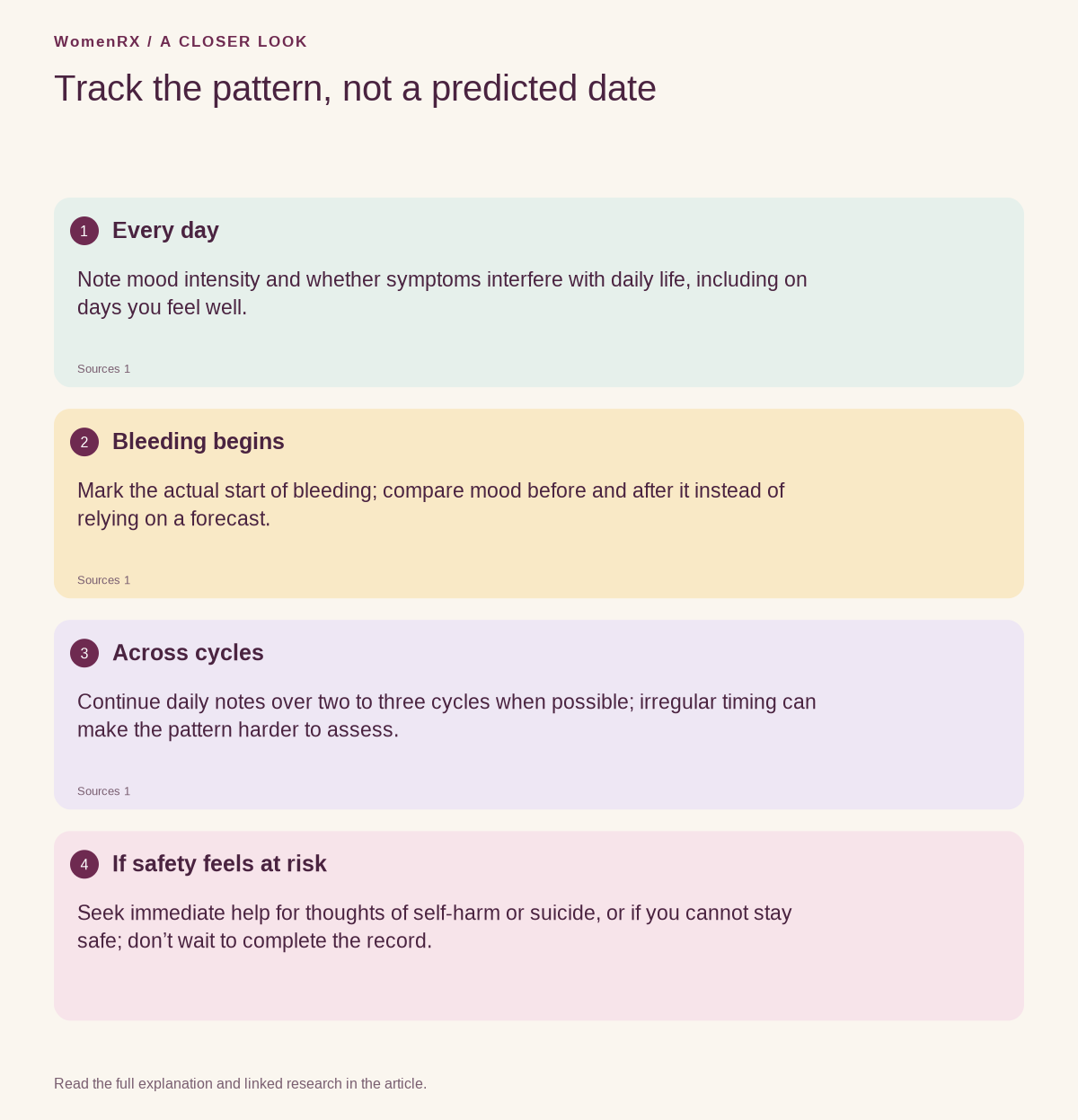
Track the pattern, not a predicted date
Every day: Note mood intensity and whether symptoms interfere with daily life, including on days you feel well.1
Bleeding begins: Mark the actual start of bleeding; compare mood before and after it instead of relying on a forecast.1
Across cycles: Continue daily notes over two to three cycles when possible; irregular timing can make the pattern harder to assess.1
If safety feels at risk: Seek immediate help for thoughts of self-harm or suicide, or if you cannot stay safe; don’t wait to complete the record.
Read the figure as text
A daily record can follow changing cycle lengths by marking symptoms and actual bleeding rather than assuming a regular schedule.- Every day: Note mood intensity and whether symptoms interfere with daily life, including on days you feel well.1
- Bleeding begins: Mark the actual start of bleeding; compare mood before and after it instead of relying on a forecast.1
- Across cycles: Continue daily notes over two to three cycles when possible; irregular timing can make the pattern harder to assess.1
- If safety feels at risk: Seek immediate help for thoughts of self-harm or suicide, or if you cannot stay safe; don’t wait to complete the record.
More questions, answered
Do I need to wait two or three cycles before getting help?
No. Prospective daily records across two to three cycles can help clarify a possible premenstrual pattern, but the review’s tracking recommendation is not a reason to delay care when symptoms are severe or urgent. 1
Does a history of PMDD mean I’ll have depression in perimenopause?
No. One clinic study found an association between a history of PMDD and depressive symptoms among perimenopausal participants, but it does not establish that PMDD causes later depression or predict what will happen to an individual. 3
Sources you can check
- Treatment of depression associated with the menstrual cycle: premenstrual dysphoria, postpartum depression, and the perimenopause.W Freeman E. · Dialogues in clinical neuroscience · 2002Return to first citation
- The influence of ovarian activity and menopause on mental health: Evidence from animal models and women.Neitzke EV, Dos Santos FG, Zanini BM, Cavalcante MB, Mason JB, Masternak MM, de Souza ICC, Schneider A. · Physiology & behavior · 2025Return to first citation
- Association between depressive symptoms and reproductive variables in a group of perimenopausal women attending a menopause clinic in México City.Flores-Ramos M, Heinze G, Silvestri-Tomassoni R. · Archives of women's mental health · 2010Return to first citation