PMS or PMDD? Look at the Pattern and Impact
The clearest distinction isn’t one symptom: it’s a recurring premenstrual pattern, how severe it is, and how much it disrupts daily life.
PMS and PMDD can share mood, physical, and behavioral symptoms, so severity alone doesn’t tell you which one you have. The useful clues are whether symptoms reliably rise before your period, ease after bleeding begins, and leave a clearer, less symptomatic part of the cycle. Daily ratings across at least two cycles help assess that pattern; major disruption is a reason to ask about PMDD assessment. 1 2
The difference is more than a symptom list
PMS and premenstrual dysphoric disorder (PMDD) can involve many of the same symptoms, including irritability, low mood, anxiety, changes in appetite, trouble concentrating, and physical discomfort. They’re not always cleanly separated by one symptom. Experts describe premenstrual conditions as overlapping, while PMDD refers to a severe pattern with substantial distress or disruption to everyday functioning. 1 2 3
That means a difficult few days before a period don’t automatically mean PMDD. The question is whether symptoms follow a repeatable cycle-related pattern and how much they affect your work, relationships, usual activities, or sense of well-being. 1 3
Timing helps distinguish a cycle pattern
For PMDD, the expected pattern is symptoms in the final week before menstruation, improvement within a few days after bleeding starts, and symptoms becoming minimal in the following week. A stretch of better days after the period is useful context: it helps show whether symptoms are limited to a particular part of the cycle or present more broadly. 3
If depression, anxiety, or another concern is present throughout the month but gets worse before a period, that’s also worth describing. A clinician needs to consider whether symptoms are specifically cyclical or whether an existing condition is worsening premenstrually; those possibilities aren’t interchangeable. 3
Why daily notes beat a strong memory
It can be hard to recall exactly when symptoms began, how intense they were, or whether you felt better between periods. Looking back, people may overestimate how consistently symptoms matched the cycle. Prospective daily ratings, recorded as symptoms happen, make those changes easier to evaluate. 2
For a useful record, note each day:
- Mood and physical symptoms, using your own words.
- How intense each symptom feels, rather than only whether it happened.
- Bleeding or spotting.
- The effect on ordinary activities, work, school, or relationships.
- Days when symptoms ease or are minimal.
The Daily Record of Problem Severity is one tool used to record symptoms; a simple daily log can also help you describe the pattern. Diagnostic guidance calls for prospective recording across at least two cycles. A diary is evidence for a conversation, not a score that diagnoses you on its own. 2
If your cycle is irregular, or you use hormonal contraception, include that context in your notes and tell the clinician assessing the pattern. Don’t assume that calendar dates alone identify where you are in a cycle.
Let daily-life impact guide the next step
Symptoms that are bothersome but manageable may still deserve attention, especially if you want help with them. Ask about PMDD assessment when recurring premenstrual symptoms cause significant distress or interfere with important parts of life. PMDD criteria include both a specific timing pattern and meaningful impairment, not just a high symptom count or one especially hard cycle. 1 3
The formal PMDD criteria include at least five symptoms, including at least one key mood symptom, alongside the required timing and impact pattern. That threshold is one part of a clinical assessment, not a self-diagnosis checklist. A clinician may also consider other explanations for symptoms and whether another condition is worsening at a particular time of the month. 3
You don’t have to wait until you’ve completed two cycles of notes to bring up severe symptoms. Share what you’re experiencing and ask how to assess the pattern; daily tracking can continue as part of that process. If you’re feeling suicidal, seek immediate crisis help rather than waiting to finish tracking. 1 2
A focused way to describe what’s happening
You might say: “I’m noticing mood and physical symptoms before my period. They seem to ease after bleeding starts, and they’re affecting ____. I’ve started recording them daily. Could we assess whether this is a premenstrual disorder or something else?” Add what happens during the rest of the cycle, whether your cycles are irregular, and whether you use hormonal contraception. That gives the assessment more than a retrospective impression to work with. 2 3
What to compare: PMS and PMDD
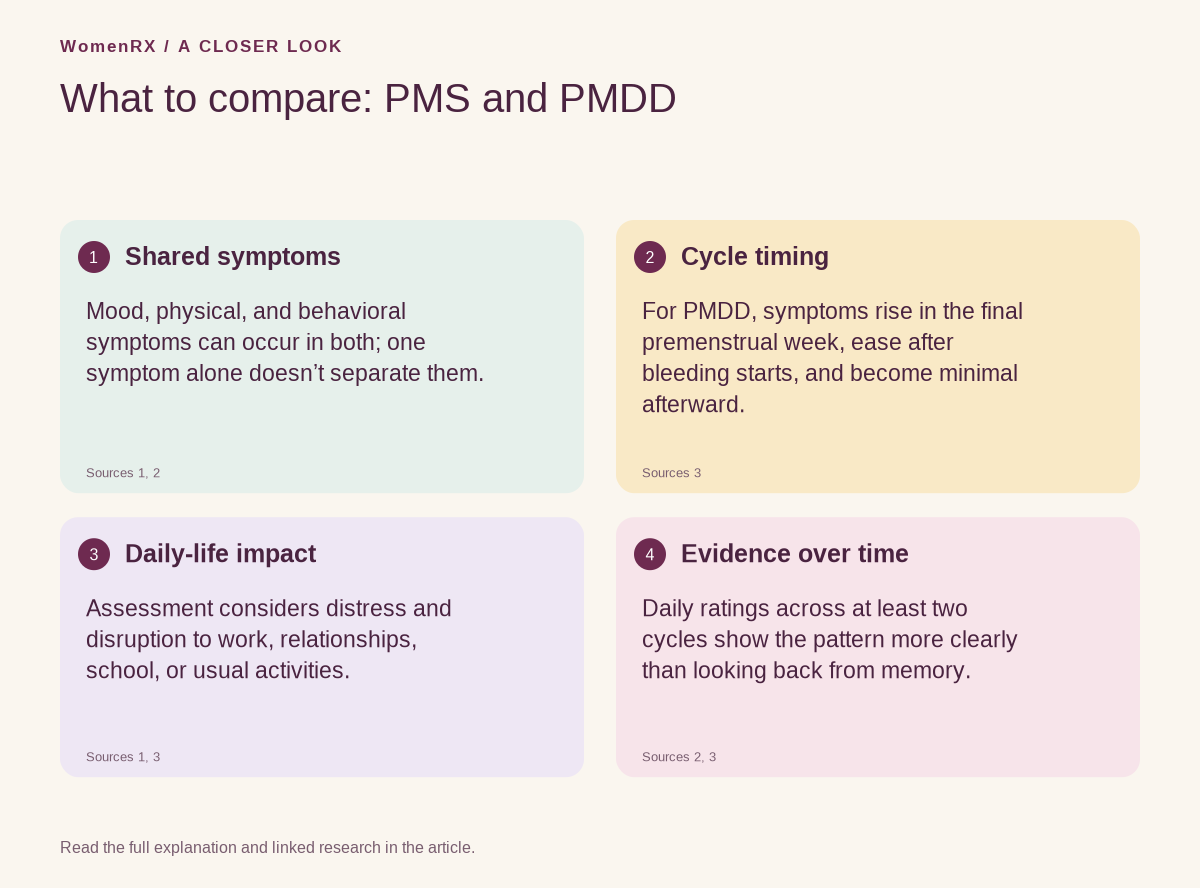
Shared symptoms: Mood, physical, and behavioral symptoms can occur in both; one symptom alone doesn’t separate them.12
Cycle timing: For PMDD, symptoms rise in the final premenstrual week, ease after bleeding starts, and become minimal afterward.3
Daily-life impact: Assessment considers distress and disruption to work, relationships, school, or usual activities.13
Evidence over time: Daily ratings across at least two cycles show the pattern more clearly than looking back from memory.23
Read the figure as text
These dimensions help explain what an assessment considers. They are not a diagnostic score, and symptoms can overlap.- Shared symptoms: Mood, physical, and behavioral symptoms can occur in both; one symptom alone doesn’t separate them.12
- Cycle timing: For PMDD, symptoms rise in the final premenstrual week, ease after bleeding starts, and become minimal afterward.3
- Daily-life impact: Assessment considers distress and disruption to work, relationships, school, or usual activities.13
- Evidence over time: Daily ratings across at least two cycles show the pattern more clearly than looking back from memory.23
More questions, answered
Do severe symptoms automatically mean PMDD?
No. Severity and disruption matter, but PMDD assessment also considers whether symptoms follow the required cycle-related timing and whether other explanations, such as a condition that worsens premenstrually, fit better. Prospective daily ratings help confirm the pattern. 2 3
Should I wait two cycles before asking for help?
No. You can describe severe or disruptive symptoms now. Recording them prospectively across two cycles can help clarify the pattern, but it doesn’t have to be a reason to postpone a conversation or support. 1 2
Sources you can check
- PMS (premenstrual syndrome) - NHSAccessed 2026-09-25Return to first citation
- Practical diagnosis and treatment of premenstrual syndrome and premenstrual dysphoric disorder by psychiatrists and obstetricians/gynecologists in Japan.Yoshimi K, Inoue F, Odai T, Shirato N, Watanabe Z, Otsubo T, Terauchi M, Takeda T. · PCN reports : psychiatry and clinical neurosciences · 2024Return to first citation
- Premenstrual DisordersMiller C, Carlson K. · 2026Return to first citation