Low Desire on Antidepressants: What to Bring Up
A short timeline can help you and your prescriber separate changes in desire from changes in arousal, comfort, or orgasm.
If your desire changed after starting or changing an antidepressant, note when it shifted, what changed sexually, and how your mood was doing. Depression and antidepressants can both affect sexual function, so the timeline helps frame the conversation without proving the cause. Ask whether staying with your current treatment or considering another plan best balances sexual side effects and mood; don’t stop suddenly. 2 3
First, name what changed
“Low libido” can describe different experiences. You might think about sex less often, feel interested but have trouble becoming aroused, notice vaginal dryness or discomfort, or find orgasm more difficult. Antidepressants can be associated with low desire, difficulty reaching orgasm, and vaginal dryness. Serotonergic antidepressants may also affect arousal. 2 3
That distinction is useful because it gives your prescriber a clearer starting point. If interest is still there but sex feels uncomfortable, for example, say that plainly rather than describing the whole change as low desire. You don’t need to choose a perfect label; concrete details are enough.
Build a small timeline, not a case file
Note whether the change began before treatment or after starting the medicine. Add what was happening with your mood around the same time. Depression can affect desire and other parts of sexual response before medication begins, while antidepressants may also contribute during treatment. The two can overlap, which makes timing helpful but not conclusive. 3
A few brief notes are usually more useful than trying to monitor every sexual experience. You could record:
- Medication details: the medicine name, when you started it, and the dates of any dose changes.
- What feels different: interest, arousal, lubrication or comfort, orgasm, or more than one of these.
- Mood: whether depression or anxiety symptoms were improving, worsening, or about the same.
- Other medicines: note any medicines you take. Medicines can affect sexual health, and antidepressants can also affect other medicines you take. 1 2
Bring the notes if they help, but you don’t need a completed worksheet to raise the concern.
Discuss the trade-off, not just the symptom
You could open with: “Since starting or changing this medication, I’ve noticed [specific change]. It began around [time]. My mood has been [better, worse, or about the same]. Can we talk about what might be contributing and what choices make sense?”
Useful questions include:
- Could the change relate to the medication, my mood, or both?
- Is it reasonable to stay with this treatment for now, or should we consider a different plan?
- How would we weigh any possible change against the benefit I’m getting for my mood?
- Could another medicine or health change be contributing?
A prescriber can help you weigh staying with a treatment that is helping your mood against the impact of sexual side effects, and discuss whether another treatment plan is appropriate. There isn’t one option that suits everyone. If you’re pregnant, planning a pregnancy, or breastfeeding, bring that up because antidepressant decisions in those situations involve weighing benefits and risks. If you’re postpartum or in perimenopause or menopause, mention that context too so the conversation reflects your circumstances and priorities. 2
Don’t make a sudden change on your own
Even if the sexual side effect feels upsetting, don’t stop an antidepressant abruptly or change how you take it without speaking with your prescriber. Stopping suddenly can cause withdrawal symptoms, and any change in treatment deserves a plan. 2 If the problem is affecting whether you want to keep taking the medicine, tell your prescriber directly. That makes the trade-off part of the treatment conversation, rather than something you have to manage alone.
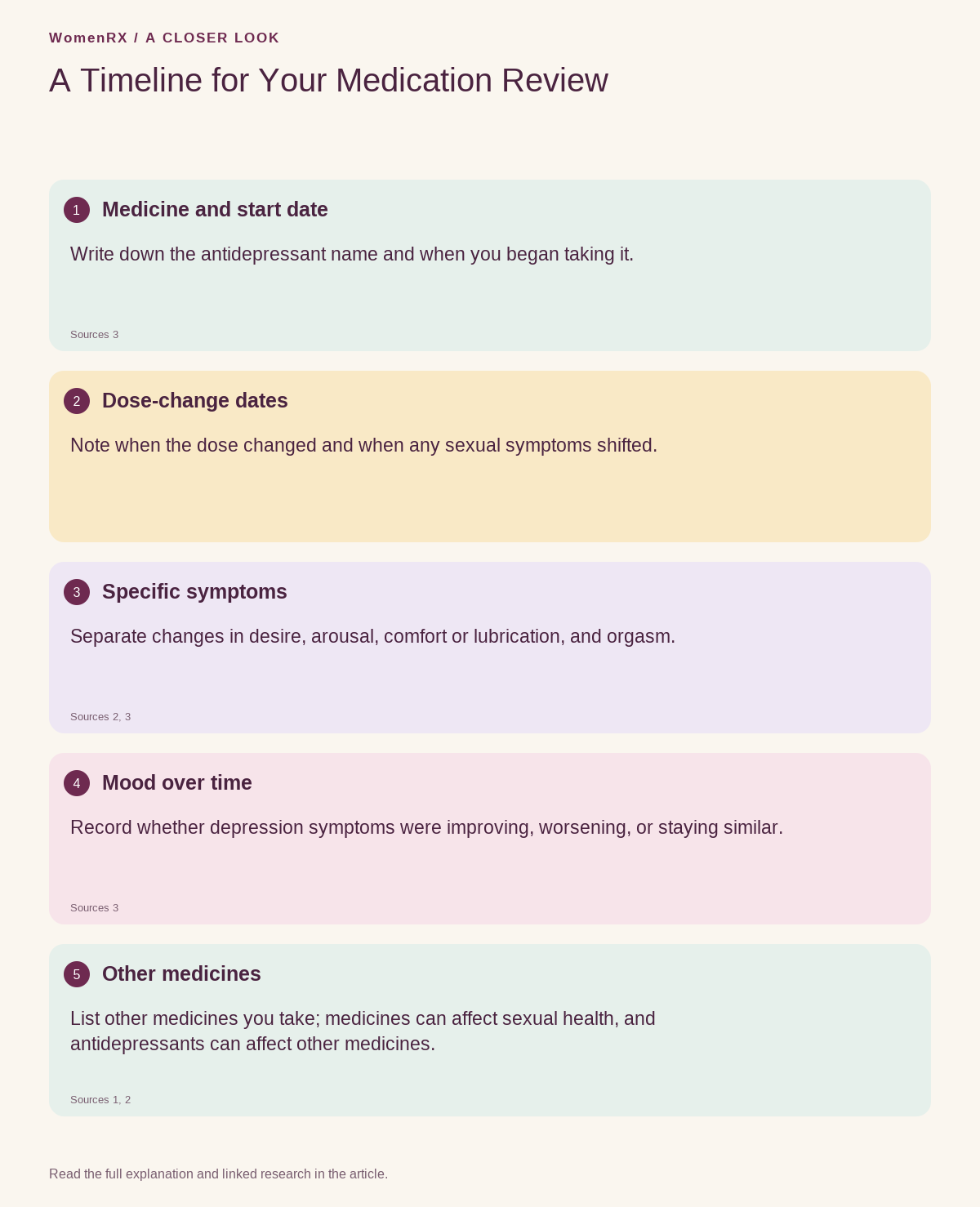
A Timeline for Your Medication Review
Medicine and start date: Write down the antidepressant name and when you began taking it.3
Dose-change dates: Note when the dose changed and when any sexual symptoms shifted.
Specific symptoms: Separate changes in desire, arousal, comfort or lubrication, and orgasm.23
Mood over time: Record whether depression symptoms were improving, worsening, or staying similar.3
Other medicines: List other medicines you take; medicines can affect sexual health, and antidepressants can affect other medicines.12
Read the figure as text
Use these prompts to put medication timing, sexual changes, and mood on the same page without assuming one cause.- Medicine and start date: Write down the antidepressant name and when you began taking it.3
- Dose-change dates: Note when the dose changed and when any sexual symptoms shifted.
- Specific symptoms: Separate changes in desire, arousal, comfort or lubrication, and orgasm.23
- Mood over time: Record whether depression symptoms were improving, worsening, or staying similar.3
- Other medicines: List other medicines you take; medicines can affect sexual health, and antidepressants can affect other medicines.12
Sources you can check
- Sexual Health | MedlinePlusAccessed 2026-09-25Return to first citation
- Antidepressants - NHSAccessed 2026-09-25Return to first citation
- Plant-derived bioactives in depression-related and antidepressant-associated sexual dysfunction: a narrative review.Liu X, Sun Z, Gao J, Fu CY, Yang Z. · Frontiers in nutrition · 2026Return to first citation