When Arousal Changes, Start by Separating the Signals
A change in sexual arousal can involve your sense of excitement, your body’s physical response, or both, so start by noticing what feels different.
Sexual arousal isn’t one signal: interest, felt excitement, and physical responses such as lubrication can change in different ways. Stress, sleep, medicines, health conditions, relationships, and life stage may be relevant, sometimes together. If you want help sorting it out, describe which part changed and whether sex is painful. That can focus a sexual, medical, and gynecologic assessment. 1 2 4 5
First, name what feels different
Arousal can mean the feeling of being mentally or emotionally engaged, physical changes in the genitals, or both. These parts of sexual response don’t always line up. You might feel interested but notice less physical response, or notice a physical response without feeling mentally aroused. Definitions of arousal disorders have differed partly because some focus on genital response and others on subjective experience. Desire and arousal can overlap, but they aren’t identical. 3 4 5
That distinction gives you a useful starting point: Is the change mainly in your interest, your felt excitement, your body’s response, or the experience overall? You don’t have to label it or decide that it’s a disorder to bring it up.
Several parts of life and health can contribute
Sexual response involves biological, psychological, and interpersonal factors. Stress, lack of sleep, emotional health, intimacy, and relationship circumstances may all be relevant. Chronic conditions such as heart disease or cancer, as well as medicines, can affect sexual health. These are possibilities to consider, not proof that any one factor explains your experience. 1 2 5
Life stage may add context. Postpartum changes, lactation, the menstrual cycle, menopause, and some reproductive surgeries are among the factors discussed in research on women’s sexual desire and related concerns. That doesn’t mean age or hormones explain every change in arousal. A useful assessment considers what changed in your life and health, rather than assuming one cause from your age or stage alone. 2 5
Medication is another reasonable topic to raise, especially if your interest changed around the time a medicine was started or changed. A review lists psychotropic medicines, hormonal contraceptives, and some medicines for high blood pressure among possible contributors to changes in sexual desire. That evidence does not show that a particular medicine is the cause of an individual woman’s arousal change. 2
Keep pain on its own track
Pain with sexual activity is worth mentioning in its own right. It is a separate concern to assess, not a reason to assume that pain caused a change in arousal. If pain is part of what’s happening, describe where it occurs and what it feels like; a sexual and gynecologic history and an examination may help assess the concern. 4 5
Let the kind of change focus the conversation
Different descriptions point to different questions, even though none identifies a cause on its own:
- Less interest in sex: Has this coincided with a change in stress, sleep, emotional well-being, your relationship, medication, or life stage? Those are all relevant contexts for a discussion about desire. 2
- Interest is there, but excitement feels muted: Describe the difference between wanting sex and feeling aroused. This helps keep subjective arousal from being treated as interchangeable with desire or with a physical response. Emotional and relationship context may be worth exploring alongside health history. 4 5
- You feel engaged, but your body responds differently: Say what you’ve noticed, such as a change in lubrication or genital sensitivity. A medical and gynecologic history and examination can help assess a physical-response concern; the change alone doesn’t establish a hormonal cause. 5
- Sex is painful: Describe the pain separately, even if you’ve also noticed less interest or arousal. It deserves its own assessment rather than being folded into an arousal label. 4 5
A clinician’s assessment may include a thorough sexual history as well as medical and gynecologic history and examination. The findings and your particular symptoms can guide what to consider next. The aim is not to force a single explanation: more than one factor may be contributing, and sometimes the initial conversation helps identify which part needs closer attention. 2 5
If the main change seems linked to a medicine or a life-stage shift, say so plainly. If it shows up alongside stress or relationship strain, that context also belongs in the conversation. You can start with the description that fits best, even if you’re not sure what to call it.
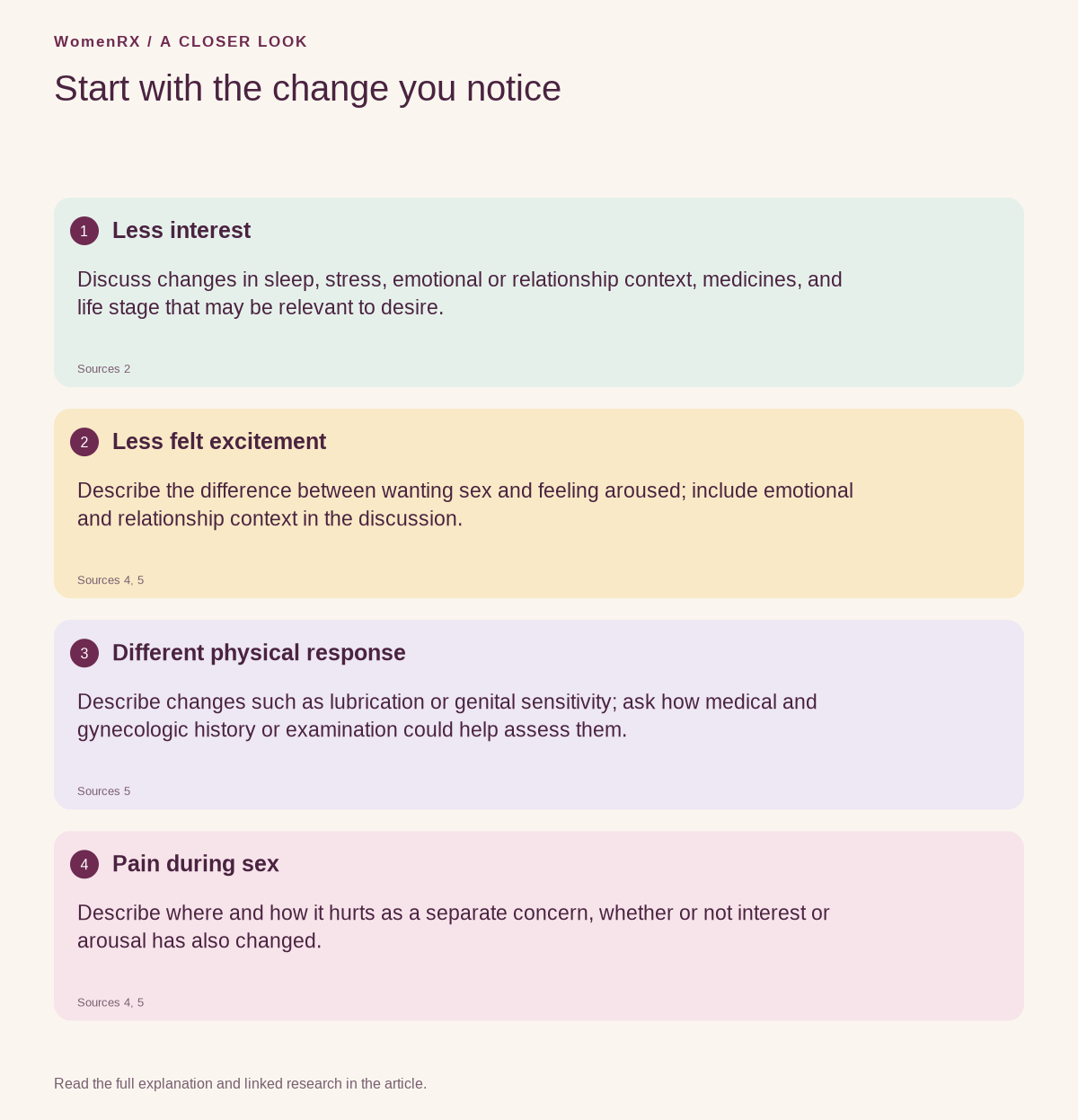
Start with the change you notice
Less interest: Discuss changes in sleep, stress, emotional or relationship context, medicines, and life stage that may be relevant to desire.2
Less felt excitement: Describe the difference between wanting sex and feeling aroused; include emotional and relationship context in the discussion.45
Different physical response: Describe changes such as lubrication or genital sensitivity; ask how medical and gynecologic history or examination could help assess them.5
Pain during sex: Describe where and how it hurts as a separate concern, whether or not interest or arousal has also changed.45
Read the figure as text
Choose the description closest to your experience, then use its discussion topic as a starting point. These branches don’t identify a cause.- Less interest: Discuss changes in sleep, stress, emotional or relationship context, medicines, and life stage that may be relevant to desire.2
- Less felt excitement: Describe the difference between wanting sex and feeling aroused; include emotional and relationship context in the discussion.45
- Different physical response: Describe changes such as lubrication or genital sensitivity; ask how medical and gynecologic history or examination could help assess them.5
- Pain during sex: Describe where and how it hurts as a separate concern, whether or not interest or arousal has also changed.45
More questions, answered
Does low arousal automatically mean low desire?
No. Desire and arousal are related but distinguishable, and arousal itself may involve a subjective feeling, a physical response, or both. Describing which part has changed can make the concern clearer. 3 4 5
Does menopause explain every change in arousal?
No. Menopause is one possible part of the picture, but research also discusses health, medicines, stress, sleep, emotional well-being, and relationship factors. Age or life stage alone doesn’t establish the cause. 2 5
Sources you can check
- Sexual Health | MedlinePlusAccessed 2026-09-25Return to first citation
- Systematic Review of l-Arginine for the Treatment of Hypoactive Sexual Desire Disorder and Related Conditions in Women.Cieri-Hutcherson NE, Jaenecke A, Bahia A, Lucas D, Oluloro A, Stimmel L, Hutcherson TC. · Pharmacy (Basel, Switzerland) · 2021Return to first citation
- The DSM diagnostic criteria for female sexual arousal disorder.Graham CA. · Archives of sexual behavior · 2010Return to first citation
- The Evolution of the Female Sexual Disorder/Dysfunction Definitions, Nomenclature, and Classifications: A Review of DSM, ICSM, ISSWSH, and ICD.Parish SJ, Cottler-Casanova S, Clayton AH, McCabe MP, Coleman E, Reed GM. · Sexual medicine reviews · 2021Return to first citation
- Female sexual arousal disorders.Giraldi A, Rellini AH, Pfaus J, Laan E. · The journal of sexual medicine · 2013Return to first citation