Does progesterone cause weight gain? Separating evidence from timing
A weight change after starting progesterone is worth reviewing, but timing alone can’t show that progesterone caused it.
The menopause research summarized here doesn’t show that micronized progesterone, on its own, causes weight gain. A systematic review found that estrogen therapy combined with micronized progesterone generally didn’t increase weight or BMI in postmenopausal women; the authors thought any favorable effect was probably mostly due to estrogen. That doesn’t rule out an individual change, but it leaves progesterone’s separate effect uncertain. 2
What the menopause evidence can tell you
The most directly relevant review looked at menopausal hormone therapy that combined estrogen with micronized progesterone. In normal-weight postmenopausal women, the review found body weight either didn’t change or decreased; BMI generally didn’t change in normal- and overweight women. The authors suggested the favorable findings were probably mostly due to the estrogen component. Those results don’t establish what progesterone alone does, or what will happen for every person taking it. 2
That distinction matters if your prescription includes both hormones. A change after starting treatment could line up with the prescription without being caused by progesterone specifically. The studies summarized in the review can’t separate progesterone’s effect from estrogen’s.
The evidence also doesn’t answer every version of “weight gain.” Weight and BMI are not the same as appetite, fluid changes, or where body fat is stored. The review’s reported outcomes don’t tell you whether any observed change was fluid, fat, or lean tissue, or whether appetite changed. So the evidence is limited for explaining a particular scale change, even when it’s useful for judging the overall pattern in postmenopausal women. 2
A scale number isn’t the whole picture
A scale measures total body weight; it doesn’t identify what contributed to a change. Waist measurement can add a different piece of information about body size, but it also doesn’t identify the cause. If you’re comparing measurements, consistency helps make the comparison more useful: use the same scale and similar conditions, and look at a pattern rather than reading too much into one weigh-in. This is a practical way to organize observations, not a test that can diagnose the cause.
Body-fat distribution can change separately from total weight. Research on postmenopausal women describes a shift toward more abdominal fat after menopause and suggests hormone therapy may mitigate that shift. But a study of 63 postmenopausal women comparing hormone-therapy users and nonusers examined sex steroids in fat tissue; it does not show that progesterone caused or prevented weight change. 1
Make the timing useful, not conclusive
If your weight changed after a prescription began or changed, write down the approximate dates and what changed: the medication or formulation, whether estrogen is also part of the treatment, and any other medication changes around the same time. Add a few consistent weight measurements and, if useful to you, waist measurements. Note changes in appetite, activity, sleep, or daily routine as observations, not proof of a cause.
Then review the pattern with the clinician who prescribed the treatment. Ask whether the weight trend, waist trend, or another change is the main concern, and whether other medication or routine changes could also fit the timing. If you’re taking combined hormone therapy, ask what can and can’t be inferred about each component. Don’t assume that stopping progesterone will lead to weight loss: the available combination-therapy findings don’t establish that outcome for an individual. 2
The evidence is strongest here for postmenopausal women using estrogen plus micronized progesterone. It’s less direct for someone in perimenopause, and it doesn’t isolate progesterone’s effect. A clear record can make the conversation more specific, but it can’t turn timing into proof.
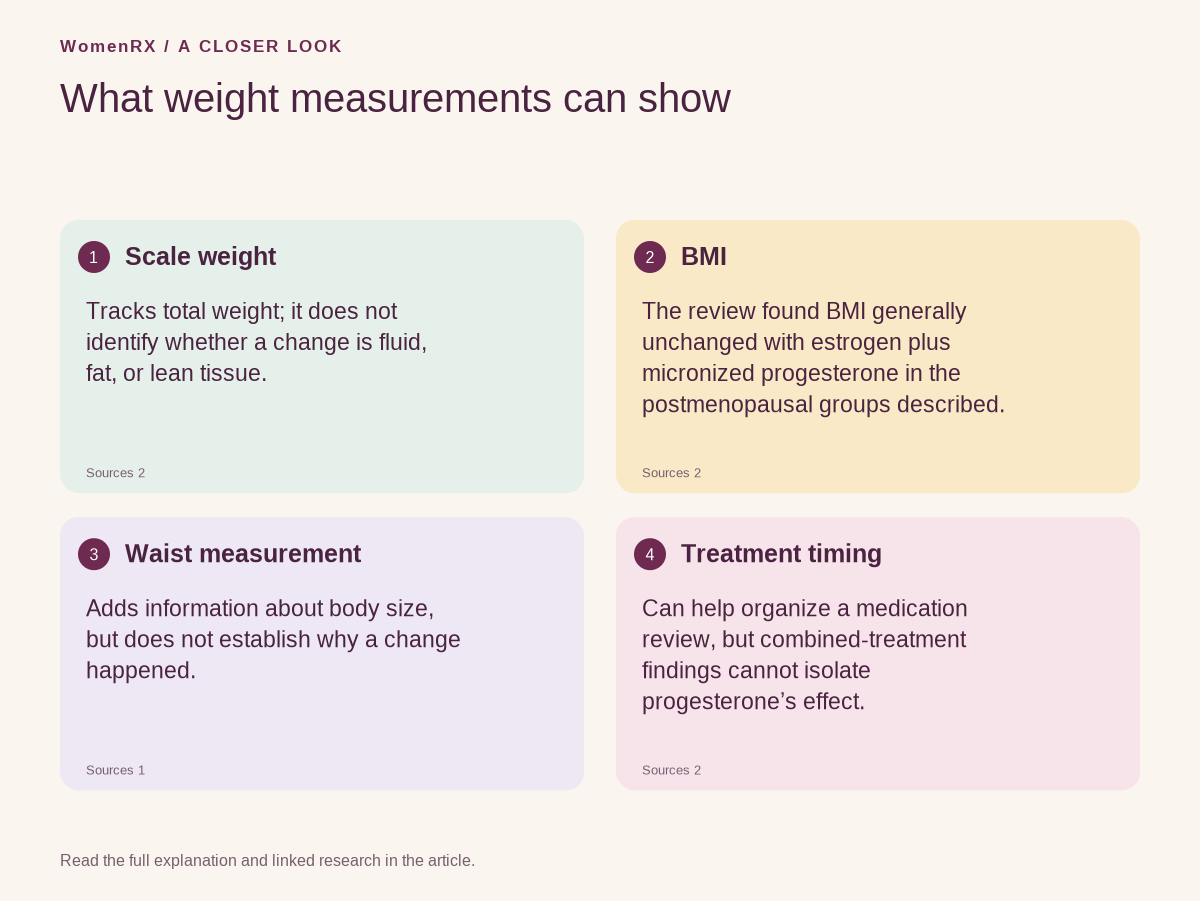
What weight measurements can show
Scale weight: Tracks total weight; it does not identify whether a change is fluid, fat, or lean tissue.2
BMI: The review found BMI generally unchanged with estrogen plus micronized progesterone in the postmenopausal groups described.2
Waist measurement: Adds information about body size, but does not establish why a change happened.1
Treatment timing: Can help organize a medication review, but combined-treatment findings cannot isolate progesterone’s effect.2
Read the figure as text
Different measurements answer different questions. None of the cited menopause findings isolates progesterone as the cause of an individual change.- Scale weight: Tracks total weight; it does not identify whether a change is fluid, fat, or lean tissue.2
- BMI: The review found BMI generally unchanged with estrogen plus micronized progesterone in the postmenopausal groups described.2
- Waist measurement: Adds information about body size, but does not establish why a change happened.1
- Treatment timing: Can help organize a medication review, but combined-treatment findings cannot isolate progesterone’s effect.2
More questions, answered
Does the research show what happens if I take progesterone without estrogen?
The menopause review summarized here focused on estrogen combined with micronized progesterone. It doesn’t establish the weight effect of progesterone alone. 2
Can I tell from my weight alone whether I gained fat or retained fluid?
No. A scale gives total weight, not its components. The review’s reported findings on weight and BMI don’t distinguish fluid, fat, or lean tissue. 2
Sources you can check
- Adipose Tissue Sex Steroids in Postmenopausal Women With and Without Menopausal Hormone Therapy.Hetemäki N, Robciuc A, Vihma V, Haanpää M, Hämäläinen E, Tikkanen MJ, Mikkola TS, Savolainen-Peltonen H. · The Journal of clinical endocrinology and metabolism · 2025Return to first citation
- Impact of micronized progesterone on body weight, body mass index, and glucose metabolism: a systematic review.Coquoz A, Gruetter C, Stute P. · Climacteric : the journal of the International Menopause Society · 2019Return to first citation