What to Check Before Getting Antidepressants Online
An online visit can make depression care easier to reach, but a thoughtful assessment and a clear follow-up plan matter more than a quick prescription.
Online care can be a way to discuss depression treatment, but the visit should do more than collect a questionnaire. Expect a clinician to review your symptoms, health history, medicines, and treatment options. 4 1 Before booking, ask what the visit and medication will cost, who handles follow-up and refills, and how to reach live help if symptoms worsen.

A prescription should follow a real assessment
An online questionnaire can help organize what you’re experiencing, but it isn’t the same as a diagnostic conversation. Depression can affect sleep, appetite, interest, and daily functioning, and it doesn’t always feel like sadness. An assessment should ask what has changed, how long it has been happening, how it affects your life, and whether another health condition or medicine could be contributing. 4
Before you book, check who will evaluate you and whether you’ll meet with that clinician by video, phone, or messaging. Ask whether the clinician can review your health history and medications, and what happens if your situation needs care beyond what the service offers. Ask how any screening results will be considered alongside the clinician’s assessment.
Medication is one option, not an automatic next step. A clinician may discuss therapy or other approaches, medication, or a combination, depending on your symptoms and circumstances. A European overview of depression care describes psychological therapy as an initial option for less severe depression; that overview isn’t a US treatment guideline. 6
Compare the care relationship, not just the format
Remote appointments can be convenient, but “online care” covers different kinds of services. In a randomized study of 167 Hispanic adults with major depression at a community health center, people offered monthly video psychiatry visits for six months had higher satisfaction and more antidepressant use than those receiving usual care. Depression severity decreased faster in the video group, but the groups did not differ in overall depression scores. This clinic-based study doesn’t show that every online prescribing service has the same results. 5
Ask what continuity looks like after the first visit. Will you see the same clinician again? If not, who can review side effects or a change in symptoms? Can you get help between appointments, and how quickly are messages answered? Find out how refills are handled and what to do if a refill is delayed. A service that only offers an intake and a prescription may leave you without a clear way to adjust care.
There are other routes, too. You might start with a primary care clinician, a mental health clinician, or a combined or referral-based model. One consultation-clinic study described diagnostic input and treatment recommendations for primary care clinicians, with most consultations conducted by telemedicine; it was a retrospective study, not a comparison of direct-to-consumer prescribing with in-person care. 7 The useful question is which option can provide the kind of assessment and continuing support you need.
Check the whole cost, not just the tablet price
A pharmacy listing can give you a concrete medication-price example, but it won’t tell you what an online course of care will cost. On September 25, 2026, Cost Plus Drugs listed 30 paroxetine tablets, 40 mg each, for $6.38, with $5.25 standard shipping added and taxes varying by location. That’s a price for a specific prescription-required product and package, not a recommended dose, a guaranteed future price, or necessarily a month of treatment. 8
Before you book, ask the service to separate its assessment fee from any membership or follow-up charges. Ask whether medication is billed through a pharmacy and whether any proposed tests would cost extra. A low tablet price doesn’t establish the total cost, or whether that medication is a good fit for you.
Bring the details that can change the choice
Before your visit, jot down what you’ve noticed and what you hope treatment might help with. Include any past depression treatment and whether it helped, didn’t help, or caused side effects. Bring a complete list of prescription medicines, over-the-counter medicines, vitamins, and supplements. Different antidepressants can suit different symptoms and health circumstances, and some medicines or supplements can interact. 1
Mention any history of unusually elevated or “high” moods, as well as other medical conditions. These details can affect whether a particular medicine is a suitable choice; the NHS medicine guidance for fluoxetine and sertraline, for example, flags a history of mania as relevant to assessment. 2 3
If relevant to you, say whether you’re pregnant, planning a pregnancy, breastfeeding, recently postpartum, or noticing changes around your menstrual cycle or menopause. Depression can occur around menstruation, pregnancy, the postpartum period, and menopause; pregnancy and breastfeeding can also affect medication discussions. These are reasons to personalize the conversation, not reasons to assume that one treatment is right for everyone. 1 4
Agree on what happens after the first prescription
Ask when you should expect a check-in, who will review how you’re doing, and how to report side effects or worsening symptoms. Antidepressants can take several weeks to help; MedlinePlus says they usually take four to eight weeks, and sleep or appetite may improve before mood does. That makes a follow-up plan useful: you’ll know when to share changes and who will help decide what to do next. 1
Don’t assume you should change the dose or stop on your own if a medicine is bothering you. Ask the prescriber what to do if side effects occur and how to get advice. MedlinePlus cautions against changing or stopping an antidepressant without the prescriber’s help. 1
Finally, ask the service how urgent safety concerns are handled and whether messages are monitored in real time. Depression can include thoughts of ending one’s life. 1 Find out before you need it how to reach live help and what care the service recommends when it cannot respond promptly.
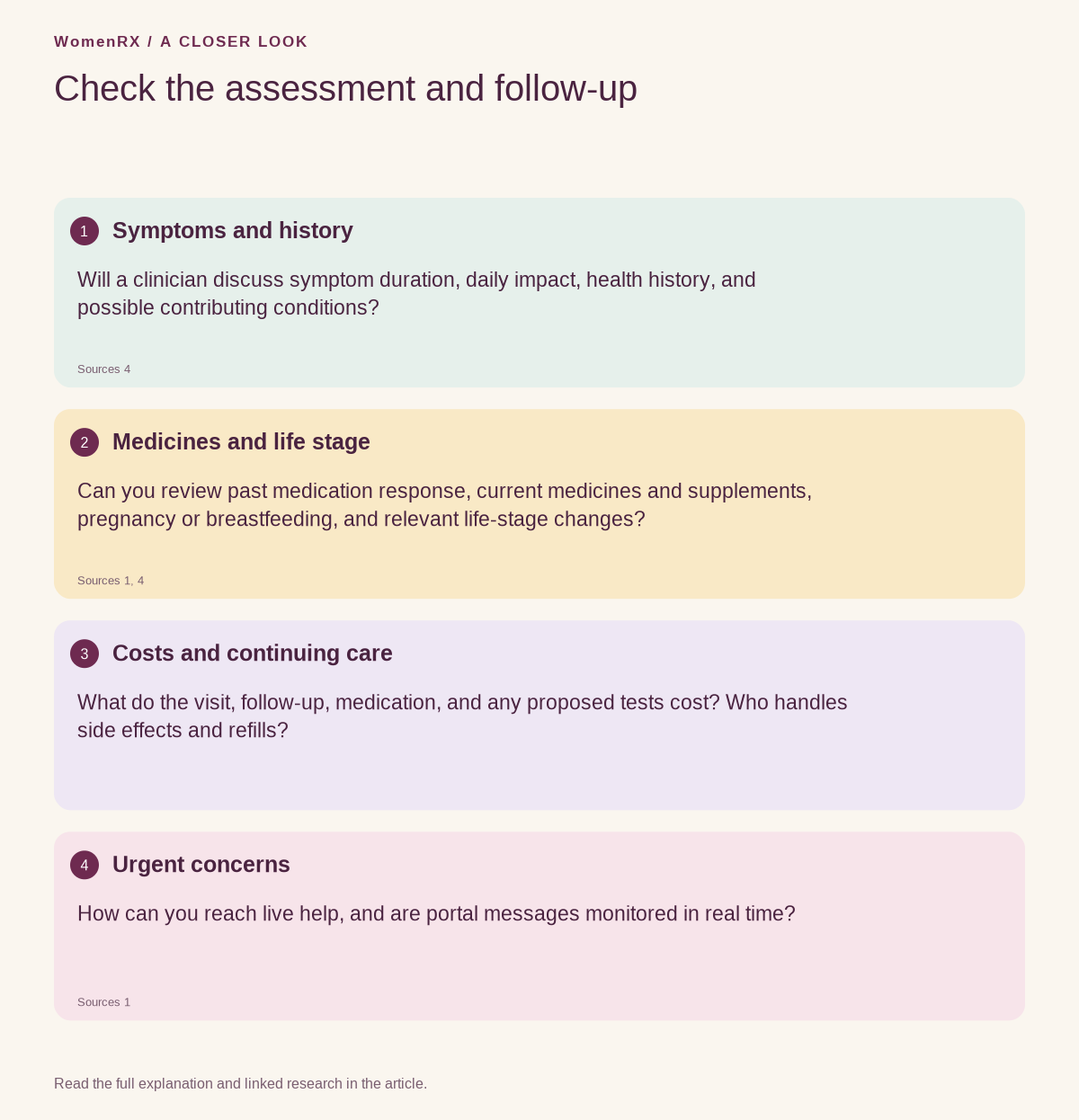
Check the assessment and follow-up
Symptoms and history: Will a clinician discuss symptom duration, daily impact, health history, and possible contributing conditions?4
Medicines and life stage: Can you review past medication response, current medicines and supplements, pregnancy or breastfeeding, and relevant life-stage changes?14
Costs and continuing care: What do the visit, follow-up, medication, and any proposed tests cost? Who handles side effects and refills?
Urgent concerns: How can you reach live help, and are portal messages monitored in real time?1
Read the figure as text
Use these questions to see whether an online service covers the important parts of care, not just the initial prescription.- Symptoms and history: Will a clinician discuss symptom duration, daily impact, health history, and possible contributing conditions?4
- Medicines and life stage: Can you review past medication response, current medicines and supplements, pregnancy or breastfeeding, and relevant life-stage changes?14
- Costs and continuing care: What do the visit, follow-up, medication, and any proposed tests cost? Who handles side effects and refills?
- Urgent concerns: How can you reach live help, and are portal messages monitored in real time?1
More questions, answered
How soon might an antidepressant start helping?
MedlinePlus says antidepressants usually take four to eight weeks to work. Some symptoms, such as sleep or appetite changes, may improve before mood does. Ask your prescriber when and how to report changes while you wait. 1
What if I’ve taken an antidepressant before?
Tell the clinician which medicine you tried, whether it helped, and what side effects you had. No one antidepressant works for everyone; symptoms, other medicines, and health conditions are factors to consider when choosing one. 1
Sources you can check
- Antidepressants | Depression Medicines | MedlinePlusAccessed 2026-09-25Return to first citation
- Fluoxetine: an antidepressant medicine - NHSAccessed 2026-09-25Return to first citation
- Sertraline: an antidepressant medicine - NHSAccessed 2026-09-25Return to first citation
- Depression: MedlinePlusAccessed 2026-09-25Return to first citation
- Feasibility and acceptability of clinic-based telepsychiatry for low-income Hispanic primary care patients.Chong J, Moreno F. · Telemedicine journal and e-health : the official journal of the American Telemedicine Association · 2012Return to first citation
- Understanding the potential of digital therapies in implementing the standard of care for depression in Europe.Courtet P, Amiot O, Baca-Garcia E, Bellardita L, Cerveri G, Clair AH, De Leo D, Drapier D, Fakra E, Gheysen F, Giner L, Gonzalez-Pinto A, Gussoni G, Haffen E, Lecardeur L, Mayoral-... · European psychiatry : the journal of the Association of European Psychiatrists · 2023Return to first citation
- Psychiatry Consultation Clinic: A Model that Improves Access to Care and Corresponds to Decreased Anxiety and Depressive Symptoms.Parker C, Mahajan S, Flicek CB, Zeng X, Sowa NA. · Administration and policy in mental health · 2026Return to first citation
- Cost Plus Drugs: Paroxetine exact package priceAccessed 2026-09-25Return to first citation