Bupropion Alternatives: Compare Options by What You Need
Whether bupropion has helped a little, not at all, or at too high a cost in side effects changes which alternative is worth discussing.
If bupropion isn’t helping enough or its side effects are hard to live with, your next option isn’t necessarily another pill. A prescriber may discuss switching antidepressants, adding treatment to something that partly helps, or adding talk therapy. The useful comparison starts with your remaining symptoms, side effects, health history, and pregnancy or breastfeeding plans, not a universally “best” replacement. 1
Start with what “not working” means for you
There’s a difference between feeling no benefit, feeling some benefit but still struggling, and feeling better while dealing with a side effect you can’t reasonably live with. Each points to a different conversation about bupropion.
Timing matters too. Antidepressants usually take four to eight weeks to work, and sleep or eating may improve before mood does. If you’ve recently started bupropion, ask when you and your prescriber should judge its effect. If you’ve had enough time and still aren’t getting the relief you need, that’s useful information for choosing a next step. 1
If you need a switch, compare what you’re trading
Switching antidepressants may make sense to discuss when a medicine isn’t helping enough or side effects outweigh its benefits. Sertraline, for example, is an antidepressant used to treat depression. That makes it an option to ask about, not a proven better replacement for bupropion. The choice also depends on which symptoms bother you most, other conditions you have, and medicines or supplements you take. 1 2
Appetite and weight offer a more concrete example of a trade-off. A review describes mirtazapine as appetite-stimulating and notes weight gain as a concern. A separate review discusses bupropion and fluoxetine among antidepressants that may improve depressive symptoms while reducing metabolic risks. Those broad findings can help you raise a priority, but they won’t predict what will happen to your weight or mood on a particular medicine. If appetite or weight changes are part of why you want a change, say so. 5 6
The same goes for sleep or sexual side effects. Rather than asking for the “strongest” alternative, ask: “What would this option aim to improve, and what new problems might matter to me?” Sleepiness and sexual problems are among the side effects people can experience with antidepressants, though the balance differs from person to person. 1
If bupropion helps somewhat, replacing it isn’t the only route
A partial response gives you and your prescriber something to build on. MedlinePlus describes several possibilities when more relief is needed: combining antidepressants, adding another kind of medicine, or adding talk therapy. The question is whether adding support addresses what remains difficult without keeping you on a medicine whose side effects are already too burdensome. 1
For severe depression that hasn’t improved with other treatments, other approaches may enter the conversation. Electroconvulsive therapy (ECT) is generally used in that situation; repetitive transcranial magnetic stimulation (rTMS) is another brain-stimulation option. Neither is simply an interchangeable substitute for an antidepressant, but it helps to know that the choices don’t end with trying one pill after another. 3
Bring the parts of your history that could change the choice
Tell your prescriber about other health conditions and everything you take, including over-the-counter medicines, herbs, and supplements. Mention alcohol or recreational drugs too. These details can affect which depression treatment fits and whether a combination could cause problems. If a close relative did well on a particular antidepressant, that’s also worth sharing, though it doesn’t guarantee the same result for you. 1
If you’re pregnant, planning a pregnancy, or breastfeeding, bring that into the discussion before changing treatment. Those circumstances affect how depression treatment is weighed; they don’t automatically point to one antidepressant for everyone. 1
One distinction is easy to miss: if you also take bupropion to help stop smoking, say so. A review of smoking-cessation trials found evidence that bupropion helps people quit, while it found no evidence of a cessation benefit for the selective serotonin reuptake inhibitors (SSRIs) it examined. A medicine chosen for depression may not serve the same second purpose. 4
You can make the conversation specific in one sentence: “Bupropion has helped with _, but I’m still dealing with _, and my biggest concern about changing treatment is ____.” Ask whether switching or adding support better matches that picture. Don’t change your dose or stop an antidepressant on your own; stopping too quickly can bring depression back or make it worse. If you develop thoughts of hurting yourself, get help right away. 1 3
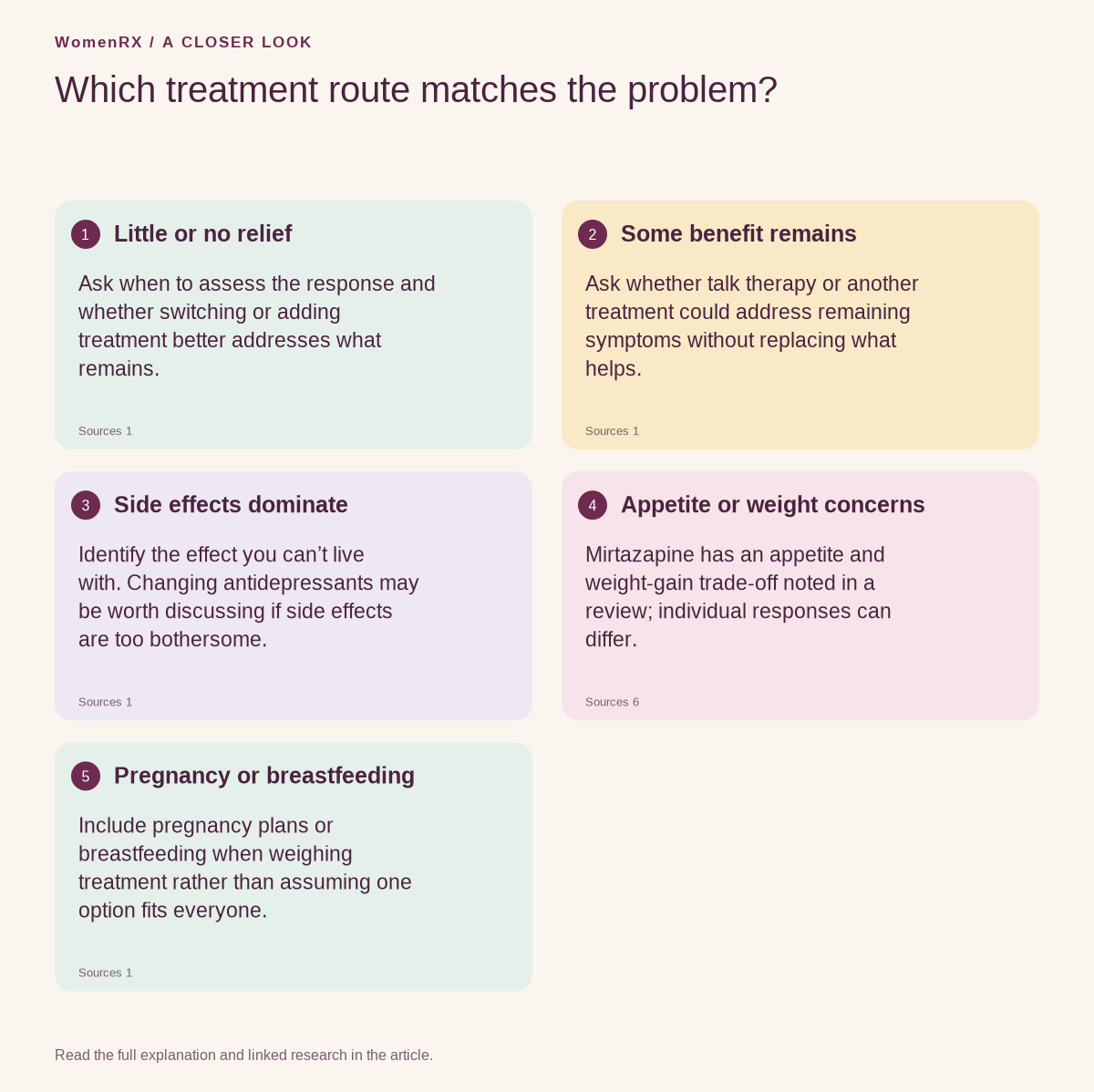
Which treatment route matches the problem?
Little or no relief: Ask when to assess the response and whether switching or adding treatment better addresses what remains.1
Some benefit remains: Ask whether talk therapy or another treatment could address remaining symptoms without replacing what helps.1
Side effects dominate: Identify the effect you can’t live with. Changing antidepressants may be worth discussing if side effects are too bothersome.1
Appetite or weight concerns: Mirtazapine has an appetite and weight-gain trade-off noted in a review; individual responses can differ.6
Pregnancy or breastfeeding: Include pregnancy plans or breastfeeding when weighing treatment rather than assuming one option fits everyone.1
Read the figure as text
These routes answer different questions. They are discussion options, not a ranking or instructions to change treatment.- Little or no relief: Ask when to assess the response and whether switching or adding treatment better addresses what remains.1
- Some benefit remains: Ask whether talk therapy or another treatment could address remaining symptoms without replacing what helps.1
- Side effects dominate: Identify the effect you can’t live with. Changing antidepressants may be worth discussing if side effects are too bothersome.1
- Appetite or weight concerns: Mirtazapine has an appetite and weight-gain trade-off noted in a review; individual responses can differ.6
- Pregnancy or breastfeeding: Include pregnancy plans or breastfeeding when weighing treatment rather than assuming one option fits everyone.1
More questions, answered
If bupropion helps a little, do I need to add another medicine?
No. Adding a medicine is one possible discussion, but talk therapy or a switch may also fit, especially if side effects are making bupropion hard to continue. What matters is which symptoms remain and whether the current benefit is worth its costs to you. 1
Sources you can check
- Antidepressants | Depression Medicines | MedlinePlusAccessed 2026-09-25Return to first citation
- Sertraline: an antidepressant medicine - NHSAccessed 2026-09-25Return to first citation
- Depression: MedlinePlusAccessed 2026-09-25Return to first citation
- Antidepressants for smoking cessation.Howes S, Hartmann-Boyce J, Livingstone-Banks J, Hong B, Lindson N. · The Cochrane database of systematic reviews · 2020Return to first citation
- Antidepressants and Weight Gain: An Update on the Evidence and Clinical Implications.Moss L, Laudenslager M, Steffen KJ, Sockalingam S, Coughlin JW. · Current obesity reports · 2025Return to first citation
- Insulin resistance: The role in comorbid type 2 diabetes mellitus and depression.Yao J, Zhu CQ, Sun Y, Huang YW, Li QH, Liao HM, Deng XJ, Li WM. · Neuroscience and biobehavioral reviews · 2025Return to first citation