Starting an SNRI: What to Expect and Ask
An SNRI may help depression or anxiety, but the first conversations should cover your specific medicine, side effects, and a plan for follow-up.
SNRIs such as venlafaxine and duloxetine are used for depression and some anxiety conditions. Antidepressants often take 4 to 8 weeks to work, though sleep or appetite may change sooner. Before starting, agree on what improvement you’re looking for, which side effects should prompt a call, and how you’ll review progress. Don’t change or stop the medicine on your own.123

Start with the reason for this medicine
An SNRI affects how the brain uses serotonin and norepinephrine, chemicals involved in mood. Venlafaxine is mainly used for depression and is sometimes used for anxiety or panic attacks; duloxetine is used for depression and anxiety and can also treat some kinds of pain. Those differences matter if, for example, pain is part of what you’re hoping to improve. Ask your prescriber why this particular medicine fits your symptoms and what change you’ll use to judge whether it’s helping.12
One useful starting question is: “What should we review first: my mood, anxiety, sleep, ability to get through the day, or side effects?” That makes the follow-up more useful than a vague “How are you feeling?” It also leaves room to say that one symptom has improved while another hasn’t.
What the first weeks may feel like
Antidepressants usually take 4 to 8 weeks to work. Sleep or eating may improve before mood does, so an early change isn’t necessarily the whole result. At the same time, you don’t have to silently put up with a side effect while waiting to see whether the medicine helps. A prescriber may suggest a way to manage it or consider a different antidepressant if it’s too bothersome.3
Stomach and digestive effects are worth discussing early. A systematic review of studies in people treated for major depression found higher rates of gastrointestinal side effects with the antidepressants it examined than with placebo during the first 12 weeks. The effects studied included nausea or vomiting, diarrhea, constipation, and dry mouth, and the profiles differed by medicine. Tell your prescriber which effect you’re having and whether it’s getting in the way of eating, working, or taking the medicine consistently.5
Also speak up about a new or worsening symptom, an unusual mood change, or behavior that feels unlike you. MedlinePlus advises calling your prescriber right away about changes that worry you. People under 25 may be more likely to have thoughts of self-harm when starting an antidepressant or after a dose change; get medical help right away if that happens.3
Questions that make the plan specific
Before you leave the prescribing conversation, try to get clear answers to these questions:
- What’s the follow-up plan? Ask when you’ll review benefits and side effects, and what would lead to another look at the treatment. The general 4-to-8-week estimate is a guide, not a promise about when you’ll feel better.3
- What should I do if I miss a dose? Instructions depend on the medicine and how you take it. The NHS guidance for both venlafaxine and duloxetine says not to take two doses to make up for one missed dose; check the instructions for your own prescription rather than extending that advice to every SNRI.12
- What if I want to stop? Ask how you would contact your prescriber before making a change. Stopping venlafaxine or duloxetine suddenly can cause withdrawal symptoms, and stopping an antidepressant too quickly can also allow depression to return.123
- Does anything about my health affect the choice? For example, tell your prescriber if you’ve ever had mania before starting duloxetine. If you’re at higher risk of low blood sodium, ask whether that changes monitoring: a review of observational studies found an association between SSRIs and SNRIs and low sodium, particularly relevant to people with other medical conditions or medicines such as thiazide diuretics. That finding does not mean everyone starting an SNRI needs the same testing.16
If you’re pregnant, planning pregnancy, or become pregnant during treatment, raise it promptly rather than stopping on your own. Guidance for venlafaxine and duloxetine describes a discussion of the benefits of treatment and possible risks during pregnancy, not a rule that either medicine must always be avoided. If you’re breastfeeding or planning to, ask for advice about the specific medicine; the pregnancy guidance here doesn’t answer the breastfeeding question.12
You can bring up changes in sexual wellbeing, your menstrual cycle, or menopausal symptoms, too, especially if they’ll affect whether the treatment feels workable for you. Don’t assume a change that happens around the time you start an SNRI was caused by it. Venlafaxine is sometimes used for hot flashes in women with breast cancer, but that particular use does not mean every SNRI treats menopausal symptoms.2
If it helps, what happens next?
Feeling better doesn’t automatically mean it’s time to stop. In a review of randomized maintenance trials involving adults whose major depression had stabilized on an antidepressant, people assigned to continue desvenlafaxine, duloxetine, or venlafaxine had lower six-month relapse rates than those assigned to placebo. The studies included women and men but did not report a separate result for women in the provided findings. They address treatment after improvement, not which SNRI to start or how long any one person should take it.4
The practical next move is to agree on a review point and a way to report troublesome effects between visits. If the medicine helps, you and your prescriber can weigh that benefit against side effects and the risk of symptoms returning. If it doesn’t help enough, or the side effects make daily life harder, that’s a reason to reassess the plan, not to adjust or stop the dose by yourself.34
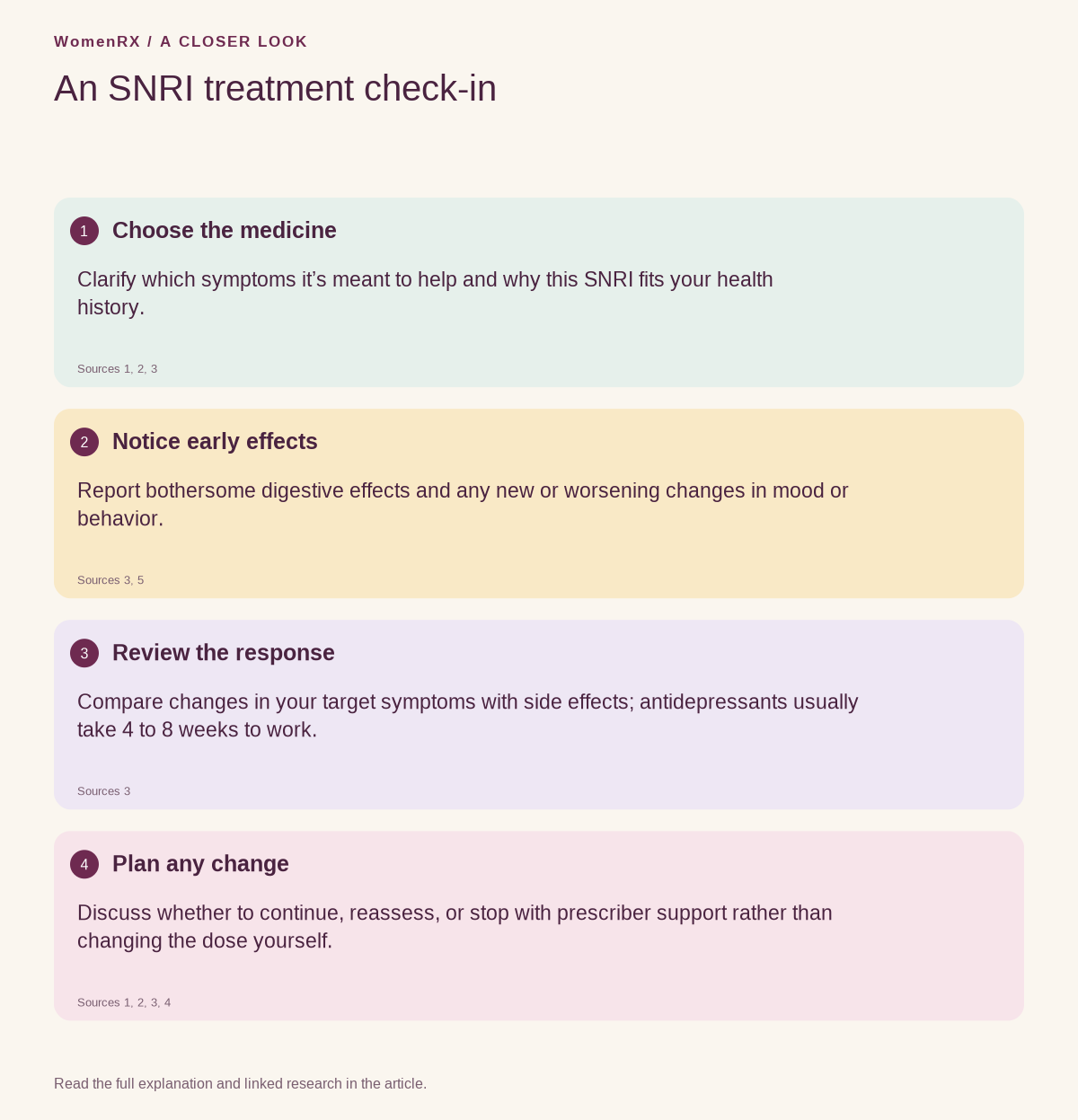
An SNRI treatment check-in
Choose the medicine: Clarify which symptoms it’s meant to help and why this SNRI fits your health history.123
Notice early effects: Report bothersome digestive effects and any new or worsening changes in mood or behavior.35
Review the response: Compare changes in your target symptoms with side effects; antidepressants usually take 4 to 8 weeks to work.3
Plan any change: Discuss whether to continue, reassess, or stop with prescriber support rather than changing the dose yourself.1234
Read the figure as text
Four distinct conversations, from choosing a medicine to deciding what comes next. These are decision points, not a fixed dosing or visit schedule.- Choose the medicine: Clarify which symptoms it’s meant to help and why this SNRI fits your health history.123
- Notice early effects: Report bothersome digestive effects and any new or worsening changes in mood or behavior.35
- Review the response: Compare changes in your target symptoms with side effects; antidepressants usually take 4 to 8 weeks to work.3
- Plan any change: Discuss whether to continue, reassess, or stop with prescriber support rather than changing the dose yourself.1234
Sources you can check
- Duloxetine: an antidepressant medicine - NHSAccessed 2026-09-25Return to first citation
- Venlafaxine: an antidepressant medicine - NHSAccessed 2026-09-25Return to first citation
- Antidepressants | Depression Medicines | MedlinePlusAccessed 2026-09-25Return to first citation
- Antidepressants for the treatment of adults with major depressive disorder in the maintenance phase: a systematic review and network meta-analysis.Kishi T, Ikuta T, Sakuma K, Okuya M, Hatano M, Matsuda Y, Iwata N. · Molecular psychiatry · 2023Return to first citation
- Gastrointestinal side effects associated with antidepressant treatments in patients with major depressive disorder: A systematic review and meta-analysis.Oliva V, Lippi M, Paci R, Del Fabro L, Delvecchio G, Brambilla P, De Ronchi D, Fanelli G, Serretti A. · Progress in neuro-psychopharmacology & biological psychiatry · 2021Return to first citation
- The risk of hyponatremia induced by SSRIs and SNRIs antidepressants: a systematic review and meta-analysis.Li Y, Du X, Wu H. · BMC pharmacology & toxicology · 2025Return to first citation