What to Ask Before Starting Testosterone Online
For women, the clearest evidence concerns low sexual desire after menopause, so an online offer should explain the assessment, product, follow-up, and full cost.
Before agreeing to online testosterone, ask what specific symptom it’s meant to treat, how the clinician assessed it, and how they’ll judge whether it helps. Research is strongest for sexual desire concerns after menopause; long-term safety remains uncertain. Get the exact product, follow-up plan, and total cost in writing, since an advertised medication price may exclude membership and testing. 2 5 6
An online offer is worth considering only if it starts with your concern, not with a product. Testosterone has been studied for women’s sexual function, particularly low desire after menopause. That evidence doesn’t establish it as a general treatment for low energy, aging, or overall wellbeing. 2 3
A useful assessment should make room for the details of your experience. Sexual desire can be affected by health conditions and medicines, among other factors, so ask how the clinician considered possible contributors before recommending a hormone. 1
First, name the outcome you want
Ask: What specific change are we hoping testosterone will make, and how will we know if it’s happening? The research concerns sexual outcomes such as desire, satisfaction, and sexual function. A 2026 systematic review found the strongest trial evidence in postmenopausal women, while the premenopausal evidence came from fewer randomized trials and was described as more limited. 2
That distinction matters if you’re cycling, in perimenopause, or postmenopausal. A service should explain how your menopausal context relates to the evidence, rather than treating all women as if the research were interchangeable. It should also be able to describe what it would mean to continue, change, or stop if the intended improvement doesn’t happen.
The size and certainty of the expected benefit deserve a direct conversation. A 2019 position statement described testosterone’s effect on desire as positive but small and said the evidence wasn’t enough for a broad recommendation. A newer systematic review found the most substantial support in postmenopausal women. These assessments differ in date and scope, but neither makes testosterone a routine answer for every woman with low desire. 2 3
Ask what the assessment actually covered
A clinician should be able to explain how your reported concern led to this recommendation. Ask whether they considered other health issues or medicines that could affect sexual desire or enjoyment. MedlinePlus identifies both chronic illness and medicines as possible influences on sexual health. 1
You can also ask what role any blood test plays in the decision. A 2015 review reported that no testosterone level cutoff had been established to diagnose androgen deficiency in women and noted limitations with available assays. That finding doesn’t tell you what any particular clinician should test today, but it’s a reason to ask how a result would change the plan rather than treating one number as the whole assessment. 4
Get specifics about the product and follow-up
Before starting, ask for the exact formulation and route, why that option was selected for you, and what evidence supports its use for your intended outcome. Ask whether the product is approved for use in women in the United States, and whether its status or use differs from products intended for men. Product availability alone doesn’t answer those questions. A 2019 position statement discussed the lack of women-specific approved formulations at that time, but it can’t establish current US regulatory status. 3
Then ask what follow-up will look like. How will you and the clinician assess the symptom you chose to treat? What side effects should prompt a message or a change in the plan? What monitoring, if any, is appropriate for this formulation? The evidence summarized in a 2026 review notes that long-term safety data were inconsistently reported, so a service should be candid about what its monitoring plan can and can’t establish. 2
Check the full cost, not just the cream price
Ask for a breakdown of the medication, membership or visit fees, initial tests, follow-up visits, and repeat laboratory work. Two offers observed on September 25, 2026 show why the distinction matters:
- Midi advertised compounded testosterone cream starting at $100 for a 90-day supply. That’s a starting medication price, not an all-in cost. Its page also described a clinician visit, baseline laboratory work, and follow-up blood draws, and advised checking laboratory coverage with your insurer. 5
- Hone listed compounded testosterone cream at an estimated $60 per month, billed separately from its $155-per-month Premium membership. It listed an initial at-lab test at $65; follow-up consultations and quarterly laboratory testing were included in the membership, though exact testing could vary by treatment. Medication estimates could vary with dose and modality. 6
These are examples of advertised terms, not national averages or comparable quotes for the same prescription. Neither price tells you whether you’re eligible, which product a clinician would recommend, or your final cost. Ask the service to show you what applies before you commit. 5 6
You don’t need to accept vague promises such as “balance your hormones” in place of answers. A thoughtful online visit should connect a specific concern to the evidence, explain uncertainties, identify the product, and set out how progress and safety will be reviewed. If the offer centers on broad claims about energy or aging without explaining the sexual-health evidence and its limits, it isn’t answering the question this research can address. 2 3
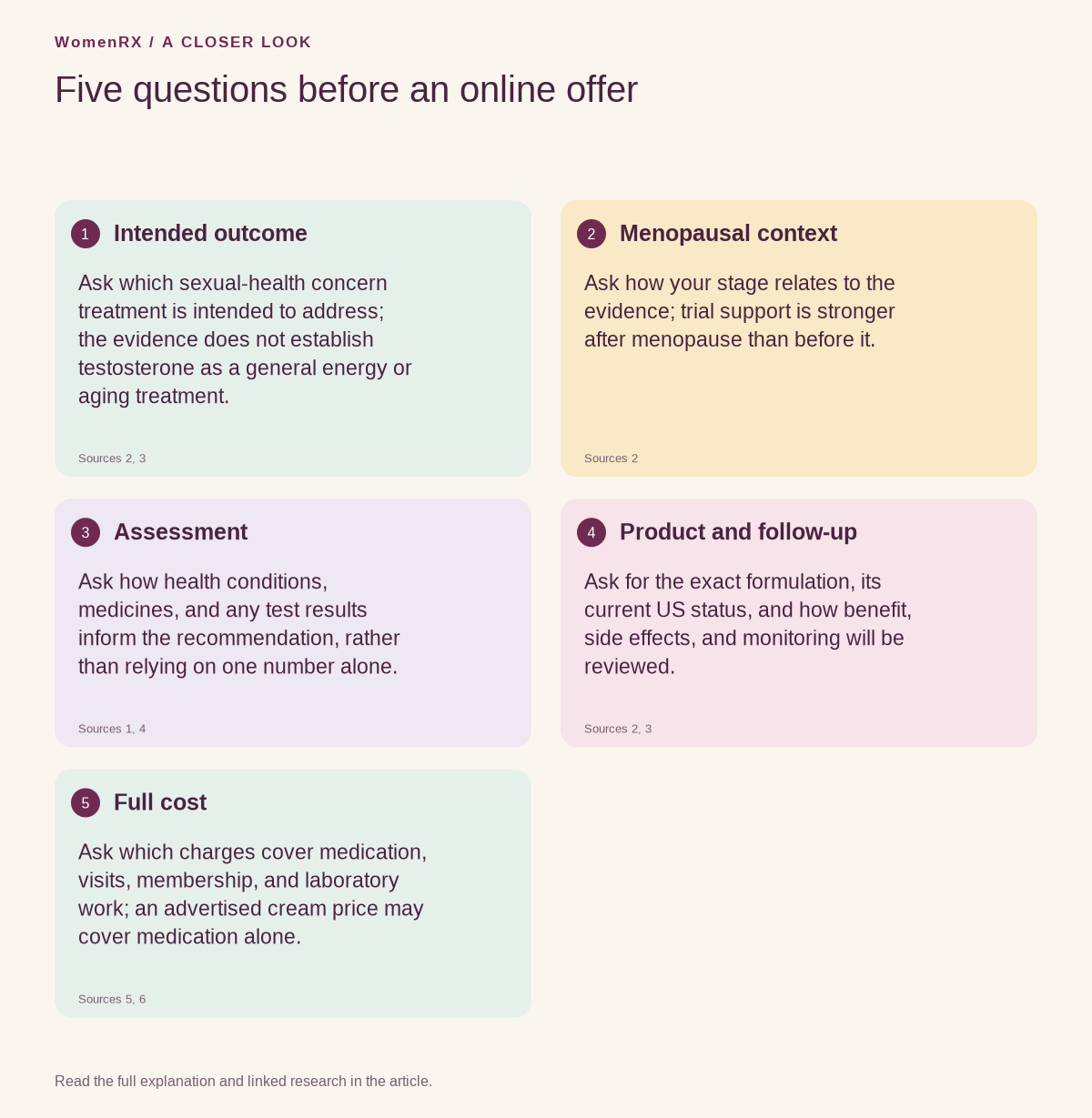
Five questions before an online offer
Intended outcome: Ask which sexual-health concern treatment is intended to address; the evidence does not establish testosterone as a general energy or aging treatment.23
Menopausal context: Ask how your stage relates to the evidence; trial support is stronger after menopause than before it.2
Assessment: Ask how health conditions, medicines, and any test results inform the recommendation, rather than relying on one number alone.14
Product and follow-up: Ask for the exact formulation, its current US status, and how benefit, side effects, and monitoring will be reviewed.23
Full cost: Ask which charges cover medication, visits, membership, and laboratory work; an advertised cream price may cover medication alone.56
Read the figure as text
Separate an individualized treatment discussion from a product-centered pitch by asking what is being treated, how the decision was made, and what the full plan costs.- Intended outcome: Ask which sexual-health concern treatment is intended to address; the evidence does not establish testosterone as a general energy or aging treatment.23
- Menopausal context: Ask how your stage relates to the evidence; trial support is stronger after menopause than before it.2
- Assessment: Ask how health conditions, medicines, and any test results inform the recommendation, rather than relying on one number alone.14
- Product and follow-up: Ask for the exact formulation, its current US status, and how benefit, side effects, and monitoring will be reviewed.23
- Full cost: Ask which charges cover medication, visits, membership, and laboratory work; an advertised cream price may cover medication alone.56
More questions, answered
Does a testosterone blood test show whether I need treatment?
Not by itself. A 2015 review reported no established testosterone cutoff for diagnosing androgen deficiency in women and noted assay limitations. Ask what a test is intended to clarify and how its result would affect your care. 4
Sources you can check
- Sexual Health | MedlinePlusAccessed 2026-09-25Return to first citation
- Testosterone therapy for female sexual dysfunction: a systematic review of the literature demonstrating outcomes in premenopausal and postmenopausal women.Furlan VA, Hammad MAM, Quesada S, Nguyen S, Yih J. · The journal of sexual medicine · 2026Return to first citation
- Testosterone therapy for women with low sexual desire: a position statement from the Brazilian Society of Endocrinology and Metabolism.Weiss RV, Hohl A, Athayde A, Pardini D, Gomes L, Oliveira M, Meirelles R, Clapauch R, Spritzer PM. · Archives of endocrinology and metabolism · 2019Return to first citation
- To be or not to be in sexual desire: the androgen dilemma.Nappi RE. · Climacteric : the journal of the International Menopause Society · 2015Return to first citation
- Midi: women's testosterone cream starting price and supplyAccessed 2026-09-25Return to first citation
- Hone: women's Premium membership and testosterone cream priceAccessed 2026-09-25Return to first citation