Questions to Ask Before Starting Hormone Therapy Online
A useful telehealth visit should connect your reason for treatment to a clear plan for benefits, risks, and follow-up.
Before agreeing to hormone therapy through telehealth, make sure you understand what it’s meant to treat, which options fit that goal, how your health history affects the tradeoffs, and how the plan will be reviewed. For menopause treatment, benefits and risks can vary by the product, route, timing, and whether a progestogen is used, so ask about the specific plan being offered. 4
Start with the reason for treatment
“Hormone therapy” can refer to different treatments for different goals. Menopause symptom care, contraception, and gender-affirming care aren’t interchangeable, and the right questions depend on which one you’re considering. Start by asking: What is the specific reason you’re recommending this treatment for me? If your goal is menopause symptom relief, name the symptoms you want help with and ask how the proposed treatment is expected to address them.
For menopause, hormone therapy is the most effective treatment for hot flashes and night sweats, and it can help with genitourinary symptoms of menopause. But that doesn’t make it the right choice for every person or every symptom. Ask what benefit is realistic for your goal, and what other options make sense if you’d rather not use hormones or if this treatment isn’t a good fit. 45
Ask how the recommendation fits your situation
A useful recommendation should be about the treatment being offered to you, not just hormones in general. For menopause therapy, ask:
- Which hormone or hormones are you recommending, and why? Ask whether the plan is local or systemic, and why that approach matches your symptoms.
- How do my age and timing since menopause affect the benefit-risk balance? Menopause guidance says the balance differs with age and time since menopause, as well as with treatment type, dose, duration, route, and use of a progestogen. 4
- How does my medical history affect the choice? Ask the clinician to name the history or health factors they considered, and whether anything needs further evaluation before deciding.
- If I have a uterus, how does this plan account for that? Ask the clinician to explain whether the specific treatment requires another hormone and why. Don’t assume that one product’s instructions apply to every hormone regimen. 34
- What nonhormone options could address my goal? For menopause-related hot flashes and night sweats, evidence-based options include some prescription treatments and cognitive behavioral therapy; which options are appropriate depends on your situation. 5
These questions can help you tell the difference between a recommendation with a reasoned fit and a standard package offered without much discussion.
Make the tradeoffs specific
Ask the clinician to explain the main expected benefit and the important risks of the exact product and route being proposed. Menopause hormone therapy risks are not identical across all formulations or treatment plans, and guidance calls for individualizing treatment and periodically reassessing its benefits and risks. 4
You might ask: What do we know about this treatment for someone with my circumstances, and where is the evidence less certain? A clear answer should distinguish established information from what can’t be predicted for one person. If the explanation relies on risk figures, ask what population they came from and what comparison they use. For example, findings from one estrogen-progestin product shouldn’t automatically be presented as exact estimates for a different product or route; product labeling itself notes limits on applying some trial findings to other formulations. 2
Also ask what side effects or changes should prompt you to contact the clinician, and what to do if you don’t notice the intended benefit. You should leave understanding how to reach the care team, not just how to obtain a prescription.
Find out what telehealth can and can’t cover
A virtual visit can support care from a distance, but good communication and preparation still matter. Ask what information the clinician needs to make a decision, what they can assess remotely, and what would mean you need an in-person evaluation or another kind of assessment. MedlinePlus describes telehealth as care delivered through communication technologies and notes that good communication matters for virtual visits. 1
You can also ask who is responsible for your care after the appointment, how to send a question, and how quickly the team typically responds. If a clinician says an in-person assessment isn’t needed, it’s reasonable to ask them to explain why that’s appropriate for your situation. An online format shouldn’t prevent you from getting a fuller evaluation when one is needed.
Agree on how the plan will be revisited
Before starting, ask when and how you’ll review whether treatment is helping, whether the balance of benefits and risks has changed, and whether the plan needs adjusting. For menopause hormone therapy, periodic reevaluation is part of the individualized approach recommended by the North American Menopause Society. 4
Clarify what the follow-up will cover, how to raise a new concern between visits, and what happens if the treatment doesn’t meet your goal. The aim isn’t to predict every outcome in advance. It’s to know why you’re starting, what you’re watching for, and how the decision can be revisited with the same clinician or care team.
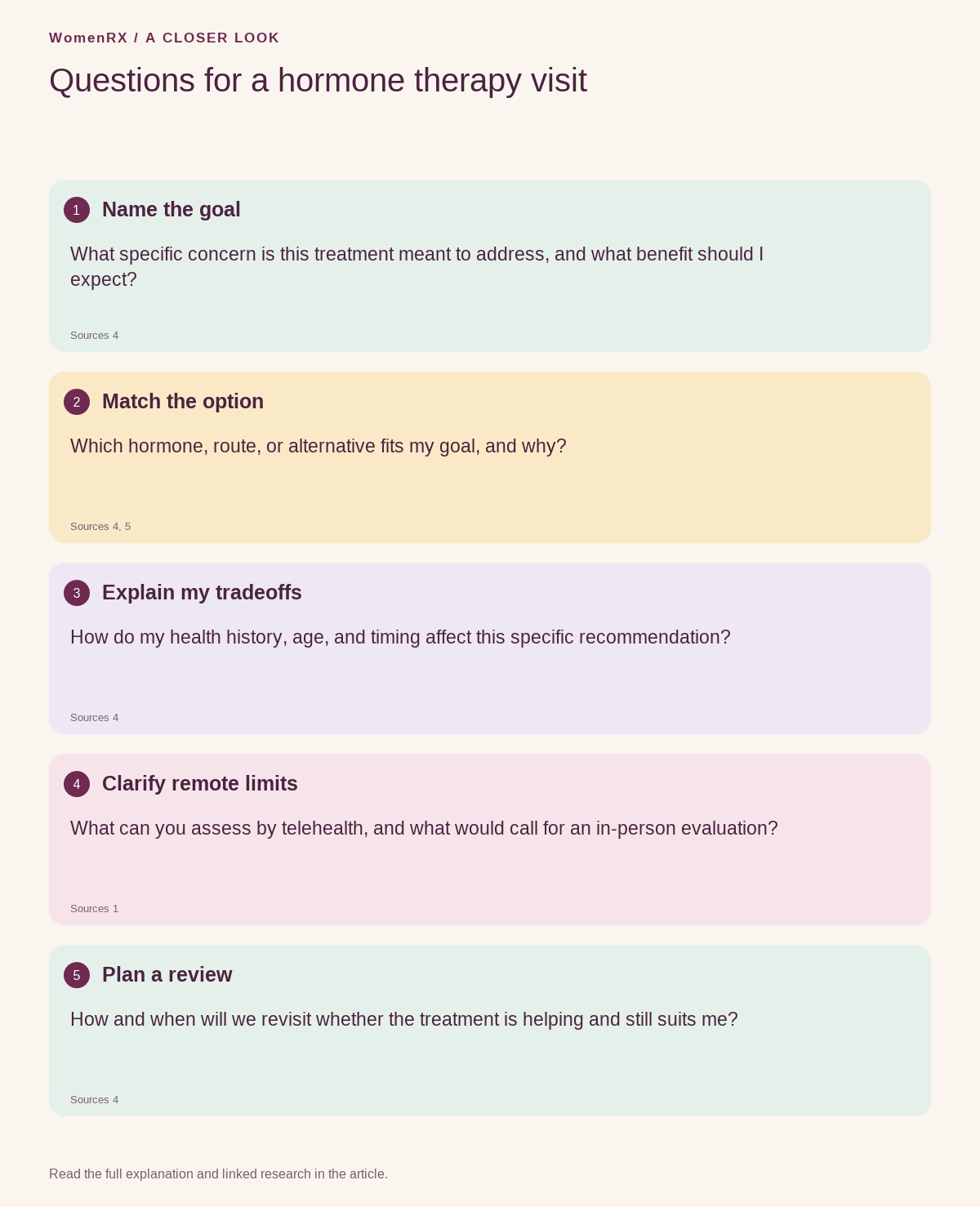
Questions for a hormone therapy visit
Name the goal: What specific concern is this treatment meant to address, and what benefit should I expect?4
Match the option: Which hormone, route, or alternative fits my goal, and why?45
Explain my tradeoffs: How do my health history, age, and timing affect this specific recommendation?4
Clarify remote limits: What can you assess by telehealth, and what would call for an in-person evaluation?1
Plan a review: How and when will we revisit whether the treatment is helping and still suits me?4
Read the figure as text
Use these prompts to connect your treatment goal with the choice, its tradeoffs, what telehealth can assess, and follow-up.- Name the goal: What specific concern is this treatment meant to address, and what benefit should I expect?4
- Match the option: Which hormone, route, or alternative fits my goal, and why?45
- Explain my tradeoffs: How do my health history, age, and timing affect this specific recommendation?4
- Clarify remote limits: What can you assess by telehealth, and what would call for an in-person evaluation?1
- Plan a review: How and when will we revisit whether the treatment is helping and still suits me?4
More questions, answered
Should I ask about the route of menopause hormone therapy?
Yes. Ask whether the recommendation is local or systemic and why it suits your symptoms. Menopause guidance identifies route, along with treatment type, dose, duration, timing, and progestogen use, as factors that affect risks. 4
What if the visit is for contraception or gender-affirming care?
Say that clearly at the start. The questions and evidence for those goals differ from menopause treatment, so ask the clinician to explain the recommendation in relation to your specific goal rather than relying on menopause guidance.
Sources you can check
- Telehealth: MedlinePlusAccessed 2026-09-25Return to first citation
- BIJUVA (ESTRADIOL AND PROGESTERONE) CAPSULE [MAYNE PHARMA] | US prescribing information and patient instructionsAccessed 2026-09-25Return to first citation
- PROMETRIUM (PROGESTERONE) CAPSULE [ACERTIS PHARMACEUTICALS, LLC] | US prescribing information and patient instructionsAccessed 2026-09-25Return to first citation
- The 2022 hormone therapy position statement of The North American Menopause Society.“The 2022 Hormone Therapy Position Statement of The North American Menopause Society” Advisory Panel. · Menopause (New York, N.Y.) · 2022Return to first citation
- The 2023 nonhormone therapy position statement of The North American Menopause Society.Menopause (New York, N.Y.) · 2023Return to first citation