Alternatives to Bupropion: Compare What Matters to You
A different antidepressant, therapy, or a more specialized treatment may fit better, but the useful comparison depends on your symptoms, treatment history, and the trade-offs you care about.
If bupropion isn’t a good fit, options may include another antidepressant, psychotherapy, or both. These comparisons don’t give a simple symptom-by-symptom ranking of medication alternatives, but they do point to differences worth weighing: possible SSRI side effects, weight-related trade-offs with mirtazapine, and specific limits on evidence for switching in treatment-resistant depression. Don’t stop bupropion without discussing a plan with your prescriber. 2 3 4 5
First, name the problem you want to solve
If bupropion hasn’t helped enough, the next question is different from “What can I take instead?” You might need a different depression treatment, more support alongside medication, or a closer look at whether something else is contributing to how you feel. Depression can affect sleep, appetite, thinking, and daily life, and medical conditions or other medicines can sometimes cause similar symptoms. 2
If the issue is a side effect or a preference not to take medication, that changes the comparison too. Tell the prescriber managing your bupropion what’s happening before you stop it or start something else. Finding a suitable antidepressant can take more than one try, and MedlinePlus advises against stopping one without first discussing it with your care provider. 2
What medication comparisons can and can’t tell you
SSRIs, such as fluoxetine, are one group of antidepressants you could discuss. An older clinical review lists nausea, diarrhea, dizziness, sleep changes, and sexual dysfunction among their possible side effects. If one of those concerns is central to why you’re reconsidering treatment, say so rather than assuming a different prescription will automatically feel better. 5
SNRIs, such as duloxetine and venlafaxine, are another antidepressant group. An older review of adults with treatment-resistant depression reported positive results in five of six studies that examined switching from an SSRI to venlafaxine. That finding doesn’t show venlafaxine is generally a better replacement for bupropion, or that it works better than SSRIs for a particular symptom. The review is about a specific, treatment-resistant population, not a head-to-head ranking for everyone considering a change. 4
Mirtazapine raises a different trade-off. A review of antidepressant weight effects describes bupropion as generally associated with weight neutrality or loss, while mirtazapine is associated with greater weight gain. Neither pattern predicts what will happen to you, but the difference is worth raising if weight change would make a treatment hard to live with. 3
These comparisons offer some practical distinctions, but not a reliable rule for matching one antidepressant class to a specific symptom. What you’ve already tried, how much it helped, and which side effects matter most are useful parts of the discussion. A change in medication doesn’t always mean a straight switch. For depression that hasn’t responded adequately, clinicians may consider switching, combining antidepressants, or adding another treatment. An older review of adults with treatment-resistant depression found that evidence varies across these strategies, so its findings aren’t a reason to add a medicine to your current plan yourself. 4
Match non-medication options to the kind of depression
Psychotherapy is a depression treatment, not merely something to do while waiting for medication to work. It can help you work with troubling thoughts, emotions, and behaviors, and may be used on its own or alongside an antidepressant. If you’d prefer fewer medications, ask whether therapy could be a central part of your plan and how you’ll assess whether it’s helping. 2
A seasonal pattern points to a more specific option. If depression reliably comes with a change in seasons, light therapy has been shown to help seasonal affective disorder. That finding doesn’t make it a general replacement for bupropion when depression isn’t seasonal. 2
Severe or persistent depression calls for a different conversation. Electroconvulsive therapy (ECT) is most often used for severe depression that hasn’t improved with other treatments. Repetitive transcranial magnetic stimulation (rTMS) is another brain-stimulation treatment described for depression; unlike ECT, it doesn’t require anesthesia. These are options to discuss in the right circumstances, not everyday substitutes for one antidepressant. 2
Where do supplements fit?
“Natural” describes an approach, not its evidence or safety. An older review found limited data supporting complementary approaches such as St. John’s wort, exercise, acupuncture, and relaxation for depression. That doesn’t mean none could be useful to you. It does mean a supplement shouldn’t be treated as a proven stand-in for bupropion, or as a reason to stop prescribed treatment without a plan. 5 2
If you’re pregnant, breastfeeding, or planning a pregnancy
Bring that into the treatment discussion before changing medication. Pregnancy information in the US prescribing information for Contrave, a naltrexone-bupropion combination product, includes data on bupropion exposure. It does not compare depression treatments or establish which option is preferable during pregnancy or breastfeeding. Nor do the comparisons above show that antidepressant alternatives work differently for women at other reproductive life stages. 1
You don’t need to arrive with a replacement picked out. A more useful starting point is specific: “My mood hasn’t improved enough,” “This effect is difficult for me,” or “I want to try therapy.” From there, you and your prescriber can compare a switch with adding treatment, and decide how a change will be managed. If you’re thinking about hurting yourself, seek help right away rather than waiting for a medication-review appointment. 2
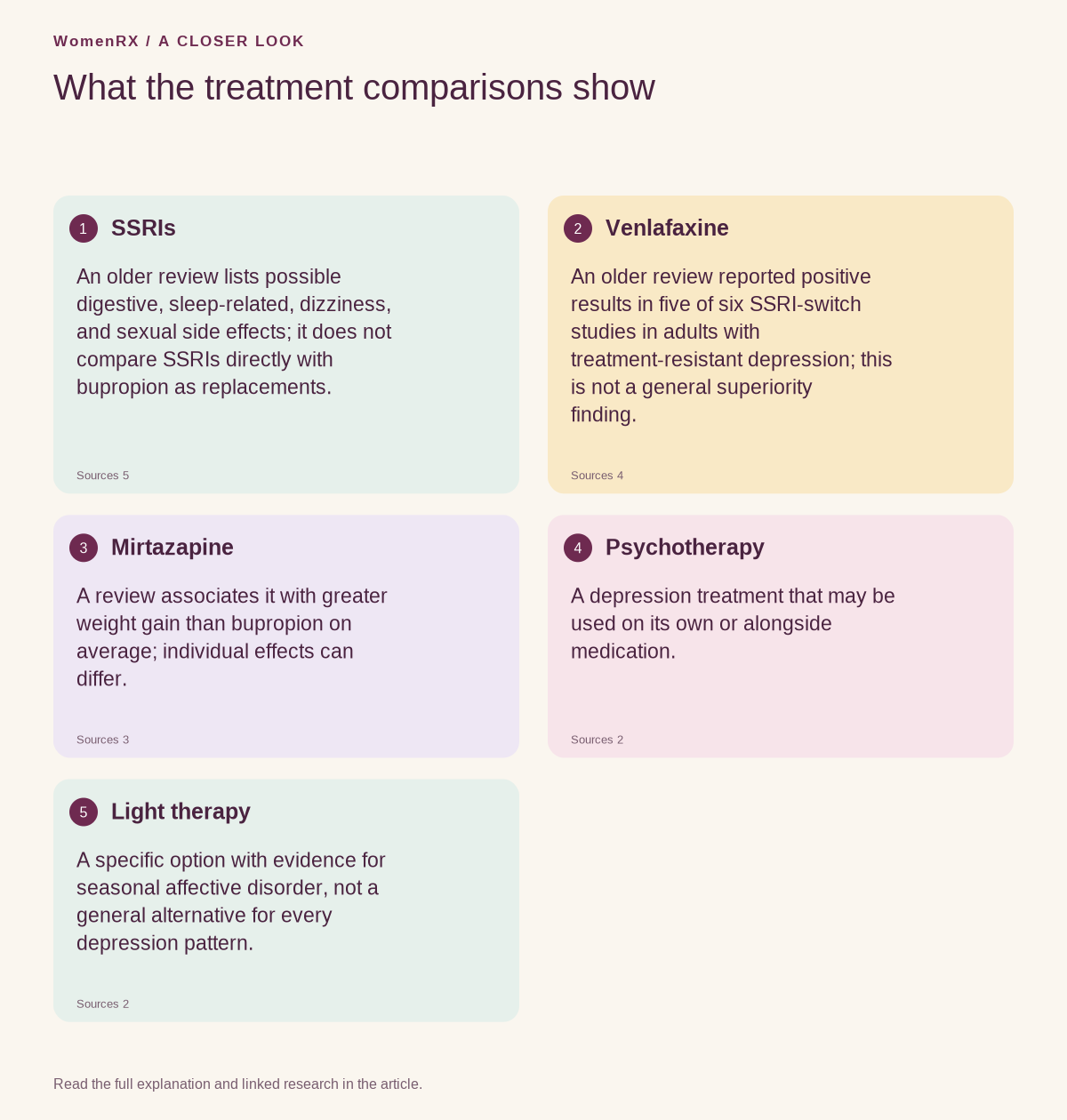
What the treatment comparisons show
SSRIs: An older review lists possible digestive, sleep-related, dizziness, and sexual side effects; it does not compare SSRIs directly with bupropion as replacements.5
Venlafaxine: An older review reported positive results in five of six SSRI-switch studies in adults with treatment-resistant depression; this is not a general superiority finding.4
Mirtazapine: A review associates it with greater weight gain than bupropion on average; individual effects can differ.3
Psychotherapy: A depression treatment that may be used on its own or alongside medication.2
Light therapy: A specific option with evidence for seasonal affective disorder, not a general alternative for every depression pattern.2
Read the figure as text
These options differ in the trade-offs and situations the evidence addresses. They are not ranked from best to worst.- SSRIs: An older review lists possible digestive, sleep-related, dizziness, and sexual side effects; it does not compare SSRIs directly with bupropion as replacements.5
- Venlafaxine: An older review reported positive results in five of six SSRI-switch studies in adults with treatment-resistant depression; this is not a general superiority finding.4
- Mirtazapine: A review associates it with greater weight gain than bupropion on average; individual effects can differ.3
- Psychotherapy: A depression treatment that may be used on its own or alongside medication.2
- Light therapy: A specific option with evidence for seasonal affective disorder, not a general alternative for every depression pattern.2
More questions, answered
Is switching antidepressants the same as adding one?
No. A switch replaces the current antidepressant; a combination keeps it while adding another. Reviews of difficult-to-treat depression examine these as different strategies, with different evidence behind particular choices. Ask which approach is being proposed before making any change. 4
Sources you can check
- CONTRAVE EXTENDED-RELEASE (NALTREXONE HYDROCHLORIDE AND BUPROPION HYDROCHLORIDE) TABLET, EXTENDED RELEASE [NALPROPION PHARMACEUTICALS LLC] | US prescribing information and patient instructionsAccessed 2026-09-25Return to first citation
- Depression: MedlinePlusAccessed 2026-09-25Return to first citation
- Impact of Antidepressants on Weight Gain: Underlying Mechanisms and Mitigation Strategies.Mouawad M, Nabipur L, Agrawal DK. · Archives of clinical and biomedical research · 2025Return to first citation
- Pharmacologic approaches to treatment resistant depression: Evidences and personal experience.Tundo A, de Filippis R, Proietti L. · World journal of psychiatry · 2015Return to first citation
- Identification and treatment of depression in minority populations.DeJesus SA, Diaz VA, Gonsalves WC, Carek PJ. · International journal of psychiatry in medicine · 2011Return to first citation