Hormonal IUD Alternatives, Matched to What Matters to You
The alternative worth considering depends on whether you want to avoid hormones, avoid insertion, or have less to remember.
If you want to avoid hormones but keep a low-maintenance method, ask about a copper IUD. If uterine insertion is the sticking point, an implant is another long-acting option; condoms avoid that insertion but depend on correct use each time. If heavy periods are part of your decision, compare bleeding goals separately: Mirena is also used to treat heavy menstrual bleeding. 541
Start with the part you want to change
A levonorgestrel IUD combines highly effective, long-acting contraception with a hormone released inside the uterus. That combination may sound appealing until one part of it doesn’t: the hormone, the insertion, or having a device in your uterus. Those are different concerns, and they point toward different alternatives. Along with contraceptive implants, copper and levonorgestrel IUDs are among the most effective reversible methods. Barrier and fertility-awareness methods depend more on consistent use. 145
If you want to avoid hormones
A copper IUD keeps the long-acting, low-upkeep approach without levonorgestrel. It does not, however, avoid an intrauterine insertion. If your main concern is the procedure rather than the hormone, changing IUD types won’t solve it. 5
Condoms and fertility-awareness methods avoid both hormones and IUD insertion. The trade-off is how much correct, consistent use matters. Condoms are used with sex and also help prevent sexually transmitted infections (STIs). Fertility awareness involves identifying fertile days and changing sexual activity during that time. A guideline review found that natural and barrier methods are generally more demanding and less effective in common use than long-acting methods. They are choices to discuss honestly, not direct substitutes for an IUD’s set-it-and-leave-it protection. 45
If a cycle-tracking app is part of your plan, look closely at what it asks you to do rather than treating the app itself as contraception. A systematic review found that studies of contraceptive apps had poor methodological quality and substantial loss to follow-up, limiting confidence in their effectiveness estimates. 8
If insertion into the uterus is the sticking point
A contraceptive implant offers a long-acting, highly effective alternative to an intrauterine device. Bleeding patterns matter here: a systematic review specifically examined treatments for bothersome bleeding irregularities among implant users. If predictable bleeding is high on your list, ask about that possibility before choosing it. 57
A combined contraceptive pill is another option if you’d rather avoid an intrauterine device, and it may also be considered when heavy periods need treatment. That doesn’t mean it will be the right choice for every person or produce the same bleeding pattern as a hormonal IUD. Put both goals on the table: preventing pregnancy and making periods easier to live with. 35
Condoms avoid a placement procedure and hormones altogether. Their distinctive advantage is STI protection; their trade-off is that protection against pregnancy depends on using them correctly each time. You can also use condoms for STI protection alongside a non-barrier contraceptive method. 46
If your periods are influencing the decision
Don’t let “hormonal versus nonhormonal” stand in for “what happens to my bleeding?” Mirena is indicated for treating heavy menstrual bleeding in people who choose an IUD for contraception. Changes in bleeding, including irregular bleeding or spotting early on, are also common with levonorgestrel IUD use. The combined pill is another contraceptive option used to treat heavy periods, while irregular bleeding can be a concern with an implant. Those distinctions are more useful than assuming every hormonal method will affect your period the same way. 1237
For example, if you’re reconsidering an IUD because you’ve always had heavy periods, ask two separate questions: Which method fits the level of pregnancy protection and upkeep I want? and Which options might help, worsen, or make my bleeding less predictable? Heavy bleeding that affects daily life, severe period pain, or bleeding between periods or after sex also deserves attention as a symptom, not just a reason to switch contraception. 3
After childbirth, timing becomes part of the choice
If you’re considering an IUD after giving birth, there may be a choice between placement immediately after delivery and placement later. Mirena’s prescribing information describes both placement timings. 1 Kyleena’s prescribing information separately warns that Kyleena may be expelled and will not protect against pregnancy if displaced or expelled. 2 Ask how timing and the possibility of an IUD not staying in place would affect your choice.
Breastfeeding alone shouldn’t be treated as a blanket contraceptive plan. The lactational amenorrhea method depends on all three of these conditions: you’re within six months of giving birth, your periods have not returned, and breastfeeding is exclusive or nearly exclusive, including day and night. If any condition changes, the basis for relying on that method changes too. 4
The shortest route to a useful choice is to name your nonnegotiable first. Hormone-free and low-upkeep points toward discussing copper IUDs. No uterine insertion but low-upkeep points toward discussing an implant. No placement procedure points toward condoms or fertility-awareness methods, with a clearer look at their routines and real-world effectiveness. If period relief matters just as much as pregnancy prevention, compare that goal separately before deciding. 543
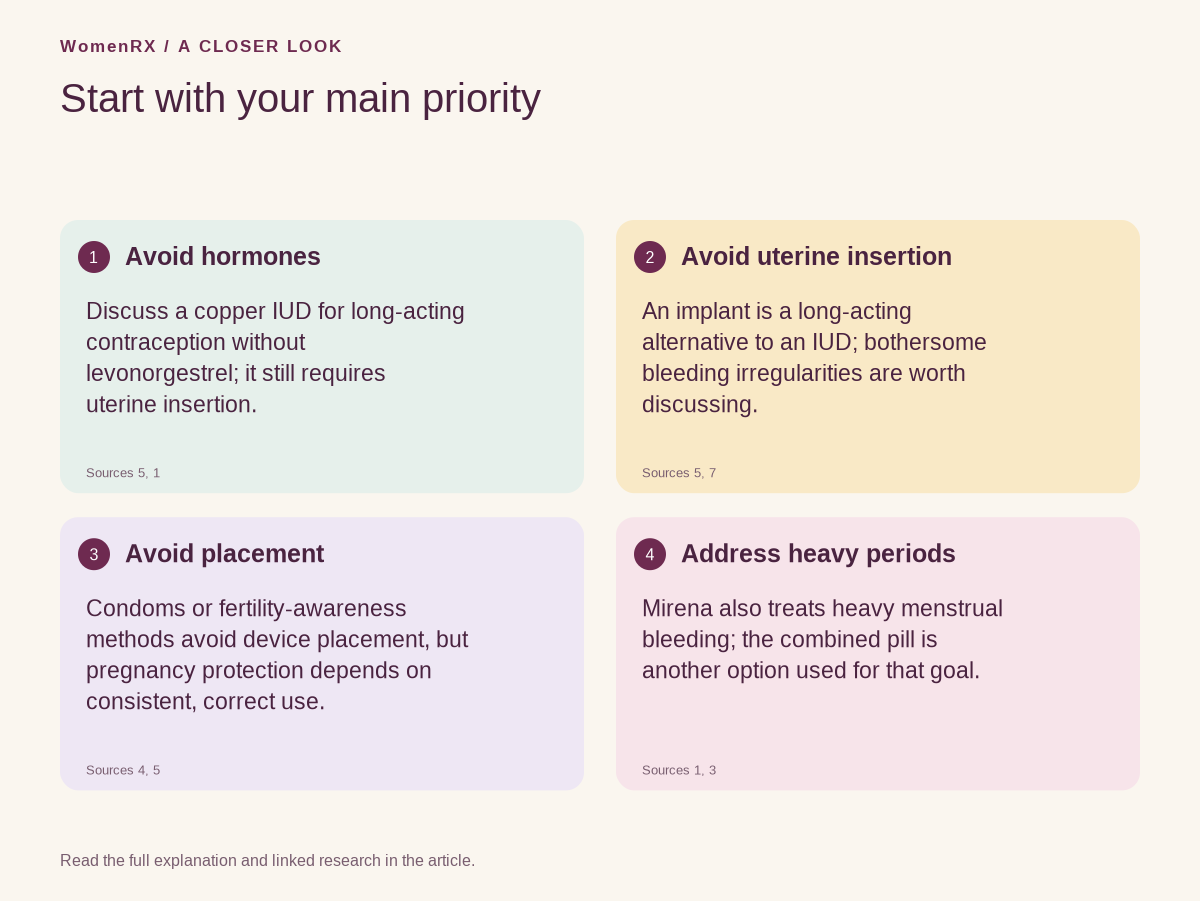
Start with your main priority
Avoid hormones: Discuss a copper IUD for long-acting contraception without levonorgestrel; it still requires uterine insertion.51
Avoid uterine insertion: An implant is a long-acting alternative to an IUD; bothersome bleeding irregularities are worth discussing.57
Avoid placement: Condoms or fertility-awareness methods avoid device placement, but pregnancy protection depends on consistent, correct use.45
Address heavy periods: Mirena also treats heavy menstrual bleeding; the combined pill is another option used for that goal.13
Read the figure as text
Each priority narrows the options, but none removes every trade-off.- Avoid hormones: Discuss a copper IUD for long-acting contraception without levonorgestrel; it still requires uterine insertion.51
- Avoid uterine insertion: An implant is a long-acting alternative to an IUD; bothersome bleeding irregularities are worth discussing.57
- Avoid placement: Condoms or fertility-awareness methods avoid device placement, but pregnancy protection depends on consistent, correct use.45
- Address heavy periods: Mirena also treats heavy menstrual bleeding; the combined pill is another option used for that goal.13
More questions, answered
Will an IUD or implant protect me from STIs?
Condoms provide STI protection; an IUD or implant is chosen for pregnancy prevention, not STI protection. Condoms can be used alongside another contraceptive method when STI protection matters. 46
Sources you can check
- MIRENA (LEVONORGESTREL) INTRAUTERINE DEVICE [BAYER HEALTHCARE PHARMACEUTICALS INC.] | US prescribing information and patient instructionsAccessed 2026-09-25Return to first citation
- KYLEENA (LEVONORGESTREL) INTRAUTERINE DEVICE [BAYER HEALTHCARE PHARMACEUTICALS INC.] | US prescribing information and patient instructionsAccessed 2026-09-25Return to first citation
- Heavy periods - NHSAccessed 2026-09-25Return to first citation
- [Natural Family Planning methods and Barrier: CNGOF Contraception Guidelines].Hassoun D. · Gynecologie, obstetrique, fertilite & senologie · 2018Return to first citation
- Canadian Contraception Consensus (Part 2 of 4).Black A, Guilbert E, Co-Authors, Costescu D, Dunn S, Fisher W, Kives S, Mirosh M, Norman WV, Pymar H, Reid R, Roy G, Varto H, Waddington A, Wagner MS, Whelan AM, Special Contributo... · Journal of obstetrics and gynaecology Canada : JOGC = Journal d'obstetrique et gynecologie du Canada : JOGC · 2015Return to first citation
- Canadian Contraception Consensus (Part 1 of 4).Black A, Guilbert E, Co-Authors, Costescu D, Dunn S, Fisher W, Kives S, Mirosh M, Norman WV, Pymar H, Reid R, Roy G, Varto H, Waddington A, Wagner MS, Whelan AM, Special Contributo... · Journal of obstetrics and gynaecology Canada : JOGC = Journal d'obstetrique et gynecologie du Canada : JOGC · 2015Return to first citation
- Management of bleeding irregularities during contraceptive implant use: A systematic review.Cohen MA, Snyder EM, Curtis KM, Nguyen AT, Clark EA, Folger SG, Gaffield ME, Whiteman MK. · Contraception · 2026Return to first citation
- Effectiveness of tracking cycle mobile applications as a contraceptive Method: A systematic review.Silva MR, Ferreira-Filho ES, Campanharo FF, Meletti NFT, Luiz MFC, Riccio LGC. · European journal of obstetrics, gynecology, and reproductive biology · 2026Return to first citation