Want to Avoid an IUD? Compare Nonhormonal Options
The copper IUD avoids hormones but not an IUD; condoms, fertility awareness, and permanent methods each ask something different of you.
If hormones are your concern, the copper IUD offers highly effective, reversible contraception without hormones, but it’s still an IUD. If you want no IUD, condoms, other barriers, and fertility-awareness methods leave more control in your hands but generally require more attention to use. Tubal surgery and vasectomy are permanent options. Only condoms among these choices help protect against STIs. 34
First, decide what you want to avoid
A levonorgestrel IUD combines hormonal contraception with an in-uterus device. Those may be two separate objections. If hormones are the issue, a copper IUD keeps the device but removes the hormone. If having an IUD is the issue, copper doesn’t solve it. 34
The next distinction is how you want contraception to fit into your life. The copper IUD works without an action at each encounter; barriers need to be used when you have sex; fertility awareness requires identifying fertile days and avoiding sex or using a barrier on those days. Permanent procedures are intended for people who don’t want future pregnancies. The CDC’s typical-use failure rates describe pregnancies during use, not how reliably a method works when used perfectly every time. 35
Copper IUD: low maintenance, with a bleeding trade-off
The copper IUD is placed in the uterus and can remain there for up to 10 years. The CDC lists a typical-use failure rate of 0.8%. Like a levonorgestrel IUD, it’s reversible and doesn’t protect against STIs. Unlike a levonorgestrel IUD, it contains no hormone. 34
Periods may be the deciding detail. Spotting or heavier or longer menstrual bleeding can occur, especially during the first three to six months with a copper IUD. Bleeding generally decreases over time with a levonorgestrel IUD, and many users eventually have light periods or none. If lighter bleeding was one reason you liked your hormonal IUD, copper may not feel like an even swap. 4
A three-year prospective study at four Utah family-planning clinics reported pregnancy attributed to method failure at rates of 1.1 per 100 person-years among copper IUD users and 0.7 per 100 person-years among hormonal IUD users. Participants chose their methods, so this wasn’t a randomized comparison. These person-year rates also aren’t the same measure as the CDC’s typical-use percentages. 1
Condoms and other barriers: control at each encounter
External condoms are IUD-free and hormone-free. The CDC lists a 13% typical-use failure rate for pregnancy prevention, compared with 0.8% for the copper IUD. They must be used each time you have sex, but latex external condoms also help protect against HIV and other STIs. Internal condoms may offer STI protection, although the CDC says the evidence is limited. An IUD doesn’t offer that protection, so a condom can serve a different purpose even when you use another contraceptive method. 34
Diaphragms and cervical caps are other barriers placed before sex with spermicide. The CDC lists typical-use failure rates of 17% for a diaphragm and 22% for a cervical cap. Neither replaces a condom’s STI-protection role. If you’ve given birth and previously used a diaphragm, its fit may need to be checked. 35
In the Utah study, only 52 participants chose male condoms at the start. The reported failure rate was 2.6 per 100 person-years over three years, but the small group and wide confidence interval make it a poor personal prediction. Participants received counseling and same-day access to their chosen method; that study result shouldn’t replace the CDC’s broader typical-use comparison. 1
Fertility awareness: a method, not a promise of “natural” protection
Fertility-awareness methods involve identifying the days when pregnancy is possible, then avoiding sex or using a barrier on those days if you don’t want to become pregnant. They aren’t one uniform technique: the CDC gives a 2% to 23% range of typical-use failure rates across methods. That range matters more than a single reassuring number if you haven’t yet chosen and learned a specific approach. 3
This may appeal if you want no device, hormones, or permanent procedure. The trade-off is ongoing attention to your fertility pattern and a plan for fertile days. If that plan includes condoms, your pregnancy protection on those days also depends on using them. Fertility awareness itself doesn’t provide STI protection. An undefined “natural” practice can’t be assigned the effectiveness range for defined fertility-awareness methods. 35
Permanent options: a different decision about the future
Tubal surgery and a partner’s vasectomy avoid ongoing contraception at each encounter, but they’re intended to be permanent. The CDC lists typical-use failure rates of 0.5% for tubal surgery and 0.15% for vasectomy. Tubal surgery is effective immediately; after a vasectomy, another method is needed until a follow-up sperm check confirms it has worked. Neither procedure protects against STIs. 3
Pregnancy afterward is possible. In an analysis of nationally representative US surveys, the estimated percentage of participants reporting pregnancy after tubal sterilization in the 2013-2015 survey wave was 2.9% within the first 12 months and 8.4% within 120 months. Those estimates concern past procedures and shouldn’t be lined up as a direct ranking against the CDC’s first-year typical-use figures. If you might want to carry a pregnancy later, give that possibility more weight than a small difference between effectiveness estimates. 23
After a birth, timing and feeding can change the comparison
A copper IUD can be placed postpartum, including immediately after birth. The practical trade-off is that expulsion is more common with postpartum placement than with placement later; waiting may mean arranging another method in the meantime. Breastfeeding alone isn’t automatically reliable contraception. The lactational amenorrhea method, or LAM, applies only while all three conditions hold: your periods haven’t returned, you’re fully or nearly fully breastfeeding, and you’re less than six months postpartum. Once any condition changes, another contraceptive method is needed if you want to avoid pregnancy. 34
Already have a levonorgestrel IUD? Decide what you’ll use next before it’s removed so the change doesn’t leave an unintended gap. Your clearest short list starts with one question: is your firm boundary no hormones, no IUD, or no action needed each time you have sex? 3
What Each Nonhormonal Choice Asks of You
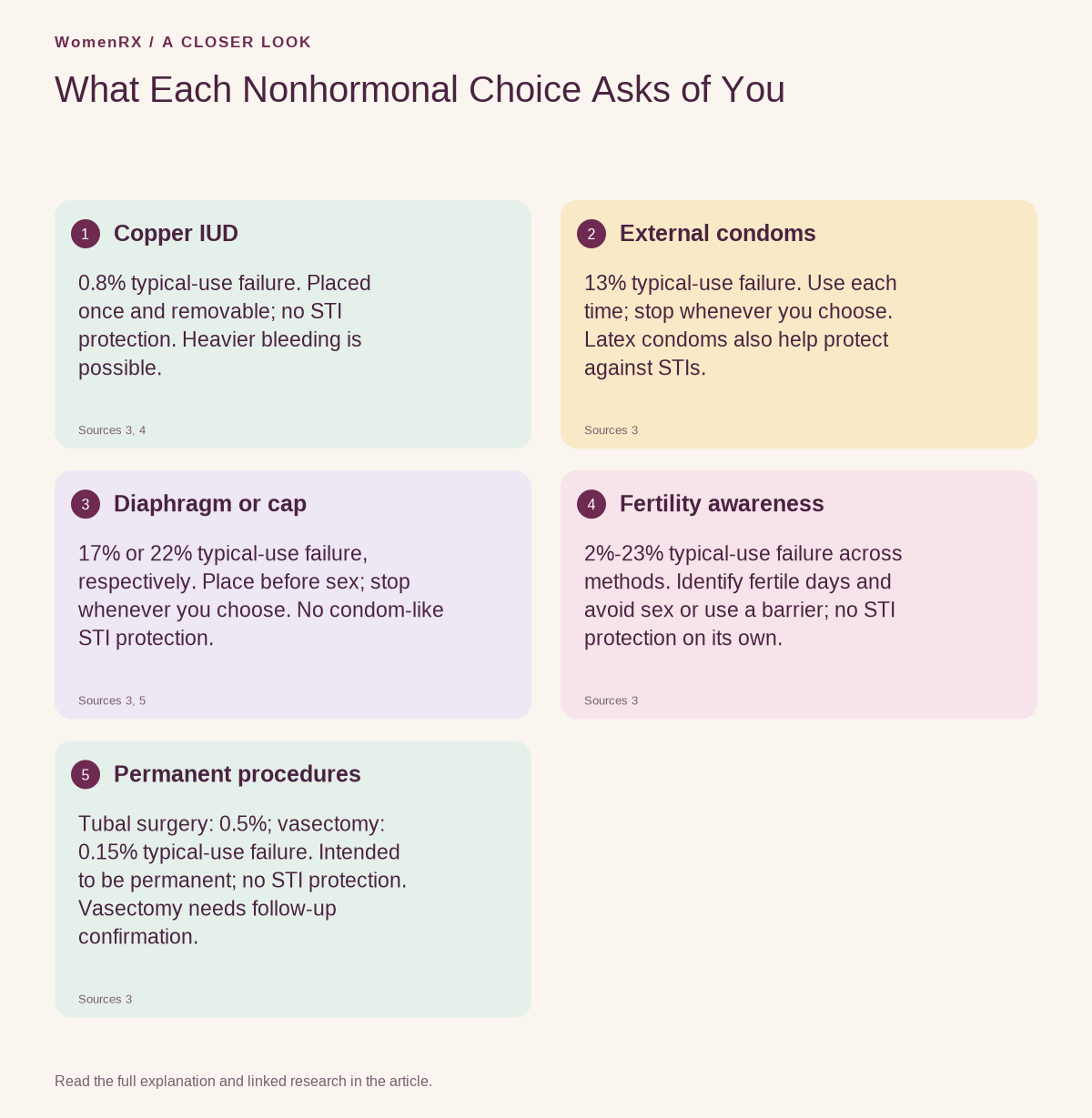
Copper IUD: 0.8% typical-use failure. Placed once and removable; no STI protection. Heavier bleeding is possible.34
External condoms: 13% typical-use failure. Use each time; stop whenever you choose. Latex condoms also help protect against STIs.3
Diaphragm or cap: 17% or 22% typical-use failure, respectively. Place before sex; stop whenever you choose. No condom-like STI protection.35
Fertility awareness: 2%-23% typical-use failure across methods. Identify fertile days and avoid sex or use a barrier; no STI protection on its own.3
Permanent procedures: Tubal surgery: 0.5%; vasectomy: 0.15% typical-use failure. Intended to be permanent; no STI protection. Vasectomy needs follow-up confirmation.3
Read the figure as text
Typical-use figures describe pregnancy prevention; the other differences may matter just as much to your choice.- Copper IUD: 0.8% typical-use failure. Placed once and removable; no STI protection. Heavier bleeding is possible.34
- External condoms: 13% typical-use failure. Use each time; stop whenever you choose. Latex condoms also help protect against STIs.3
- Diaphragm or cap: 17% or 22% typical-use failure, respectively. Place before sex; stop whenever you choose. No condom-like STI protection.35
- Fertility awareness: 2%-23% typical-use failure across methods. Identify fertile days and avoid sex or use a barrier; no STI protection on its own.3
- Permanent procedures: Tubal surgery: 0.5%; vasectomy: 0.15% typical-use failure. Intended to be permanent; no STI protection. Vasectomy needs follow-up confirmation.3
Sources you can check
- Three-Year Contraceptive Failure Rates During the HER Salt Lake Contraceptive Initiative.Sanders JN, Carter G, Bullington BW, Gero A, Simmons R, Gawron LM, Kaiser JE, Turok DK. · JAMA network open · 2026Return to first citation
- Pregnancy after Tubal Sterilization in the United States, 2002 to 2015.Schwarz EB, Chiang AY, Lewis CA, Gariepy AM, Reeves MF. · NEJM evidence · 2024Return to first citation
- CDC: Birth control methods, barrier methods, fertility awareness and breastfeedingAccessed 2026-09-25Return to first citation
- CDC: Intrauterine contraception and copper IUD bleedingAccessed 2026-09-25Return to first citation
- Office on Women's Health: Barrier contraception side effectsAccessed 2026-09-25Return to first citation