Does Vitamin E Help You Lose or Gain Weight?
A review of trials in adults with fatty liver disease found no clear difference in BMI with vitamin E supplementation.
Vitamin E supplements haven’t been shown to reliably cause weight loss or weight gain. A review that included 12 randomized trials in adults with metabolic dysfunction-associated steatotic liver disease reported no statistically significant pooled BMI difference with vitamin E. That finding isn’t a test of weight effects in all women, and the review abstract doesn’t report BMI results by sex or menopause status. 3
What the human trials found
A 2026 systematic review examined randomized trials of vitamin E in adults with metabolic dysfunction-associated steatotic liver disease (MASLD), a form of fatty liver disease. The review included 12 trials and reported a pooled BMI difference of 0.36 kg/m² for vitamin E versus comparison groups. Its 95% confidence interval ran from −0.86 to 1.58 kg/m², and the difference was not statistically significant. The abstract doesn’t say how many of the 12 trials contributed BMI data. 3
In everyday terms, these trials didn’t show a clear average shift in BMI toward either weight loss or weight gain. That’s more useful for this question than vitamin E’s reputation as an antioxidant, but it has limits: the participants had MASLD, and BMI isn’t a direct measure of body fat. It doesn’t distinguish fat from muscle or bone. 3 1
Why a metabolism claim isn’t a weight claim
Vitamin E is an antioxidant that plays a role in metabolic processes. That describes what the nutrient does in the body, not what happens to your weight when you take a supplement. 2
The distinction shows up in the MASLD review. Its pooled results found a reduction in blood triglycerides with vitamin E, but no statistically significant difference in BMI. A change in a blood-fat measurement shouldn’t be read as pounds lost. Likewise, a proposed biological mechanism can’t establish that a supplement burns fat or causes weight gain. 3
What the result means for you
If you’re considering vitamin E specifically to manage your weight, these trials don’t provide a demonstrated weight-loss benefit. If you’re concerned that a supplement will make you gain weight, they also don’t show a clear average BMI increase. Neither finding predicts what will happen to every individual. The review abstract does not report BMI findings separately for women or by menopause status, so it can’t answer whether those groups respond differently. 3
Most people get enough vitamin E from food, according to MedlinePlus. If you’re thinking about a supplement for a reason other than weight, that reason deserves its own assessment. In particular, vitamin E supplements may be harmful alongside blood thinners and some other medicines, so check before adding one if you take medication. 2
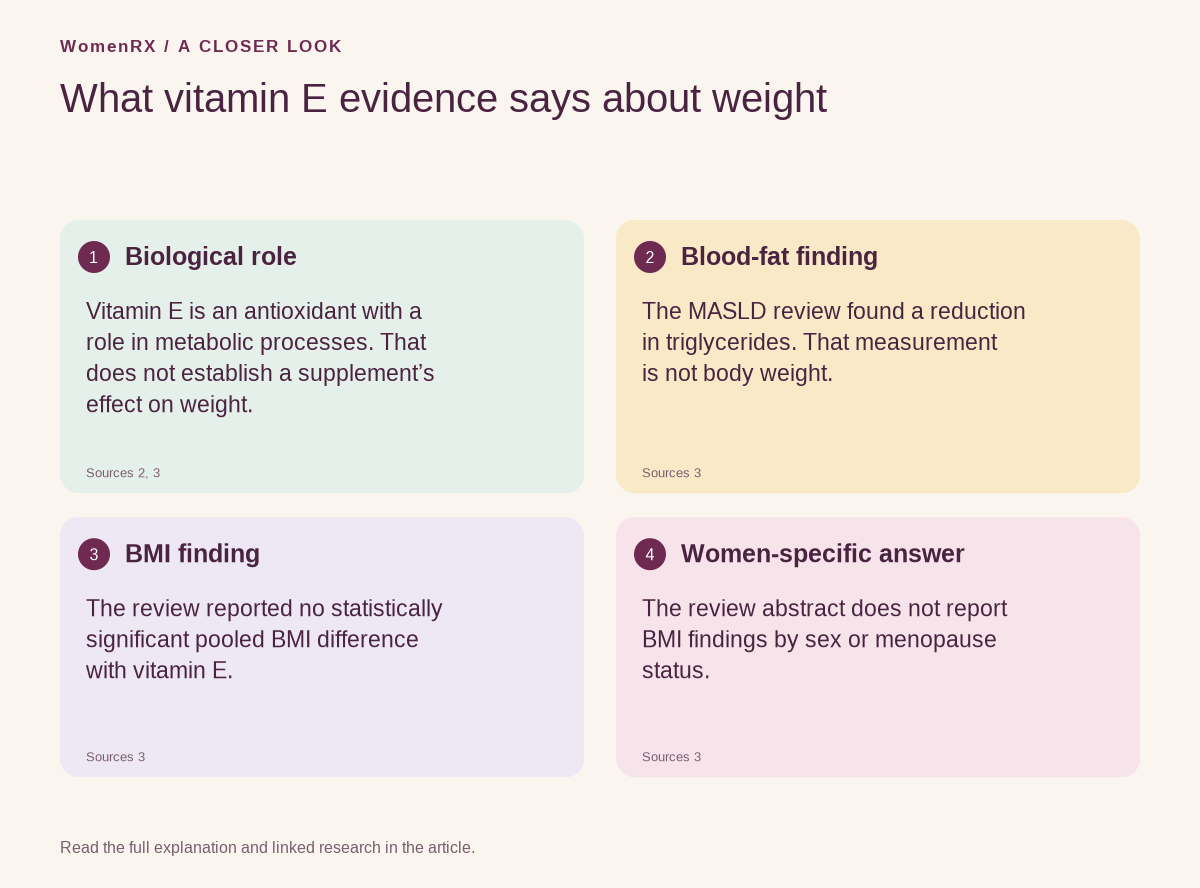
What vitamin E evidence says about weight
Biological role: Vitamin E is an antioxidant with a role in metabolic processes. That does not establish a supplement’s effect on weight.23
Blood-fat finding: The MASLD review found a reduction in triglycerides. That measurement is not body weight.3
BMI finding: The review reported no statistically significant pooled BMI difference with vitamin E.3
Women-specific answer: The review abstract does not report BMI findings by sex or menopause status.3
Read the figure as text
This evidence map separates vitamin E’s biological role from the outcomes measured in adults with MASLD.- Biological role: Vitamin E is an antioxidant with a role in metabolic processes. That does not establish a supplement’s effect on weight.23
- Blood-fat finding: The MASLD review found a reduction in triglycerides. That measurement is not body weight.3
- BMI finding: The review reported no statistically significant pooled BMI difference with vitamin E.3
- Women-specific answer: The review abstract does not report BMI findings by sex or menopause status.3
Sources you can check
- Body Weight: MedlinePlusAccessed 2026-09-25Return to first citation
- Vitamin E: MedlinePlusAccessed 2026-09-25Return to first citation
- Efficacy of Vitamin E on Lipid Profile in Patients With Metabolic Dysfunction-Associated Steatotic Liver Disease (MASLD): A Systematic Review and Meta-Analysis.Karimi M, Abidi M, Aghaei A, Kazemian P, Banadak NR, Bahman AD, Moghadam OF, Amin MA, Khorgoo RK, Sharifara F, Hosseini M, Asbaghi O. · Lipids · 2026Return to first citation